
Road signage maintenance is usually reactive, which means signs are replaced when somebody complains or when one is
knocked down. That approach guarantees that the signs failing quietly, by losing night time performance while looking
perfectly acceptable in daylight, are never addressed at all. This guide sets out how to build a measured maintenance
cycle: what to record, how to survey, what threshold triggers replacement, and why batch renewal by installation year
beats replacing signs one at a time.
Key Takeaways
- Daytime appearance tells you almost nothing about night time performance, so visual inspection alone is not a
maintenance regime. - An inventory recording sign type, installation year, sheeting grade and orientation is the foundation of every
useful decision. - Signs installed together degrade together, so batch replacement by cohort is cheaper per sign than reactive
individual visits.
Start With an Inventory
Nothing else in road signage maintenance works without an inventory. The minimum useful record for each sign is its
location, category, face size, substrate, sheeting grade, installation year, orientation and support type. Those eight
fields turn a collection of assets into something that can be forecast, budgeted and prioritised.
Orientation matters more than people expect in this climate. A sign facing the afternoon sun ages measurably faster
than one on the opposite carriageway of the same route, so a route running east to west can have two populations with
different effective lives sharing one installation date.
Installation year is the field that unlocks batch planning. Signs installed together, from the same batch of sheeting,
in the same conditions, degrade together. Knowing the cohort means a replacement programme can be planned as a series
of batches rather than as an endless stream of individual jobs.
Building the inventory is a one off cost that is repaid on the first batch renewal. It also makes any later dispute
about grade or supplier resolvable, because the certification can be tied to specific assets rather than to a delivery
note nobody can find. The asset context is covered in the guide to
road traffic signs and signage systems.
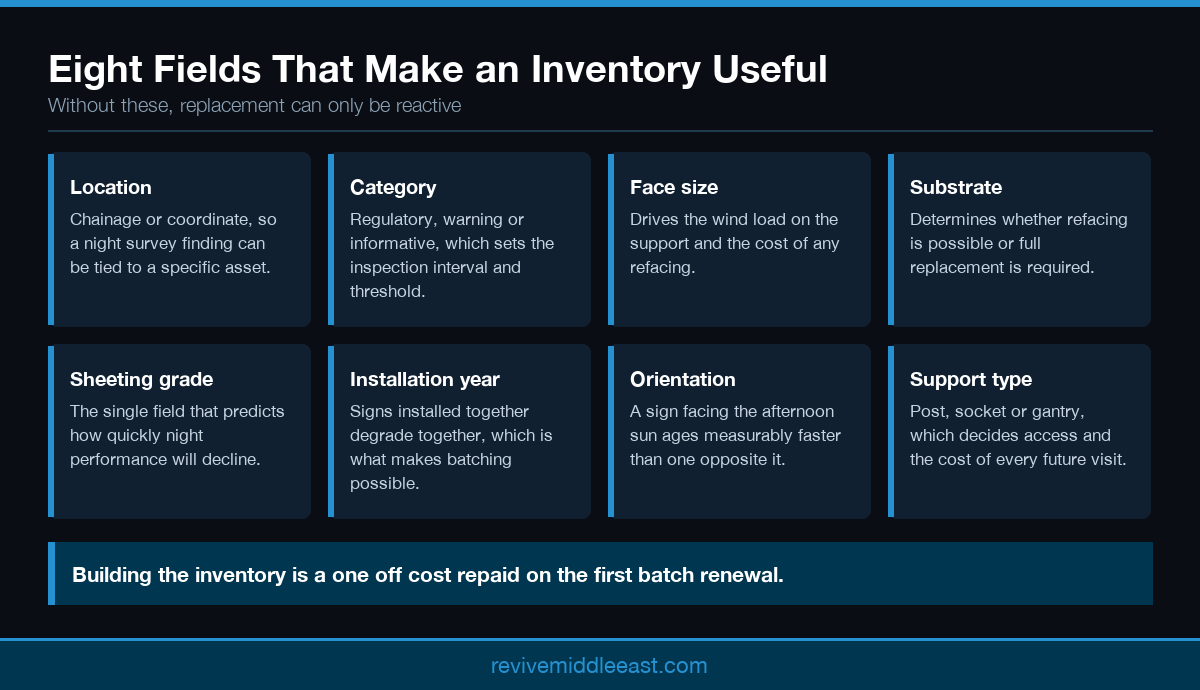
The eight fields that make a signage inventory useful
Why Visual Inspection Is Not Enough
Retroreflective sheeting degrades under ultraviolet exposure, and the degradation affects night performance long
before it affects daytime appearance. A sign can look entirely acceptable at midday in its twelfth year and deliver a
small fraction of its original brightness in headlights that same night.
Colour behaves differently again. Reds and yellows fade first, so a warning sign can lose the colour contrast that
lets a driver classify it at a distance while its white areas still look fresh. An inspector walking the route in
daylight will record that sign as satisfactory.
The other limitation of a daytime walk is that it does not test what the sign is for. Obstruction by vegetation,
rotation on its fixings and poor placement all become obvious only when the sign is approached from a moving vehicle
at the design speed, which is exactly the condition a daytime inspection does not replicate.
The remedy is not complicated. Combine a night drive of the route with instrument measurement of a sample, and the
picture becomes real. The underlying physics is the same as for road markings, described in the guide to
glass beads and retroreflectivity, and the general principle is summarised in the article on
retroreflectors.
Night Surveys and Instrument Measurement
A night drive is the cheapest and most informative single activity in road signage maintenance. Drive the route at the
design speed after dark, with a second person recording, and note every sign that is not legible at a reasonable
distance, every sign that is obstructed, and every sign that has rotated. One pass over a route produces a prioritised
list immediately.
Instrument measurement then quantifies what the drive identified. A retroreflectometer reads the coefficient of
retroreflection at a standard geometry, and the readings are compared against a threshold appropriate to the sheeting
grade and sign category. Measuring a sample rather than every sign is entirely adequate provided the sample is
stratified by type, grade, year and orientation.
Sampling is where a survey either becomes affordable or becomes an excuse. A sample that covers each combination of
sign type, sheeting grade, installation year and orientation gives a defensible picture of the whole population. A
sample of whatever was convenient to reach from the hard shoulder does not, and it will quietly understate the
condition of the signs nobody stopped at.
Both activities need a written method so that results are comparable year on year. The same route, the same speed, the
same instrument geometry and the same recording form produce a trend; ad hoc surveys produce anecdotes.
The results also feed back into specification. If a particular grade is degrading faster than expected on a given
exposure, the next purchase should reflect that, and the guidance in the article on
traffic sign reflective sheeting grades
becomes a local decision rather than a general one.
Setting Replacement Thresholds
A threshold turns measurement into action. It should be set by sign category, because the categories have genuinely
different consequences of failure: a warning or regulatory sign that is not seen in time creates a safety and legal
exposure that an informative sign does not.
In practice that means shorter intervals and higher thresholds for regulatory and warning signs, and a more tolerant
threshold for informative signage on the same route. Stating this openly in a maintenance policy is what allows a
limited budget to be spent where it does the most good, and the category logic is set out in the guide to
UAE road sign categories.
Structural condition needs its own thresholds. Post plumb, foundation movement, corrosion at cut ends and fixing
tightness are pass or fail checks rather than measured values, and a sign that fails structurally should be replaced
regardless of how well its face is performing. The structural failure modes are covered in the guide to
ground mounted road signs.
Impact damage should be recorded by location as well as by asset. A location where signs are struck repeatedly is
telling the owner something about the geometry or the clear zone, and that information is more valuable than the
replacement cost it generates.
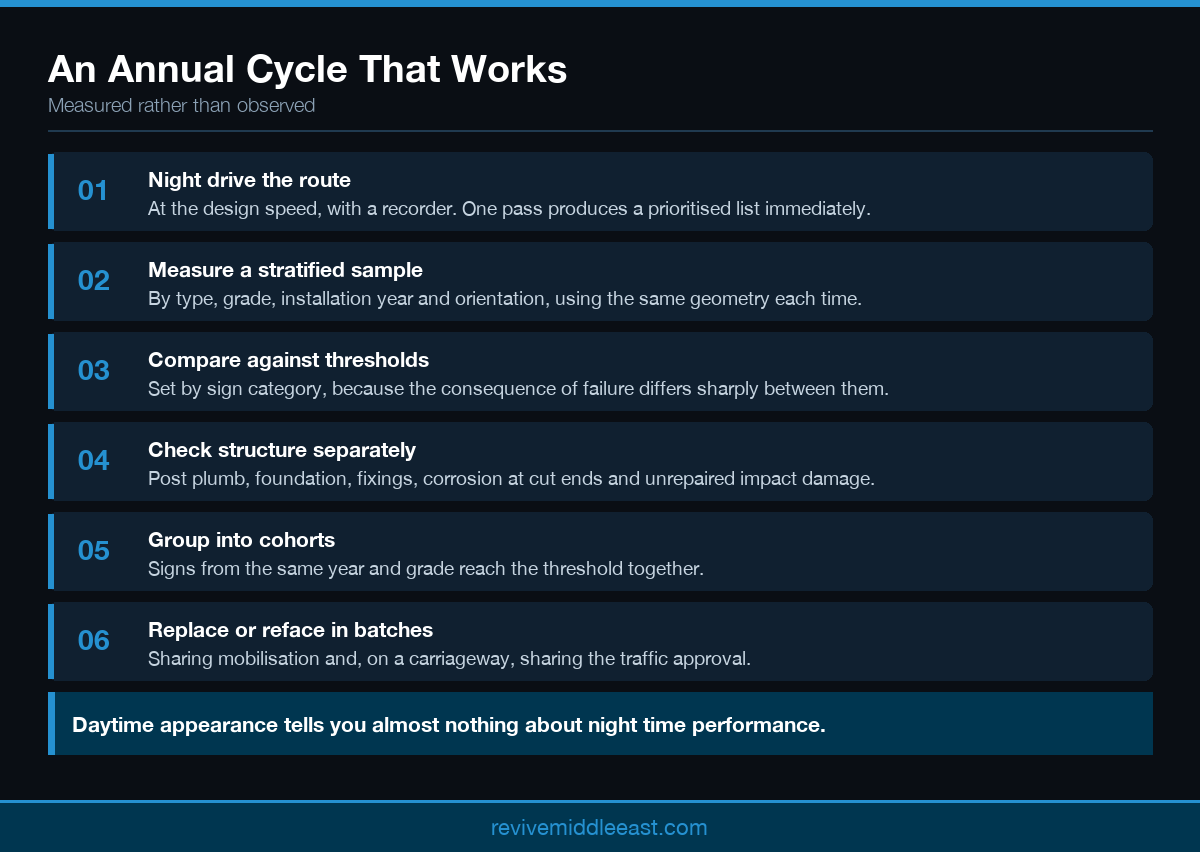
A working annual cycle for a signage asset
Batch Replacement and Budgeting
Replacing signs one at a time is the most expensive way to do it. Each visit carries mobilisation, and on a
carriageway each visit may carry its own traffic arrangement and approval. Grouping replacements into batches spreads
those fixed costs across many signs and reduces disruption to the road.
Cohort based batching is the natural grouping. Signs installed in the same year with the same sheeting will reach the
threshold at roughly the same time, so a programme that replaces cohorts rather than individuals aligns with how the
asset actually degrades.
Budgeting follows directly. Once the inventory records installation years and the survey records how each cohort is
performing, the replacement liability becomes a forecast. That forecast lets signage compete for capital budget on the
same terms as pavement and lighting instead of being funded from residual operational money.
Programme the batches around road access rather than around the calendar. If a route is already scheduled for
resurfacing or for a lighting renewal, doing the signage at the same time shares the traffic arrangement and the
closure, which is often the largest single cost in the whole exercise.
Refacing rather than full replacement is worth assessing for each batch. Where posts and foundations are sound,
applying new sheeting to the existing substrate or fitting a new face to existing supports saves the structural cost
entirely. Our road signage services page covers survey,
manufacture, installation and renewal.
Conclusion
Road signage maintenance becomes manageable the moment it is measured rather than observed. Build the inventory, drive
the route at night, measure a stratified sample, set thresholds by sign category, and replace in cohorts rather than
one sign at a time. The result is a predictable budget and an asset that performs when it matters, in the dark. Revive
Middle East Paints surveys, manufactures and installs signage across the UAE.
Contact us.