
A road safety audit is only as good as what happens after it. Road safety audit recommendations arrive as a numbered list of problems and suggested remedies, and the gap between that list and a safer road is where most value is lost. This guide explains the audit stages briefly, the findings that appear most often on UAE roads, how each maps to markings, signs, barriers or traffic management, and how to prioritise, phase and document the works. It is written for asset owners, consultants and contractors who must act on an audit report.
Key Takeaways
- Road safety audit recommendations only reduce risk once each finding is converted into a specified, priced and scheduled work item.
- Most UAE findings fall into four remedy families: markings, signs, restraint systems and temporary traffic management.
- A clear close out record, finding by finding, protects the asset owner and shows the audit was acted on.
Road Safety Audit Stages in Brief
A formal audit of this kind is an independent review of a road scheme by a team that was not involved in its design. Audits typically happen at feasibility, preliminary design, detailed design and before or shortly after opening, with some authorities also auditing existing roads.
The earlier stages shape geometry and layout. The later stages, carried out on detailed drawings and on the completed road, generate the practical findings that a contractor will implement: a missing warning sign, a confusing lane arrow, an unprotected hazard in the verge.
Practitioners in Dubai have argued that all signs and markings should be checked at the detailed design stage at the latest, because errors are far cheaper to fix on paper. A CIHT Dubai bulletin on audit practice records that discussion.
Audits of existing roads follow a slightly different logic. There is no design to correct, only a road in use, so the team looks at crash history, observed behaviour and the condition of markings, signs and roadside features. Their findings tend to be numerous, local and practical, which makes them ideal candidates for a structured programme of small improvement works rather than one large scheme.
Whatever the stage, the report follows the same pattern: a description of the problem, its location, the likely consequence and a recommended action. The owner then responds to each item, accepting it, modifying it or rejecting it with reasons.
Common Findings on UAE Roads
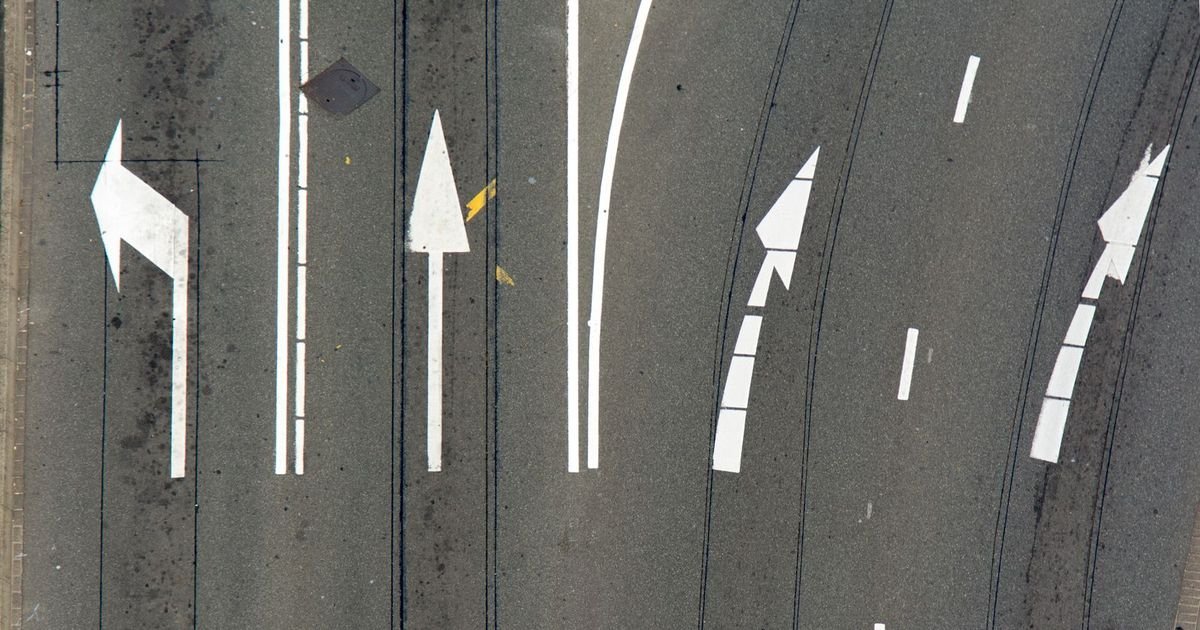
Audit reports in the region repeat a familiar set of issues. Signs placed too late for the approach speed, or mounted where they are hidden by vegetation or other signs. Arrow and lane markings that contradict the signage. Worn or low contrast markings at junctions and crossings. Directional markings that leave drivers guessing at the last moment.
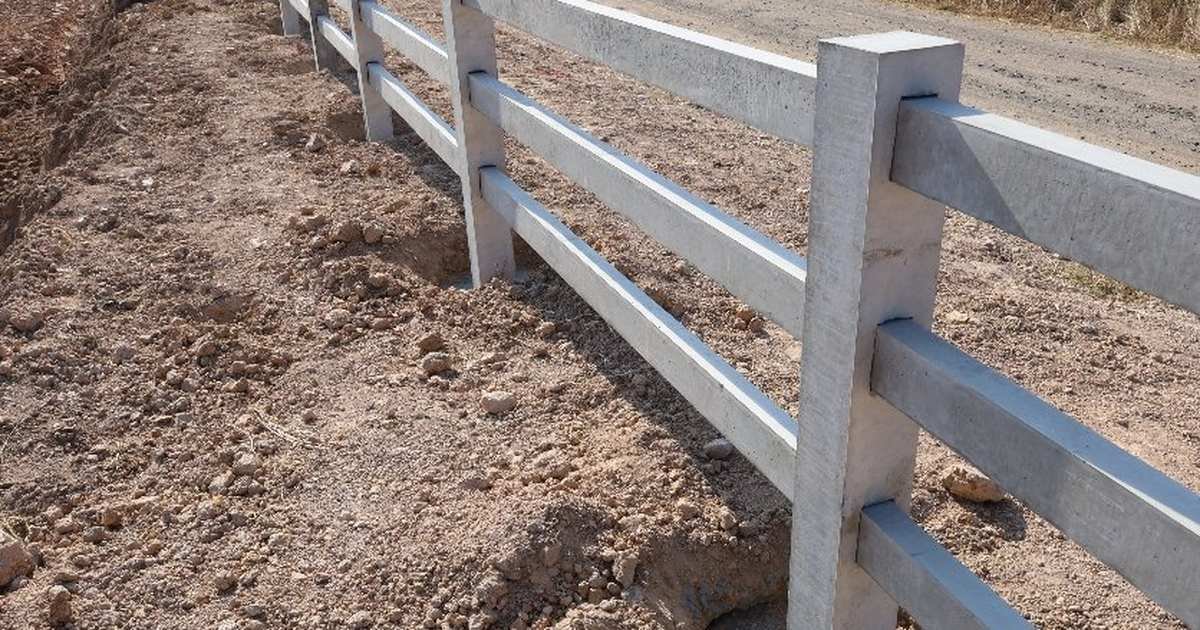
Roadside hazards form the second group. Unprotected sign posts, lighting columns and drainage structures sit inside the zone a straying vehicle can reach, a problem described as keeping the roadside forgiving for vehicles that leave the lane. Barriers sometimes end abruptly with untreated terminals, or switch between systems with no proper transition.
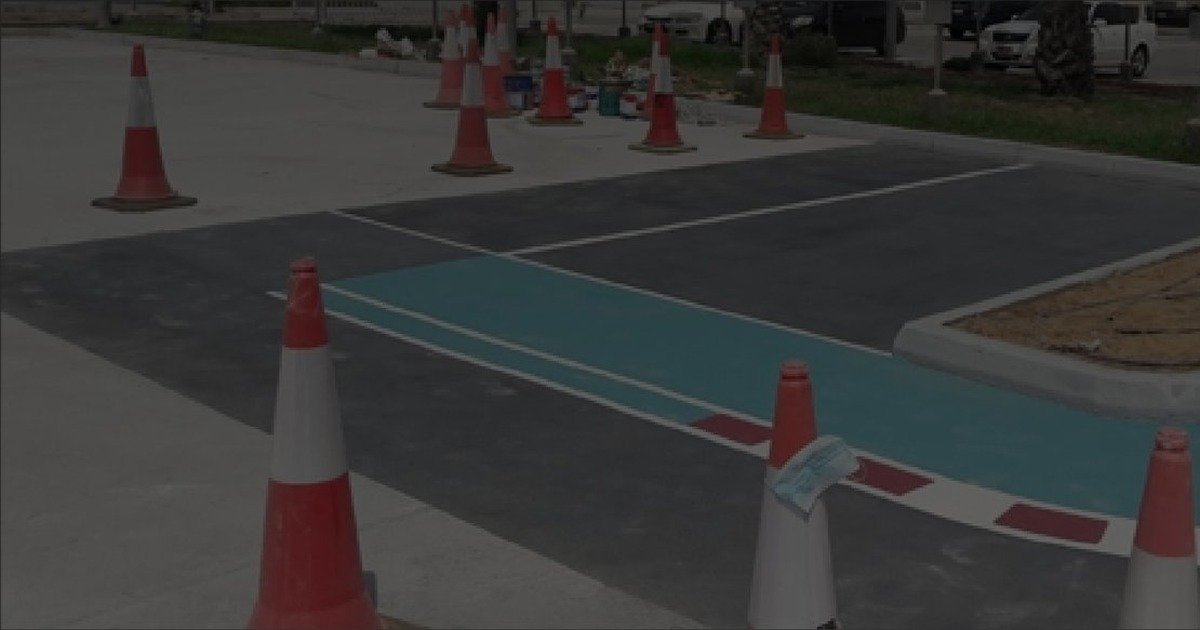
The third group concerns works and diversions. Weak advance warning, abrupt tapers and inconsistent temporary signs appear often, especially on long running projects where the layout has drifted from what was approved.
Vulnerable road users make up the fourth group. Crossings without adequate approach markings, missing tactile paving, poor lighting at bus stops and school frontages without speed management all appear regularly. These findings tend to be cheap to fix and carry a high safety benefit, which makes them obvious early priorities.
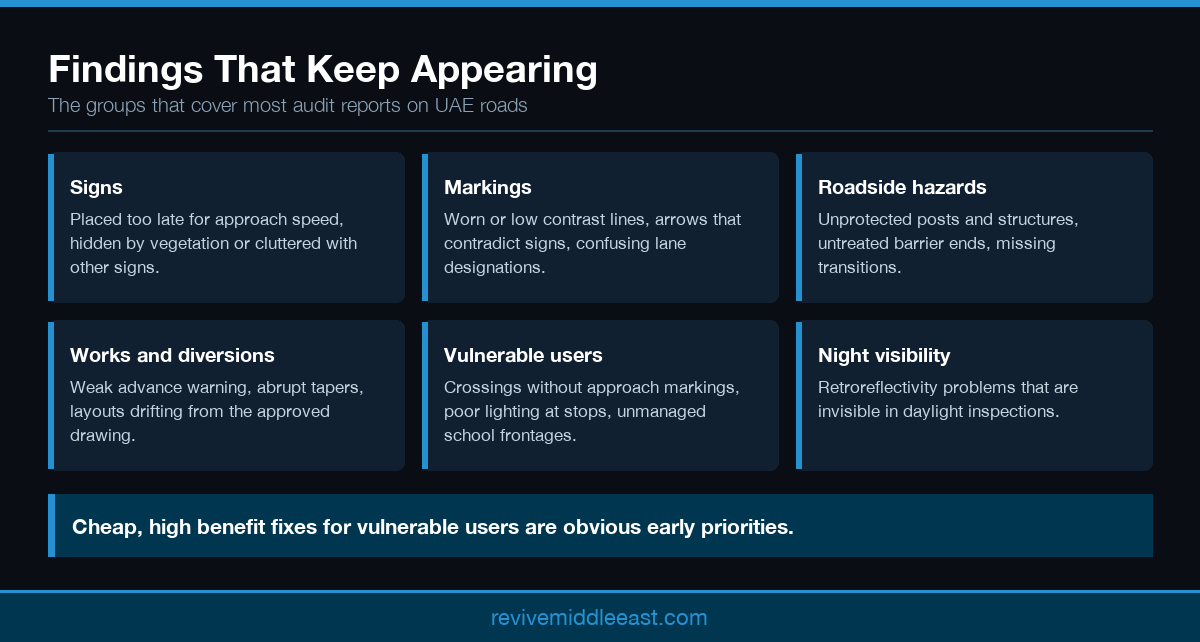
Findings that appear repeatedly in UAE audit reports
Mapping Each Finding to a Remedy
Every finding should be converted into a work item with a specification, a quantity and an owner. That conversion is where road safety audit recommendations either become safer roads or sit in a file.
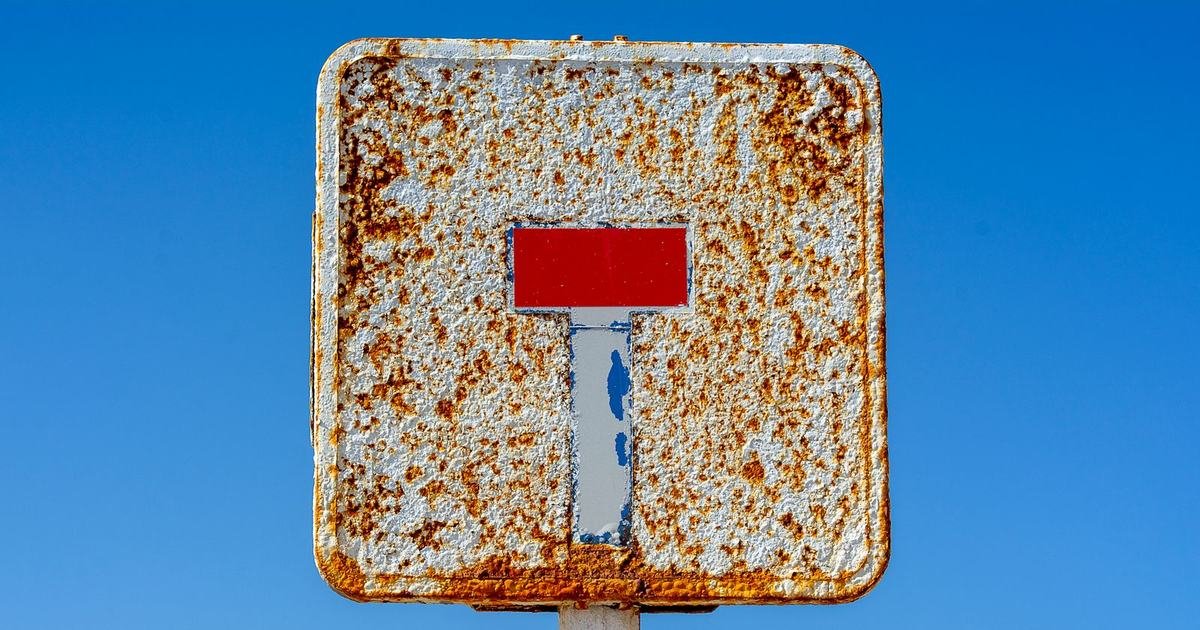
Marking findings translate into removal and remarking, higher retroreflectivity material, profiled lines or improved crossing layouts; our guides on layouts for zebra crossings and school frontages and lane, edge and chevron types cover the detail. Sign findings become relocation, larger sizes, higher sheeting grades or new advance warnings, drawing on the regulatory, warning and informative categories used in the UAE.
Roadside findings call for removal of the hazard where possible, then relocation, breakaway supports or protection with a tested system. Where protection is the answer, specify the containment class, working width and terminal treatment, not just a product name; our guardrail and barrier product range lists the systems we supply.
Works zone findings usually require a revised traffic management drawing and, often, a fresh approval from the relevant authority before anything changes on site.
Each work item should carry enough detail to be priced and checked: location by chainage or coordinates, the exact remedy, material and performance requirements, and the evidence that will prove completion. Vague items such as improve signage at junction invite inconsistent pricing and disputed handovers.
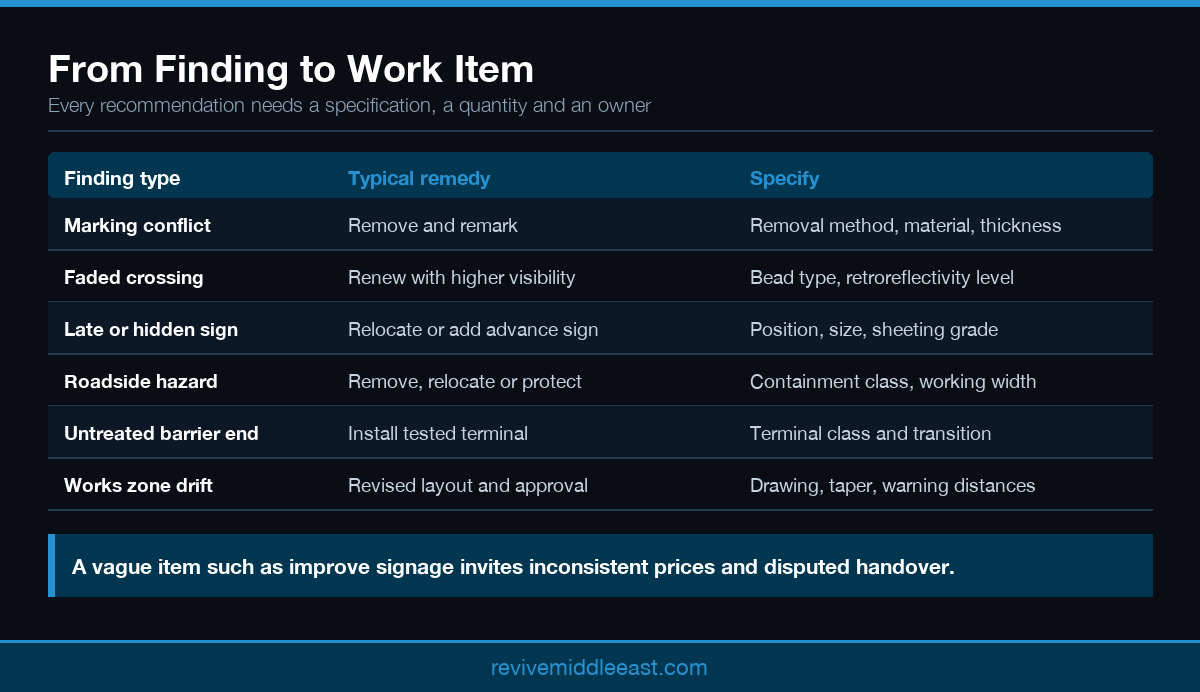
Converting audit findings into specified work items
Prioritising, Phasing and Working Under Live Traffic
Few budgets allow every recommendation to be completed at once. Rank findings by the severity of the likely crash and the exposure at that location, then group items by location so one closure delivers several fixes.
Most remedial work on UAE roads happens at night with lane closures. That brings its own approvals, crew planning and curing constraints for marking materials; our guide to night possessions and lane closures for marking crews explains how programmes are built around them.
Sequence matters within a site. Remove conflicting markings before new ones go down, install signs before the layout they describe changes, and never leave a hazard newly exposed overnight while protection is still on order.
Interim measures buy time when a permanent fix needs design or procurement. Temporary signs, delineators and refreshed markings can reduce risk within days while a barrier system or a junction change works through approval. The audit response should record which interim measure covers which finding, and for how long.
Budget cycles shape the programme as well. Many owners fund remedial works annually, so a finding raised late in the year may wait months unless an interim measure is put in place. Logging the expected funding route against each finding keeps the programme realistic and makes the case for any emergency allocation clear.
Quick wins deserve a programme of their own. Repainting a faded stop line, trimming vegetation in front of a sign or adding a missing chevron board rarely needs design input, and completing them early shows road users and stakeholders that the audit has led to visible change.
Close Out Records and Choosing Who Implements
Asset owners should receive a close out record that lists every audit finding, the action taken, the date, the materials used and photographs before and after. Where a recommendation was rejected or modified, the reason should be recorded and agreed with the audit team.
Implementation crosses trades. A finding about a junction may need marking removal, two new signs and a barrier terminal on the same night. A single contractor covering markings, signs and barriers removes the interface risk that appears when three firms share one closure.
Revive Middle East Paints implements audit findings. It does not carry out audits, which must stay independent of the contractor. That separation is healthy: the auditor identifies the risk, and the implementer is accountable for removing it.
Where the authority requires it, a follow up visit after the works lets the audit team confirm that each remedy performs as intended. Night inspections are particularly useful for marking and sign findings, because retroreflectivity problems are invisible in daylight. Build that visit into the programme rather than treating it as an afterthought.
Conclusion
Road safety audit recommendations reduce risk only when each finding becomes a specified, priced and scheduled task that is completed and recorded. Map findings to markings, signs, restraint systems or traffic management, rank them by severity and exposure, group them by location, and close out every item with evidence. Revive Middle East Paints manufactures marking material and signs and installs barriers across the Emirates, so one team can deliver a whole list. See completed work on UAE roads or talk to our team about your audit report.
Frequently Asked Questions
What are road safety audit recommendations?
They are the actions an independent audit team proposes to remove or reduce the safety problems it found. Each recommendation should link to a specific finding and be converted by the owner into a specified, scheduled work item.
Who carries out a road safety audit in the UAE?
Audits are carried out by qualified, independent audit teams appointed by the road authority or scheme promoter. The team must not have been involved in the design, and the contractor implementing the works should also be separate.
At which stages does a road safety audit happen?
Audits typically take place at feasibility, preliminary design, detailed design and around opening, and some authorities also audit existing roads in use. The later stages produce the practical findings that contractors usually implement on site.
What are the most common audit findings for road markings?
Worn or low contrast markings, arrows that conflict with signs, confusing lane designations and poorly laid out crossings are frequent. Removing old lines cleanly matters too, and our guide to clean removal without ghost lines explains the methods.
How should sign related findings be fixed?
Typical fixes are relocating signs for adequate sight distance, increasing their size, adding advance warnings and upgrading sheeting. Our guide to choosing sheeting grades for night visibility helps match the grade to speed and lighting.
Can an audit recommendation be rejected?
Yes, if the owner has a sound reason, such as a better alternative or a disproportionate cost. The decision and its reasoning should be recorded in an exception report and agreed with the audit team before close out.
How are remedial works prioritised?
Rank findings by the likely severity of a crash and the exposure at each location, then group nearby items so one closure delivers several fixes. High severity hazards beside fast moving traffic usually come first.
What should a close out record contain?
It should list each finding, the action taken, the date, materials used and before and after photographs. Rejected or modified recommendations need their justification recorded so the owner can show the audit was properly acted on.
Does Revive Middle East Paints carry out road safety audits?
No. Audits must remain independent of the contractor. Revive implements the resulting works, supplying and installing marking material, signs and restraint systems, and provides the records an owner needs to close out each individual finding.