

A thermoplastic road marking paint specification looks like a page of numbers, and most buyers skim it. That is a mistake, because the numbers predict how a line will behave in July on a Sharjah carriageway. This guide explains what a datasheet should contain, which tests in BS EN 1871 and AASHTO M249 matter, what binder, pigment and bead content tell you, and how to tell a batch certificate from a brochure. It is written for engineers, consultants and procurement teams comparing suppliers.
Key Takeaways
- A thermoplastic road marking paint specification is only useful when every value names its test method and its class.
- Softening point, heat stability and flow behaviour decide summer performance in the Gulf more than colour does.
- Ask for a batch certificate from an accredited laboratory, not a type test from years ago.
What a Thermoplastic Datasheet Should Contain
A complete datasheet answers three questions: what the material is, how it was tested, and against which standard. Values without a named method are marketing, because two laboratories can report the same property very differently.
Expect a composition summary covering binder, pigment, extender and premixed glass beads, then a table of physical properties with the test method and class for each line. Application guidance should follow: recommended heating range, maximum holding time in the kettle and the surface temperature window for laying.
A good thermoplastic road marking paint specification also states the colour and luminance class, the intended application method and the expected film thickness. If your project uses screed, spray or extrusion, check the datasheet was written for that method; our guide to screed, spray and extrusion methods explains why the same powder behaves differently in each.
Finally, look for a date and a revision number. Formulations change, and a datasheet with no revision history cannot be tied to the material arriving on site.
It also helps to ask what the datasheet leaves out. Storage conditions, shelf life, bag weight and the recommended primer for concrete surfaces are all practical details that affect the result. A supplier who can answer them quickly usually runs a controlled production process. One who has to check with somebody else may be reselling a product they did not make.
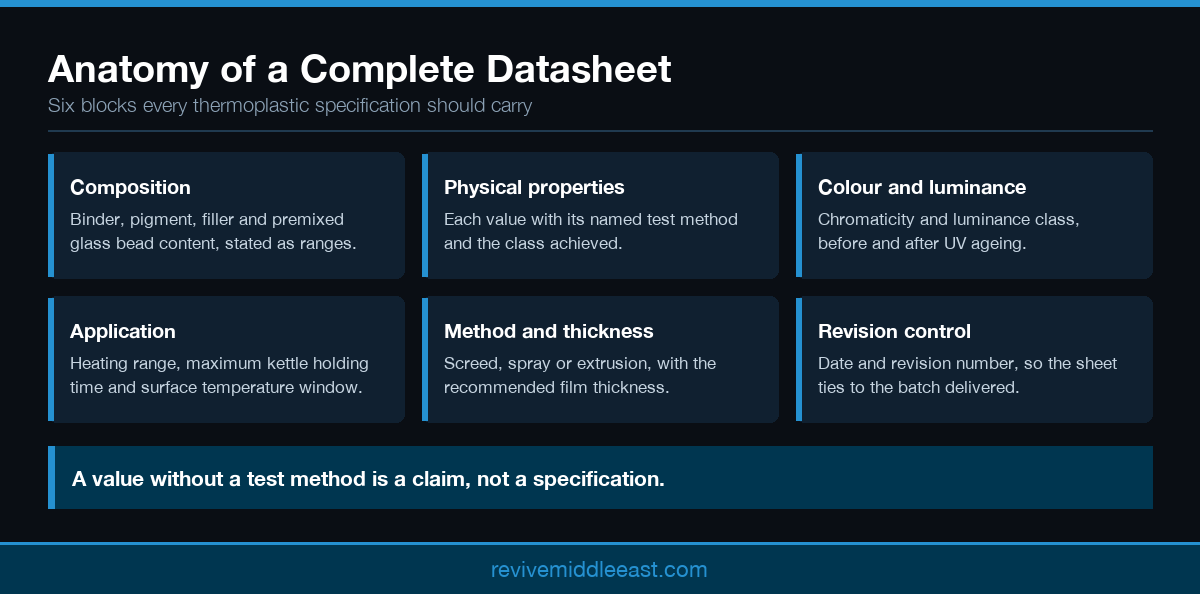
What a complete thermoplastic datasheet contains
BS EN 1871 and AASHTO M249: The Tests That Matter
Most UAE specifications reference European or American standards, sometimes both. The European reference is the BS EN 1871 physical properties standard, which classifies thermoplastic and cold plastic materials by measured performance rather than by recipe.
Its key tests are luminance factor and chromaticity, softening point, cold impact resistance, flow resistance, heat stability and resistance to UV ageing. Each result places the material in a class, so a specification should state the minimum class required, not just the test name.
AASHTO M249 takes a more prescriptive route. It sets limits on composition, including minimum binder content, a band for premixed glass beads and minimum pigment for white material, alongside physical tests. A supplier claiming compliance with both should be able to show both sets of results.
Softening point deserves special attention in the Gulf. Road surfaces here regularly exceed the air temperature by a wide margin, and a material with a low softening class will deform under tyres, pick up dirt and lose definition within one summer. That is one of the main reasons markings lose their edge early in Gulf heat.
Cold impact and flow resistance matter too, even in a hot climate. Night temperatures in the desert drop sharply in winter, and a brittle line cracks when a heavy axle hits it on a cold morning. Flow resistance shows whether the line keeps its shape on a camber or slope while it is still hot, which matters on ramps, roundabouts and superelevated bends.
Heat stability is the test most often overlooked by buyers. It shows how the material copes with being held hot in the kettle, which happens on every real site while crews wait for a lane to open. Material that discolours or thickens during that wait will not match its datasheet once laid.
Binder, Pigment, Filler and Glass Beads Explained
Composition explains the test results. The binder, usually a hydrocarbon or alkyd resin system with plasticiser, holds everything together and governs flow and softening behaviour. Too little binder and the line becomes brittle; too much and it softens and tracks in heat.
Titanium dioxide gives white material its opacity and luminance, while yellow relies on organic or inorganic pigments that must hold colour under strong UV. Fillers such as calcium carbonate and quartz add body and wear resistance, but they are also the cheapest ingredient, which is why heavily filled material can look attractive on price.
Premixed glass beads keep the line retroreflective as the surface wears, while drop on beads applied during laying give night visibility from day one. Bead grading and coating are covered by the BS EN 1423 drop on materials standard, and our guide to how glass beads build night visibility explains the mechanics.
When you compare two datasheets, read the composition and the physical results together. A strong luminance figure paired with low binder content is a warning, not a bargain.
Yellow material needs particular care. Older formulations relied on lead chromate pigments, which many authorities no longer accept. Ask the supplier to confirm the pigment system and to show colour results after UV ageing, because some organic yellows fade towards cream under strong sunlight and lose their meaning to drivers.
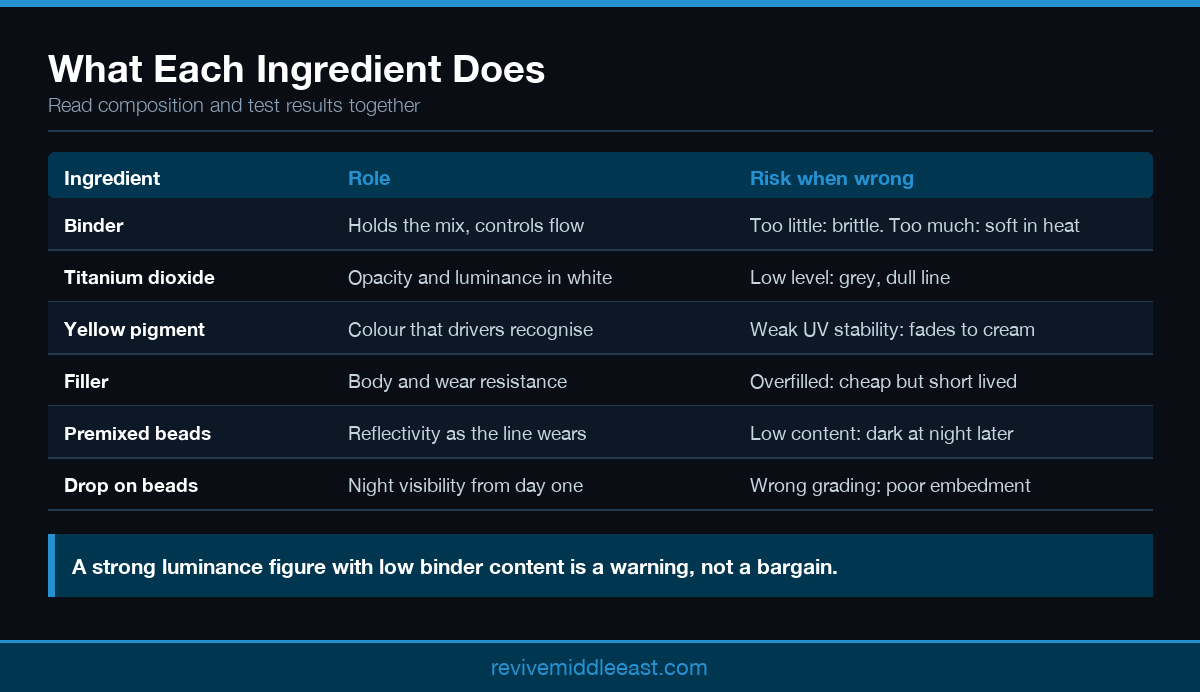
What each ingredient contributes, and the risk when it is wrong
Batch Certificates, Type Tests and Accredited Laboratories
A type test shows that a formulation passed once. A batch certificate shows that the material delivered to your site came from a production run that was tested. Both have a place, but only the second protects a project.
Ask for a certificate that quotes the batch number printed on the bags, the production date, the tests performed and the results against the specified classes. Check that the laboratory is accredited for those methods; in the UAE, the Emirates International Accreditation Centre maintains the register of accredited testing bodies.
Manufacturers can usually supply batch records quickly because they control production. A trader buying finished product may struggle, which is itself useful information. You can see how batches are made and recorded in a look inside our Sharjah plant.
Keep the certificates with the as built records. When a section is questioned two years later, a traceable batch number is the difference between a technical discussion and an argument.
Red Flags When Comparing Suppliers
The warning signs repeat across tenders. Values quoted without a test method. Compliance claimed with an obsolete standard. A single datasheet covering several colours and application methods. Certificates older than the formulation they describe. No heating range or kettle holding time.
Price gaps are another signal. When one offer is far below the others, compare binder content and filler level first, then softening class. The saving is almost always explained by the recipe.
Finally, ask how the supplier would handle a failed batch. A manufacturer can trace the run, quarantine stock and replace it. A reseller can only pass the question along.
A simple tender checklist removes most of the guesswork. Ask every bidder for a current datasheet with revision number, test results against each specified class, a sample batch certificate from an accredited laboratory, the heating range and kettle holding time, and the recommended film thickness for the chosen application method. Bids that cannot supply all five should be clarified before they are compared on price.
Site checks complete the picture. Record batch numbers from the bags at delivery, take retained samples from the kettle on each shift, and measure film thickness as the line is laid. Those three habits cost almost nothing and turn a disputed failure into a straightforward technical review.
Conclusion
A thermoplastic road marking paint specification is the most reliable predictor of how a line will perform, provided you read it properly. Check every value against a named method and class, read composition and results together, insist on accredited batch certificates, and treat missing information as an answer in itself. Revive Middle East Paints manufactures its thermoplastic in Sharjah and supplies datasheets and batch records with every order. Explore our hot melt marking material range or request a datasheet from our team.
Frequently Asked Questions
What should a thermoplastic road marking paint specification include?
It should list composition, physical properties with named test methods and classes, colour and luminance class, heating range, kettle holding time, application method and film thickness. A revision number and date tie it to the material actually supplied.
What is BS EN 1871?
BS EN 1871 is the European standard for the physical properties of road marking paint, thermoplastic and cold plastic materials. It classifies materials by measured results such as luminance, softening point, cold impact and UV ageing resistance.
How is AASHTO M249 different from BS EN 1871?
AASHTO M249 is more prescriptive about composition, setting limits for binder, glass beads and pigment. BS EN 1871 focuses on measured performance classes. Many UAE specifications reference one or both, so suppliers should show results for each.
Why does softening point matter in the UAE?
Road surfaces in the Gulf get far hotter than the air above them. Material with a low softening class deforms under traffic, picks up dirt and loses definition quickly, so softening point is a critical summer performance indicator.
What is the difference between premixed and drop on glass beads?
Premixed beads are blended into the material and become exposed as the surface wears, keeping the line reflective for longer. Drop on beads are applied onto the hot line during laying and provide night visibility from the first day.
Is a type test enough to approve a thermoplastic material?
A type test proves a formulation passed once. For real project assurance, ask for batch certificates that match the batch numbers printed on delivered bags, with results from a laboratory accredited for those specific test methods.
How do I spot an overfilled thermoplastic material?
Compare binder content and filler level across datasheets, then check softening class and cold impact results. Heavily filled material is cheaper to make, so an unusually low price often signals more filler and less binder.
How does thermoplastic compare with cold plastic and MMA?
Thermoplastic is hot applied and suits most UAE roads at a sensible cost. Cold plastic and MMA cure chemically and suit specific high wear areas. Our comparison of cold applied alternatives and when they win covers the trade offs.
Does specification affect road marking price?
Yes. Film thickness, bead type, softening class and colour all change material use and rate. Our breakdown of what drives the rate per square metre shows how specification choices flow through to the final price.