Introduction
When selecting a thermoplastic road marking paint manufacturer, quality is not a matter of preference; it is a matter of road safety. Road markings guide drivers, regulate traffic flow, and reduce the risk of collisions on busy highways and urban streets. Not all manufacturers deliver the same level of durability, regulatory compliance, or real-world performance. In a market like the UAE, where road standards are strictly enforced and climate conditions are extreme, the gap between a reliable manufacturer and an average one becomes evident very quickly. This blog explores what separates the best from the rest.
Key Takeaways
The best thermoplastic road-marking paint manufacturer prioritizes raw material quality, retroreflectivity, and full regulatory compliance.
Manufacturers of thermoplastic paints who conduct UAE climate-specific testing deliver markings that last significantly longer in local conditions.
End-to-end support from supply to installation is a defining quality of leading manufacturers over competitors.
What Is Thermoplastic Road Marking Paint and Why Does It Matter?
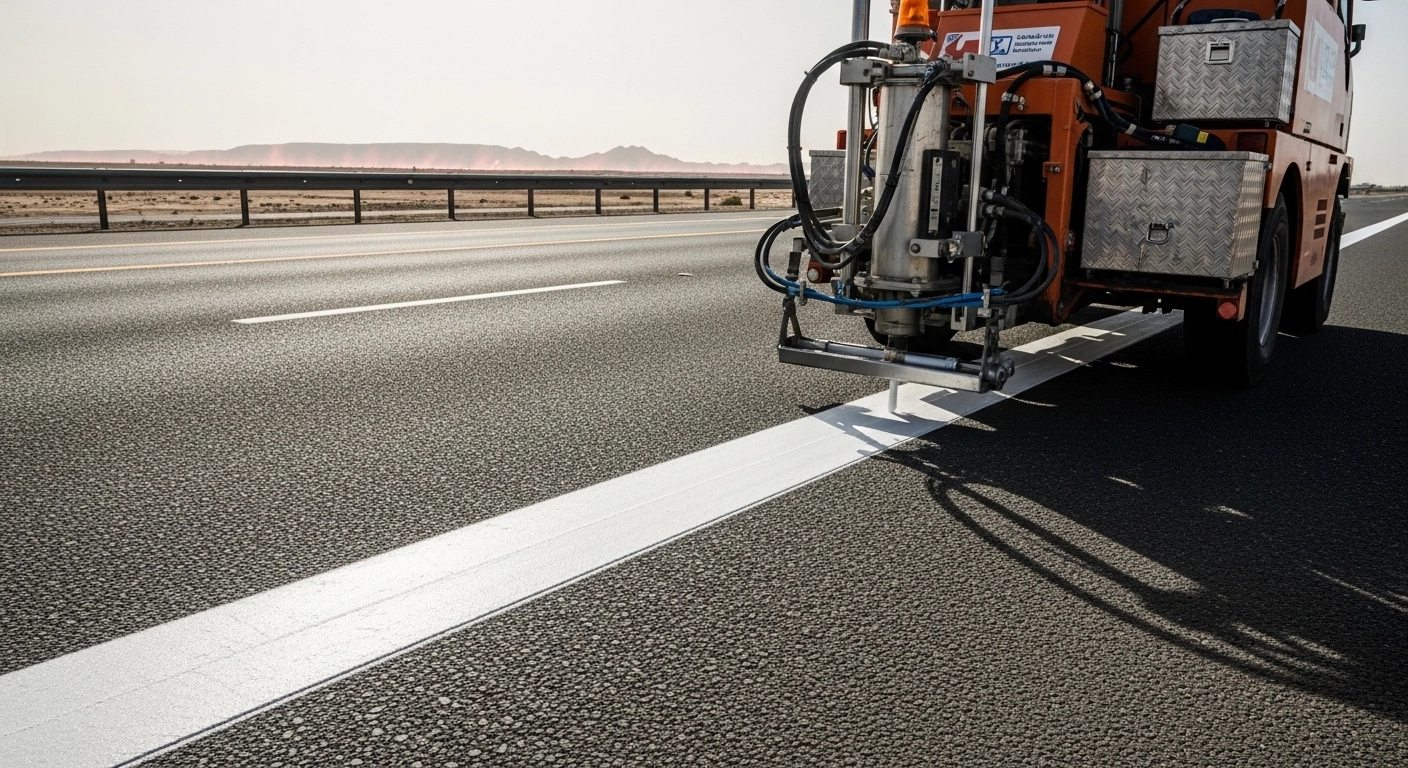
Thermoplastic paint is a heat-applied road marking material that offers far superior durability compared to standard solvent-based or water-based liquid paints. When applied, the material is heated to a molten state and bonded directly to the road surface, forming a thick, hard-wearing layer that resists fading, cracking, and surface wear.
In the UAE, where asphalt temperatures regularly exceed 60 degrees Celsius in summer, and road networks carry some of the highest traffic volumes in the region, thermoplastic road markings are the standard choice for municipalities and road authorities. A poorly chosen manufacturer can deliver markings that fade within months, creating safety hazards and significantly increasing maintenance costs. Choosing the right supplier begins with understanding what distinguishes top-tier manufacturers from those simply competing on price. According to the Federal Highway Administration, high-quality road markings are among the most cost-effective safety countermeasures available on any road network.
Key Differentiators: What Separates Top Manufacturers from the Rest
1. Raw Material Quality and Composition
The performance of any thermoplastic road marking product begins with its raw material composition. Top manufacturers of thermoplastic paints use high-grade hydrocarbon resins, precisely calibrated glass bead concentrations, and UV-stable pigments that conform to standards such as EN 1871 or AASHTO M249. These materials directly determine adhesion strength, color retention, and long-term retroreflectivity.
Manufacturers who cut costs by using lower-grade fillers or substandard binders produce markings that deteriorate quickly, losing contrast, brightness, and adhesion well before the expected service life. When evaluating any thermoplastic road marking paint manufacturer, always request material data sheets, composition certificates, and third-party test reports. The difference in raw material quality is the single largest driver of performance variation between competitors. Explore the thermoplastic paints and road markings range of products built to quality material standards.
2. Retroreflectivity and Night-Time Visibility Performance
Retroreflectivity – the ability of a road marking to reflect vehicle headlights back toward the driver—is one of the most critical performance metrics for any road marking material. The best thermoplastic road marking paint manufacturers engineer their products to sustain retroreflectivity consistently over a three-to-five year lifespan under normal traffic exposure.
Competitors who do not invest in proper glass bead size grading or bead embedment technology produce markings that appear vivid immediately after installation but lose nighttime effectiveness within the first year. This is a significant safety shortfall on roads where drivers depend on clear lane guidance after dark. When comparing manufacturers, ask for retroreflectivity performance data measured at 12 months and 24 months post-application, not just at the point of installation. Reviewing completed road marking projects in the region can help verify real-world performance claims from any manufacturer.
3. Application Consistency and Technical Support
Even the highest-quality thermoplastic material will underperform if it is applied incorrectly. Application temperature, material thickness, ambient conditions, and surface preparation all directly affect adhesion quality and durability. The best manufacturers either deploy trained application teams or provide rigorous technical guidance and on-site supervision for certified applicators.
Competitors who treat supply and applications as entirely separate functions often leave significant performance gaps. Uneven thickness, poor surface priming, or incorrect preheating leads to premature peeling, edge chipping, and inconsistent marking widths. When assessing a thermoplastic road marking paint manufacturer, confirm their technical support model—specifically, whether they provide application supervision on large-scale or high-visibility projects. At Revive Middle East, our services include both material supply and professional installation support, ensuring consistent results from project start to completion.
4. UAE Climate Compatibility and Local Testing
The UAE’s climate presents road marking materials with conditions that differ significantly from European or North American test environments. Road surface temperatures regularly exceed 70 degrees Celsius in peak summer, UV radiation is intense year-round, and occasional heavy rainfall creates rapid wet-dry cycles that stress road marking adhesion.
Leading manufacturers of thermoplastic paints validate their products under local or simulated UAE climate conditions, rather than relying solely on data generated in cooler, less UV-intense environments. Manufacturers who do not account for regional climate variability may supply technically compliant products that still fail prematurely in UAE field conditions. Requesting UAE-specific performance data or reviewing case studies from comparable GCC markets is a sound due-diligence step before committing to any supplier.
5. Regulatory Compliance and Documentation Standards
Road markings in the UAE must meet specifications set by authorities, including the Roads and Transport Authority (RTA) in Dubai and the Abu Dhabi Department of Municipalities and Transport. These specifications cover retroreflectivity values, skid resistance coefficients, colour accuracy, and application thickness tolerances.
A dependable thermoplastic road marking paint manufacturer maintains up-to-date compliance documentation and can present test certificates, approval letters, and product specifications on request. Competitors who cannot supply this documentation, or who operate with outdated approvals, expose project owners to compliance risks and rework costs. Before selecting a supplier, verify that their products carry current approvals aligned with the relevant UAE authority’s standards for your project type. Reviewing what we do at Revive Middle East gives a clear picture of the compliance-first approach we bring to every road marking project.
How to Evaluate a Thermoplastic Road Marking Paint Manufacturer Before You Commit
Choosing a manufacturer is a decision that affects road safety and project budgets over several years. Use this checklist when comparing suppliers:
- Request product data sheets and third-party test certificates confirming composition and performance.
- Ask for retroreflectivity data at 12-month and 24-month intervals post-application.
- Review past project references in the UAE or comparable GCC climate regions.
- Confirm the technical support model, including on-site supervision availability.
- Verify regulatory compliance with UAE road marking authority specifications.
- Compare total lifecycle cost, not just unit price per kilogram of material.
Selecting on price alone consistently leads to higher long-term costs through more frequent re-marking cycles, increased maintenance, and potential compliance penalties on regulated projects.
Conclusion
Choosing the right thermoplastic road marking paint manufacturer goes well beyond comparing price lists. The best manufacturers combine high-grade raw materials, climate-validated performance, consistent application support, and verified regulatory compliance – factors that directly determine how long road markings last and how effectively they protect road users. In the UAE, where infrastructure quality standards are high and environmental demands exceptional, these differentiators have a measurable impact on both safety outcomes and total project value.
Whether you are delivering a municipal road marking program, a highway infrastructure upgrade, or a commercial development with regulated traffic management requirements, working with a qualified supplier is essential. Contact Revive Middle East to discuss your road marking requirements and find out how our thermoplastic solutions are built for UAE conditions.
FAQ
Q1. What is thermoplastic road marking paint?
Thermoplastic road marking paint is a heat-applied material used to create durable lane lines, symbols, and road markings. It is melted and bonded directly to the road surface, offering significantly better durability, retroreflectivity, and weather resistance than standard liquid paints.
Q2. How long does thermoplastic road marking last?
High-quality thermoplastic road markings typically last three to five years under normal traffic conditions. Lifespan depends on raw material quality, application thickness, traffic volume, and climate conditions. In the UAE’s high-heat environment, products tested for local conditions tend to perform closer to the upper range.
Q3. What makes a thermoplastic road marking paint manufacturer reliable?
A reliable manufacturer provides certified raw material data, third-party test results, retroreflectivity performance history, and regulatory compliance documentation. They also offer technical application support and have verifiable project references in comparable climate regions such as the UAE or GCC market.
Q4. How does thermoplastic paint perform in UAE summer heat?
Thermoplastic road markings engineered for UAE conditions are designed to withstand road surface temperatures exceeding 70 degrees Celsius. Manufacturers who validate products under local climate conditions provide markings with significantly better adhesion and colour retention compared to products tested only in cooler environments.
Q5. What standards govern road markings in the UAE?
Road markings in the UAE are regulated by authorities including Dubai’s Roads and Transport Authority and Abu Dhabi’s Department of Municipalities and Transport. These bodies specify retroreflectivity levels, skid resistance values, colour accuracy, and material composition requirements for all road marking products used on public roads.
Q6. What is retroreflectivity and why does it matter?
Retroreflectivity is a road marking’s ability to reflect vehicle headlights back toward drivers at night. High retroreflectivity keeps lane markings clearly visible in low-light and wet conditions. It is a critical safety metric and a key differentiator between high-quality and average manufacturers of thermoplastic paints operating in road safety infrastructure.
Q7. How do manufacturers of thermoplastic paints differ in quality?
Key quality differences include raw material grade, glass bead specification, UV-stable pigment quality, and climate-specific testing. Top manufacturers provide documented performance data over time, while lower-quality competitors often rely on initial installation appearance without long-term performance validation or compliance certification.
Q8. Can thermoplastic road marking be applied to all road surfaces?
Thermoplastic road marking is compatible with asphalt and concrete surfaces, which are the most common road types in the UAE. Proper surface preparation, including cleaning and priming where required, is essential for adhesion. Your manufacturer or installation team should assess surface conditions before application begins.
Q9. Is thermoplastic road marking more cost-effective than standard paint?
Over a full lifecycle, thermoplastic road markings are more cost-effective than standard liquid paint. Although the initial material cost is higher, thermoplastic markings last three to five times longer, reducing re-marking frequency and total maintenance expenditure on roads, car parks, and infrastructure projects.
Q10. How do I choose a thermoplastic road marking supplier in the UAE?
Evaluate suppliers based on material quality documentation, UAE-specific project references, retroreflectivity performance data, and compliance with local road authority specifications. Prioritise suppliers who offer technical application support and after-service follow-up, rather than selecting on unit price alone. The contact page has details on how to reach the Revive Middle East team directly.