
Pedestrian crossing markings are the only road markings whose success is measured in behaviour rather than appearance. A crossing that looks immaculate but is approached at speed has failed, and one that is worn but sits inside a well designed approach may still be working. The difference lies in the arrangement rather than in any single element. This guide sets out how pedestrian crossing markings and school zone layouts are put together within a wider road line marking scheme in the UAE, which treatments genuinely change driver behaviour, and why these markings wear faster than anything else on the road.
Key Takeaways
- A crossing is an arrangement, not a marking. The approach treatment does more to reduce speed than the crossing itself.
- Crossings sit exactly where vehicles brake, so they need a heavier specification than the straight sections either side of them.
- Marking and signage must be designed together. A crossing without its advance warning sign gives the driver two different messages.
Crossing Types and What Each One Does
The most familiar of all pedestrian crossing markings, the zebra crossing, uses broad alternating bars laid along the direction of travel, and its strength is recognisability. Drivers identify it at a distance and from a shallow angle, which is exactly what is needed on an approach. Its weakness is that it grants priority without controlling speed, so it works well where approach speeds are already low and poorly where they are not.
Signal controlled crossings replace judgement with instruction and are the right answer on higher speed or higher volume roads. Their marking set is different: stop lines, studs or tactile surfaces at the kerb, and often a distinct surface treatment within the crossing area itself. The markings still matter, because the crossing has to be legible when the signal is not showing.
Raised crossings and speed tables combine the marking with a change in level, and they are the most reliable way of reducing approach speed. The marking on a raised crossing does two jobs at once: it identifies the crossing and it makes the change in level visible, which is why the ramp faces are usually marked separately from the crossing itself.
Refuge islands change the crossing from one long exposure into two short ones and are particularly valuable on wide UAE carriageways. They bring their own marking requirements, including approach nose markings and hatching, and the pedestrian crossing arrangement should be drawn as a whole rather than assembled from parts.
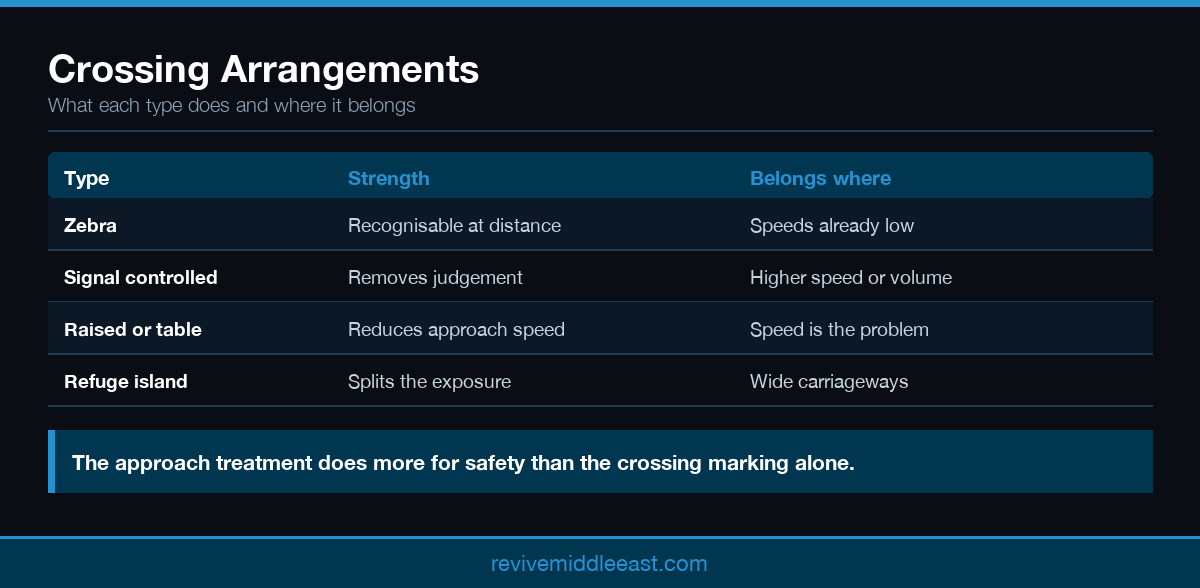
Four crossing arrangements and where each belongs
The Approach Is Where Speed Is Actually Reduced
Most of the safety benefit at a crossing comes from the fifty to one hundred metres before it. Transverse bar markings at reducing spacing create an impression of accelerating speed and prompt drivers to lift off. Visual narrowing, achieved by bringing edge lines inward or adding hatching at the kerb, produces the same effect without physical works. Neither treatment is expensive and both outperform simply making the crossing brighter.
Advance warning markings and legends give the driver time to plan, and they follow the same conventions as the rest of the highway marking vocabulary. A legend on the carriageway is read earlier than a sign at the verge on a wide road, because the driver is already looking at the road surface. Combining the two is better than either alone, and the two should be positioned together rather than independently.
Sight lines matter as much as markings. A crossing placed where parked vehicles, planting or a bus shelter obscure a waiting pedestrian will not work regardless of how it is marked, and the correct response is to control parking on the approach with kerb markings rather than to add more paint to the crossing.
Consistency across a corridor is the quiet factor. If three crossings on the same road use three different approach treatments, drivers stop building an expectation, and expectation is what produces the automatic speed reduction these layouts are trying to create.
School Zones as a Complete Layout
A school zone is a corridor treatment rather than a point treatment. It usually begins with an entry marking and legend, continues with speed reduction elements and parking restrictions along the frontage, and ends with an exit marking that returns the road to its normal regime. Marking only the crossing outside the gate leaves the highest risk period, the arrival and departure surge, largely unaddressed.
Parking and stopping control is usually the most valuable element and the most contested. Kerb markings that prohibit stopping across the crossing approach and the school entrance keep sight lines open, which matters more than any other single measure. They need to be enforceable, which means they must be unambiguous and continuous rather than intermittent.
Set down and pick up areas deserve deliberate marking. Where parents have a clearly marked place to stop, they use it. Where they do not, they stop wherever is convenient, which is invariably on the crossing approach. Marking a defined bay area with a clear entry and exit is a cheap intervention with a large effect.
Pedestrian routes on the footway side should be marked or guarded where the desire line crosses a vehicle route, such as a car park entrance. This is the point where pedestrian guardrail and marking work together, channelling children to the controlled crossing point instead of the shortest route.
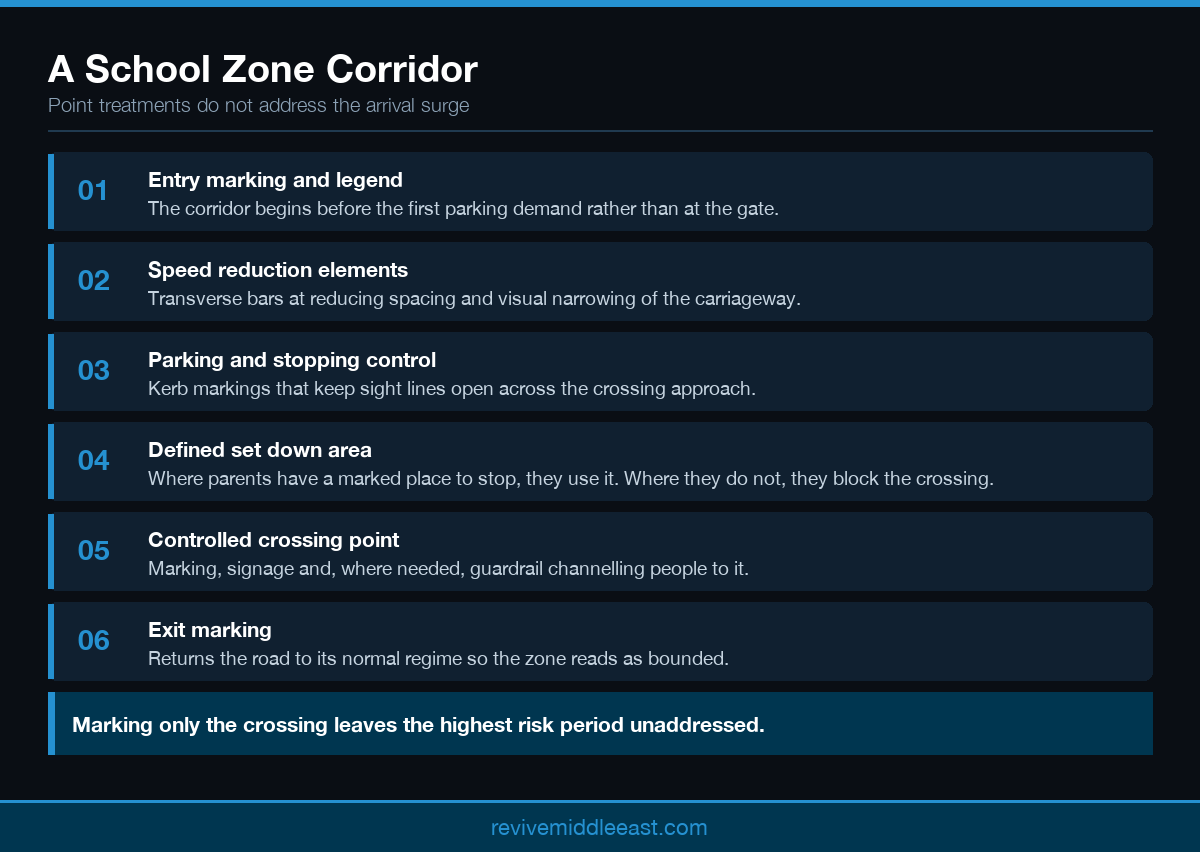
The elements of a working school zone corridor
Materials, Wear and Maintenance Priority
Crossings take braking loads on almost every vehicle that passes, which is the harshest wear regime on any road. A crossing laid in the same material and thickness as the adjacent lane lines will fade several times faster, and the road will look neglected while the straight sections are still sound. Specifying a heavier material at the crossing itself is the correct response and costs very little across a whole scheme.
Skid resistance is a genuine concern because these markings are large, continuous and sit exactly where people walk and where vehicles brake. Anti skid aggregate applied with the drop on beads restores surface texture, and it should appear in the item description for any crossing with substantial painted area.
Colour contrast against the road surface does more for daytime conspicuity than material brightness, and pedestrian crossing markings depend on it heavily. On a light coloured aged asphalt surface, white markings lose contrast, and some authorities respond with a coloured surface treatment within or before the crossing. Where that is used, its maintenance regime has to be planned too, because a patchy coloured surface is worse than none.
Maintenance priority should be explicit. In any marking maintenance programme, pedestrian crossing markings and school zone elements belong at the top of the list, ahead of lane lines on a straight section that carries no conflict. That ordering is a policy decision and should be written down rather than left to whoever schedules the work.
Approvals, Coordination and Handover
Crossings on public roads require authority approval, and the submission usually covers the marking layout, the associated signage and any change to the road geometry as one package. Where the crossing serves a development, the car park layout behind it should be reviewed at the same time, because the two determine each other. Submitting the marking alone and dealing with signage later is a common cause of delay, because the reviewer will assess the arrangement as a whole.
School zone works carry a scheduling constraint that other marking does not. The work has to happen outside term time or outside school hours, and the window is fixed by the academic calendar rather than negotiable. Planning backwards from that window, including approval lead times, is the only reliable way to deliver it.
Coordination with the school or the facility operator is worth the effort. Gate positions change, temporary entrances open during building works, and a layout drawn from a two year old survey may address a gate nobody uses any more. A short walk of the site during arrival time answers more questions than a drawing review.
Handover should include the layout as built, the material and thickness records, and a note of the maintenance priority agreed for the site. Crossings are among the first markings to need attention, and the facility that knows this in advance plans for it instead of reacting to a complaint.
Conclusion
Pedestrian crossing markings work when the whole approach is designed to slow traffic, when the material matches the braking loads they take, and when marking and signage say the same thing. School zones need the same thinking applied along a corridor rather than at a single point. Revive Middle East Paints manufactures its own thermoplastic and installs crossing and school zone layouts across the UAE. Contact us to discuss a site.