Dubai has set a public target that 25% of all trips in the emirate will be smart and driverless by 2030. That goal quietly changes the brief for every road marking paint supplier UAE authorities and contractors work with, because the line on the road is now read by cameras as well as by drivers. Lane keeping systems, driver assistance features and future autonomous shuttles all depend on markings they can detect in glare, dust and darkness. If a 2027 tender is on your desk, speak with our Sharjah team about specifying materials that serve both audiences. This guide explains the evidence, the numbers and the procurement questions that matter.
Key Takeaways
- Road markings are becoming part of the traffic technology stack. Cameras and LiDAR use them to hold a vehicle in its lane, so retroreflectivity and contrast now matter to machines as much as to people.
- Dubai is already investing in marking renewal at scale, and its driverless transport target makes machine readable lines a practical requirement rather than a distant idea.
- Buyers choosing a road marking paint supplier UAE projects can trust should ask for measurable performance, factory traceability and a maintenance method, not just a unit price.
From Paint to Data Layer: Why Machines Now Read Road Lines
A road line used to have one job: guide a human driver. Today it also feeds the sensors in modern vehicles. That shift turns marking material into a piece of safety infrastructure that software depends on.
Research is now measuring this directly. A 2025 study in the Journal of Traffic and Transportation Engineering tested motorway markings with cameras and LiDAR in different lighting and weather conditions. It found that retroreflectivity was a consistent predictor of machine detectability in camera images at night, and for LiDAR contrast in dry and moist conditions. Daytime visibility readings, however, did not reliably predict how well machines detected markings in daylight.
Regulators are moving in the same direction. In the United States, the federal rule on minimum pavement marking retroreflectivity requires agencies to use a method that keeps longitudinal markings at or above 50 mcd/m²/lx on roads with speed limits of 35 mph or more. It recommends 100 mcd/m²/lx on roads of 70 mph and above. The rule also notes that better markings will improve the ability of infrastructure to work with driver assistance and automated driving systems.
The lesson for the Gulf is simple. A marking that looks acceptable to an inspector at noon may still be hard for a camera to read at night. Specifications written for 2027 projects should treat night performance and edge definition as core requirements, not optional extras.
This also changes who cares about the line. Fleet operators, mobility start ups and vehicle manufacturers testing in the region all have a stake in consistent markings. A road authority that once answered only to motorists now answers to software teams as well, and that raises the bar for every supplier in the chain.
What the UAE and Global Numbers Say
The strongest signal for demand comes from the authorities themselves. Local investment, global safety targets and driverless transport plans all point toward more marking work and higher expectations for it.
In May 2025, Dubai’s Roads and Transport Authority announced that ground markings renewal had begun across 89 locations. The programme covers 50 major roads and 39 residential areas, with more than 30,000 linear metres of markings repainted under the 2025 Preventive Maintenance Plan. RTA said it uses top grade materials to help extend operational lifespan. The same authority estimates that the benefits of self driving transport in Dubai could be worth more than AED 22 billion per year.
The global picture explains why this matters. According to the World Health Organization, the global rate of road traffic deaths fell by 21% between 2011 and 2025, yet road crashes still claimed 1.16 million lives in 2025. The UN target is to halve road deaths and serious injuries by 2030 compared with 2021 levels. Clear, durable markings remain one of the most basic tools for reaching it.
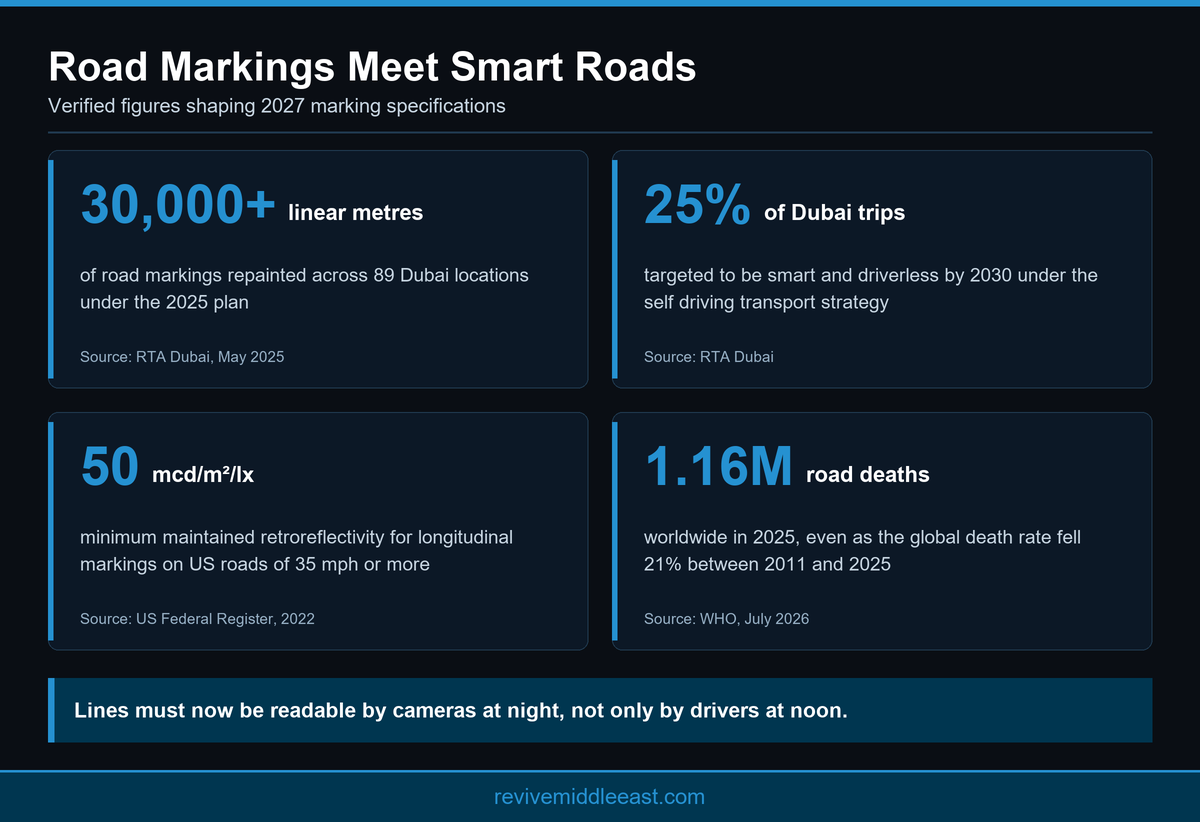
Key figures shaping road marking specifications for 2027
Taken together, these figures describe a market where volume and expectations are rising at the same time. More kilometres of line will be laid and renewed, and each one will be judged against a stricter idea of what good looks like.
Material Choices That Keep Markings Machine Readable
Not every marking system performs equally once sensors enter the picture. The material, the beads and the application method together decide whether a line stays readable through years of heat, sand and heavy traffic.
Thermoplastic remains the workhorse for UAE highways because it is laid thick, bonds well and resists wear. Any thermoplastic road marking contractor Dubai 2027 tenders are likely to shortlist will need to show how its material holds retroreflectivity over time, not just on handover day. Our comparison of thermoplastic, cold paint and MMA sets out where each system fits.
Glass beads do most of the work at night. Their size, grade and embedment depth decide how much light returns to a headlamp or a camera, which is why the role of glass beads in retroreflectivity deserves attention in every specification.
Climate is the other variable. Intense sun, high surface temperatures and abrasive sand reduce contrast faster here than in cooler regions. Understanding why road markings fade early in the UAE climate helps buyers set realistic inspection cycles. Clean, sharp edges also matter, because the 2025 study treated edge detectability as one of its core machine detectability measures.
Application quality closes the loop. A premium material laid at the wrong temperature, or on a dusty surface, will lose beads and edge definition early. Crews, equipment and surface preparation deserve the same scrutiny as the product data sheet.
What 2027 Tenders Are Likely to Ask a Supplier
Looking ahead, procurement teams are likely to write smarter specifications. The outlook points toward measurable performance, documented maintenance and fewer suppliers covering more of the road environment.
First, expect a request for a maintenance method. The US rule already requires agencies to adopt one, and Gulf authorities with driverless ambitions have good reason to follow a similar logic. Suppliers should be ready to support retroreflectivity measurement at handover and at agreed intervals.
Second, expect questions about origin and consistency. A locally manufactured product with batch records is easier to audit than an imported one with a long supply chain. Seeing how thermoplastic marking paint is manufactured shows what quality control looks like in practice.
Third, expect whole life thinking. A cheaper material that needs relining sooner often costs more over a contract term, and our breakdown of road marking cost per square metre explains the variables.
Finally, many buyers will prefer a single traffic management products supplier Middle East projects can rely on for markings, signs and barriers together. That keeps colour, reflectivity and installation standards consistent across a corridor. Revive Middle East supplies thermoplastic paints and road markings alongside traffic signs, bollards, guard rails and fencing from its base in Sharjah.
For contractors, the practical step is to prepare now. Keep product data sheets, bead specifications and batch records ready, and agree an inspection schedule with the client before work starts. Suppliers who can show that evidence quickly will be easier to approve when 2027 tender documents ask for it.
Conclusion
Smart roads do not start with software. They start with lines that a driver and a camera can both read, day and night, through a hot and dusty summer. The evidence from recent research, the scale of Dubai’s renewal work and the global push to cut road deaths all point to higher standards for marking materials. Choosing the right road marking paint supplier UAE projects depend on is now a technology decision as much as a paint decision. Revive Middle East manufactures thermoplastic road marking paint in Sharjah and supports contractors and authorities across the region. Share your project drawings with us to discuss specifications for your next tender.