Most road marking on a UAE carriageway happens at night, and the reasons are practical rather than preferential. Daytime surface temperatures often sit outside the acceptable application window, and traffic volumes make a daytime closure unworkable on any road that matters. Road marking night works therefore run inside a window of a few hours, between the last closure and the first commuter, and everything about the job is shaped by that. This guide sets out how to plan the sequence so the window is used rather than consumed.
Key Takeaways
- The productive window is always shorter than the possession. Setting and striking the closure can absorb two hours of a seven hour permit.
- Sequence so that the last line laid is the first that can be released. Material set time is a programme input, not a technical footnote.
- Handback discipline decides whether the closure is granted again. A late reopening costs more than a slow shift.
What the Closure Window Actually Gives You
A permit that runs from 22:00 to 05:00 does not give seven hours of marking. Setting out the taper, positioning signs and cones, establishing the buffer and briefing the crew consumes time at the start, and striking the layout in reverse order consumes time at the end. On a multi lane road the two together commonly account for two hours, leaving five productive hours in a seven hour possession.
That arithmetic should drive the plan rather than surprise it. Work out the productive window first, then calculate what can realistically be laid within it including heating time for the kettle, and only then agree the nightly target. A programme built from the permit length rather than the productive window will slip from the first shift.
The layout of the closure itself is a technical exercise with its own rules, covered in the guide to work zone layout and taper lengths. The taper is not a convenience, it is the element that determines whether traffic transitions safely, and shortening it to save time is the most common and most dangerous compression in temporary traffic management planning.
Where a scheme runs over many nights, the setting and striking cost repeats every night. That is a strong argument for longer possessions on fewer nights wherever the road authority will permit it, and it is worth raising at approval stage rather than accepting the default.
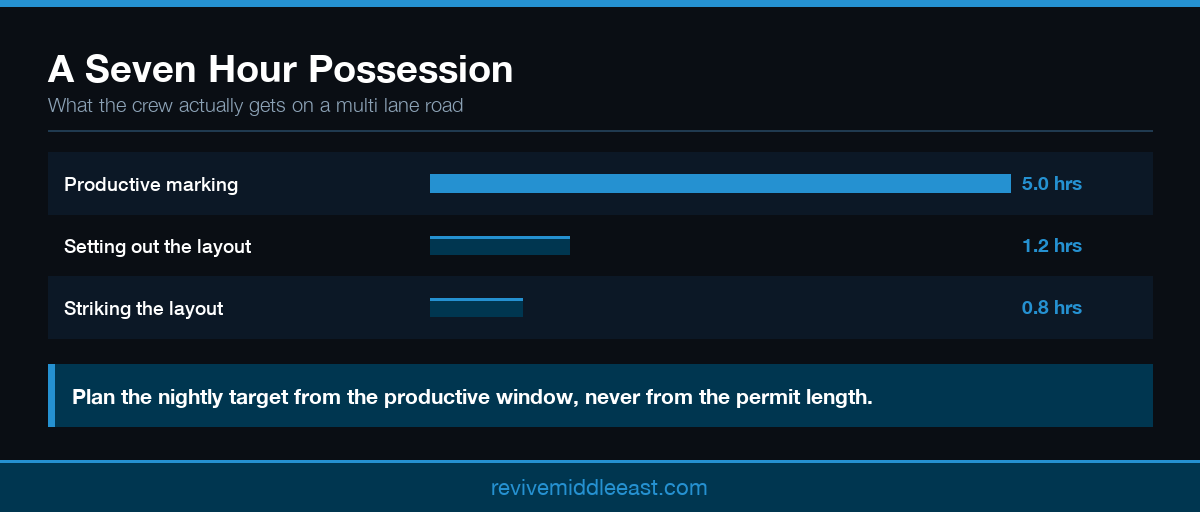
Where a seven hour possession actually goes
Sequencing Around the Handback
The governing constraint is that every line laid must be safe to traffic before the road reopens. Thermoplastic cools and hardens quickly, usually within a few minutes, which is precisely why it dominates carriageway work. Cold applied paint takes considerably longer and is rarely viable on a road that must reopen at dawn.
Sequence the work so that the areas needing the longest protection are completed first and the areas nearest the handback point are completed last. On a long run this means working away from the reopening end rather than toward it, so that the final line laid has the shortest exposure before traffic returns.
Plan for the failure case as well. If the shift falls behind, which sections can be left unmarked and reopened safely, and which cannot. A junction that has been partially remarked is more dangerous than one not started, so the sequence should break at points where an incomplete state is still coherent to a driver.
Protection of fresh material is a real cost and a real risk. Cones left to protect a cooling line have to be recovered before handback, and a cone left on a live carriageway at 05:00 is a serious incident. The recovery sweep is part of the sequence, not an afterthought.
Lighting, Visibility and Crew Safety
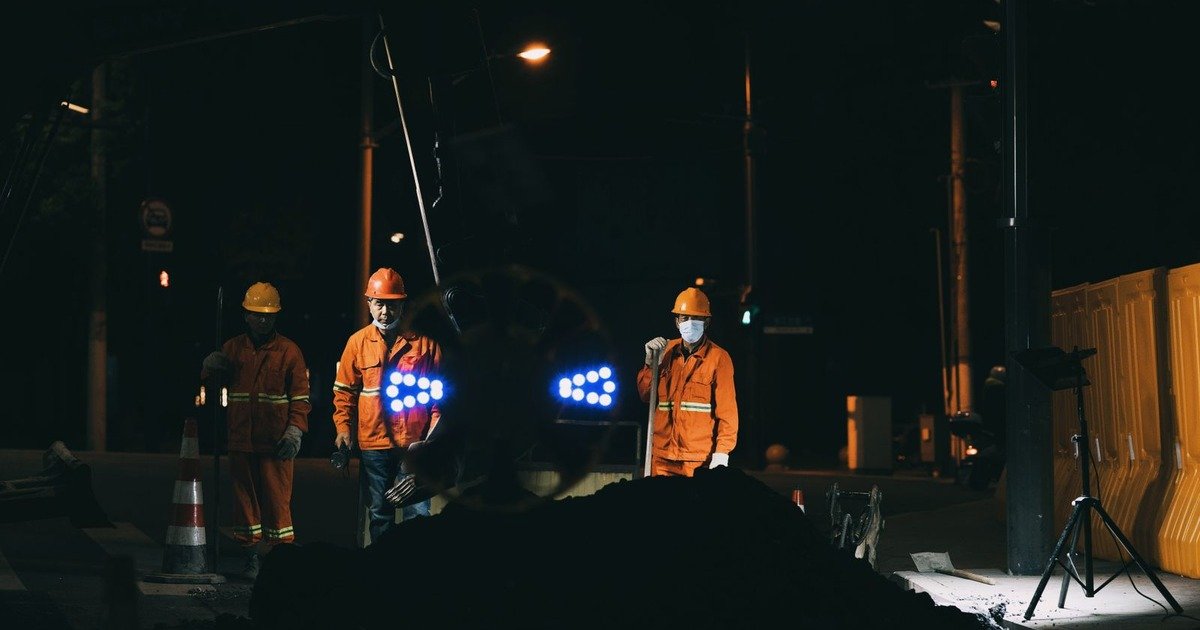
Marking accurately in the dark requires lighting on the work itself, and the lighting has to be positioned so it does not dazzle passing traffic. Balloon lighting and directional units aimed down and away from the live lane are the usual answer, and it is worth checking the arrangement from a passing vehicle before the shift settles into a routine.
Crew visibility is non negotiable. High visibility clothing to the appropriate class, worn correctly and kept clean enough to actually reflect, is the baseline. Retroreflective performance on a dirty garment is a fraction of a clean one, and on a night shift that difference is the entire margin.
Fatigue management deserves more attention than it usually receives on marking works. Night shifts across consecutive nights degrade judgement, and the judgement being degraded is about surface condition, temperature and layout accuracy. Rotation and realistic shift lengths protect quality as much as they protect people.
Communication between the marking crew and the traffic management crew has to be explicit. They are often different teams with different supervisors, and the moments of greatest risk are the transitions, when the layout is being changed while work is still under way. A single agreed point of control removes most of that risk.
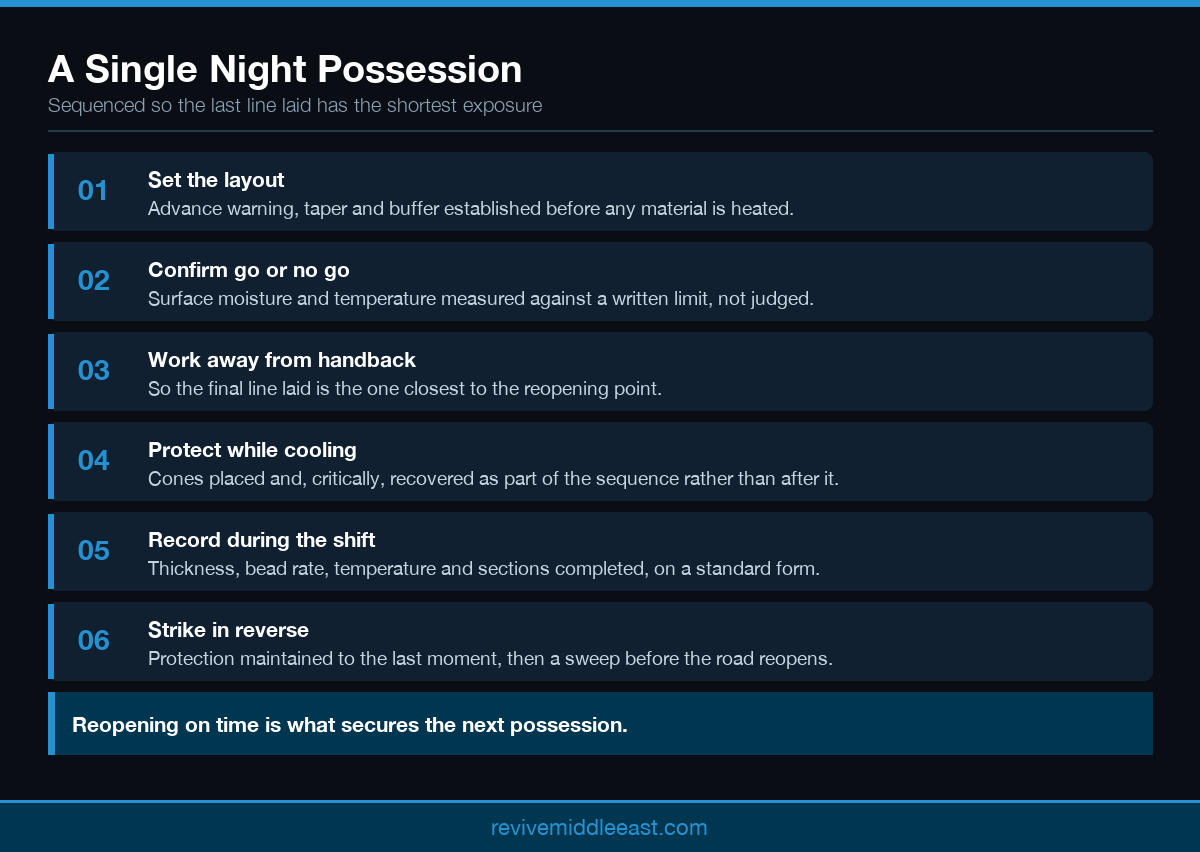
A workable sequence for a single night possession
Weather, Temperature and Go or No Go
Night working in the UAE removes the daytime heat problem and introduces a humidity one. Surface moisture from condensation late in the shift will prevent adhesion just as effectively as rain, and the effect is worst in the hours before dawn, exactly when the crew is trying to finish. Measuring surface moisture rather than judging it by eye is the only reliable check.
Surface temperature has a lower limit as well as an upper one. A surface that has cooled too far will chill the material on contact and produce a poor bond, and in winter months on an exposed desert route that limit is reached more often than people expect.
A written go or no go rule protects everyone. It should state the surface moisture and temperature limits, who takes the decision, and what happens to the possession if the answer is no. Without it, the decision falls to whoever is most under pressure, which is never the right person to be making it.
Wind matters for spray application and for bead distribution. On an exposed carriageway it can carry beads away from the line entirely, which produces a marking that looks correct and fails its night visibility check. The application method guide covers how each application method responds to these conditions.
Approvals, Records and Reopening
The closure itself requires authority approval before any of this can happen, and the lead time is measured in weeks rather than days. The submission covers the traffic arrangement, the working method and the reinstatement, and the process is set out in the guide to traffic diversion plan approval.
Records have to be captured during the shift rather than reconstructed afterwards. Thickness readings, bead rates, temperatures, the sections completed and the time of handback all belong in the night’s record, and a simple standard form completed by the supervisor is worth more than a detailed report written from memory a week later.
Reopening on time is the currency that buys the next possession. A road authority that has granted a closure and received the road back late will scrutinise the next application, and a pattern of late handbacks affects the whole programme. Building a margin into the plan is cheaper than negotiating for it later.
Finally, the marking laid at night has to be inspected in daylight. Errors in alignment and thickness that are invisible under floodlights are obvious at midday, and a daylight walk of the previous night’s work before the next shift is the cheapest quality control available on a road line marking scheme.
Conclusion
Road marking night works succeed or fail on planning rather than on effort. Calculate the productive window honestly, sequence toward the handback, set written limits for moisture and temperature, and inspect the previous night in daylight. Do that and the possession delivers what the programme assumed. Revive Middle East Paints runs night marking crews across the UAE with our own plant and our own material. Talk to us about your programme.