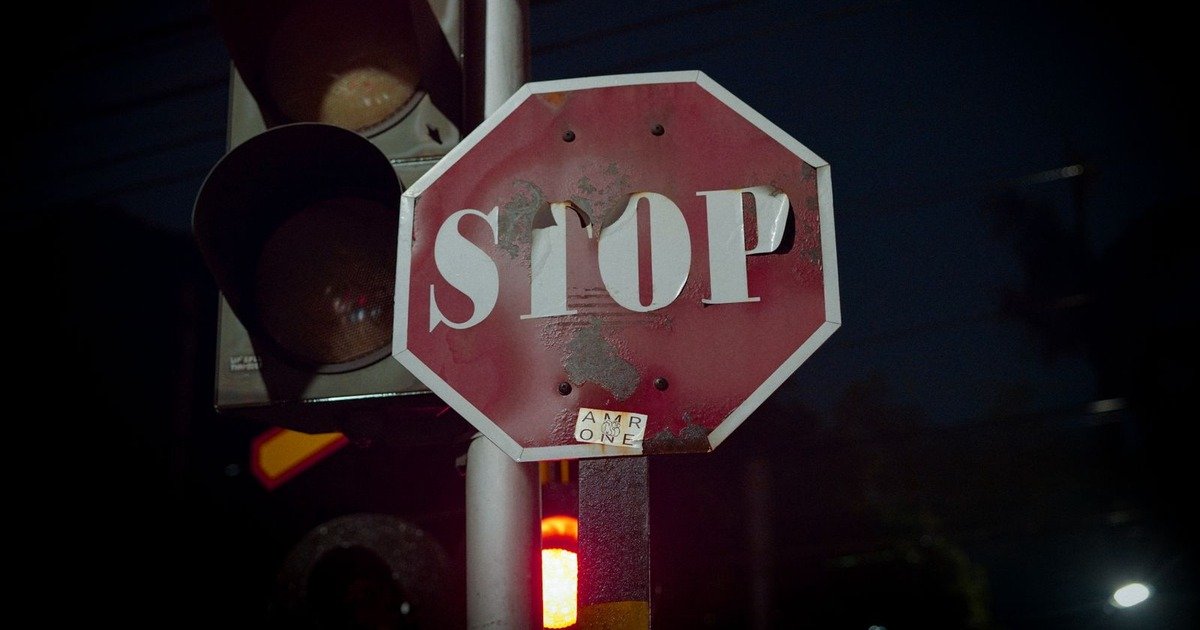
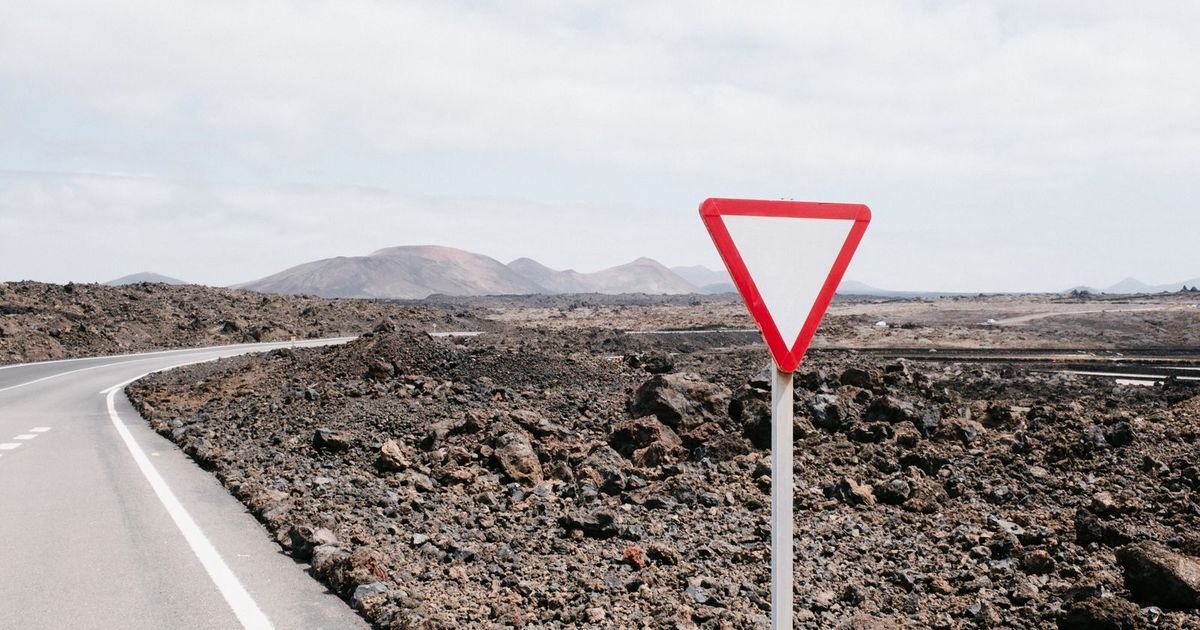
Ground mounted road signs fail structurally far more often than they fail visually. A leaning post, a rusted base or a rotated panel is the usual reason a sign stops doing its job, and none of those has anything to do with the face. The sign is a small structure carrying a large sail in a hot, humid, sandy environment, and it needs to be designed as one. This guide covers posts, foundations, wind load and the details that decide whether a sign is still upright in year fifteen.
Key Takeaways
- Wind load is the governing design case for most ground mounted road signs in the UAE, and it scales with panel area.
- Foundations are the element most often value engineered without analysis, and undersizing shows up as a leaning route several years later.
- Galvanising specification and cut end treatment decide corrosion life in a coastal environment far more than post thickness does.
Wind Load Is the Governing Case
A sign panel is a flat plate held into the wind, and the force on it grows with area and with the square of wind speed. That relationship is why a modest increase in panel size produces a disproportionate increase in the load reaching the foundation, and why enlarging a face during design development without revisiting the support calculation quietly moves the structure outside its design basis.
The design wind speed comes from the location and the exposure. An open desert route, a coastal corniche and a sheltered urban street are genuinely different, and applying one figure across a whole emirate produces signs that are over engineered in some places and under engineered in others. The general discipline is summarised in the article on wind engineering.
Gust response matters as much as the mean wind. Signs are light, stiff structures and they respond quickly to gusts, and repeated gust loading over years is what loosens fixings and works foundations free rather than a single extreme event. Designing for the mean and ignoring the fatigue effect is a common shortcut.
The practical consequence for a specifier is simple. State the design wind speed and the exposure category in the specification, and require the bidder to submit support and foundation calculations for each sign size. Without that, ground mounted road signs are quoted from a standard detail that may or may not suit the location.
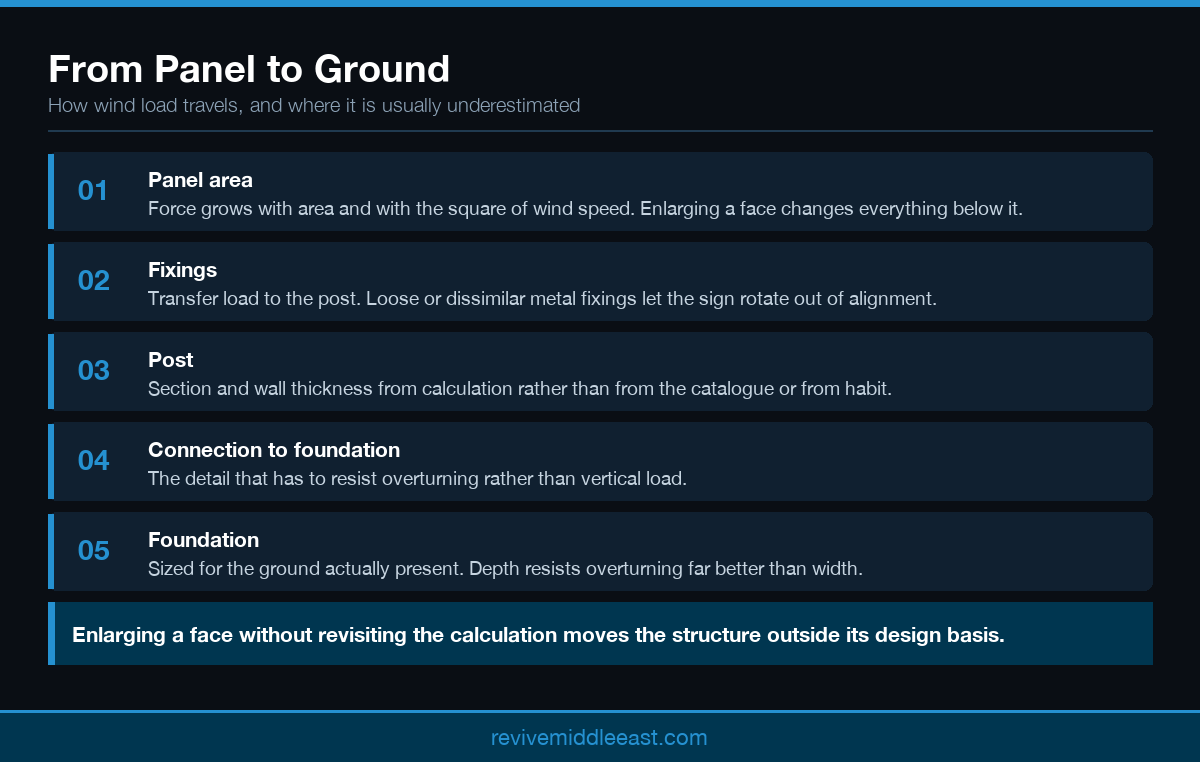
How wind load travels from the panel to the ground
Post Selection and Corrosion Protection
Circular hollow sections and rectangular hollow sections both work, and the choice is usually driven by the fixing arrangement and by the appearance the client wants. What matters more is the section size, the wall thickness and the connection detail, all of which follow from the calculation rather than from the catalogue.
Corrosion protection is where UAE conditions bite. Coastal humidity combined with salt and sand produces an aggressive environment, and hot dip galvanization applied to an adequate coating thickness is the standard answer. It gives decades of protection when done properly and very little when done thinly.
The detail that fails most often is the cut end. A post cut to length on site after galvanising exposes bare steel at exactly the point where water collects, and unless it is treated with a suitable repair coating, rust starts there and travels. Requiring posts to be cut before galvanising, or requiring a documented repair procedure, removes the problem.
Fixings deserve the same attention. Bolts, clamps and brackets in a dissimilar metal will corrode galvanically against the post, and a sign that has rotated on loose fixings is still perfectly legible from a direction nobody is driving. Stainless or properly protected fasteners with a specified torque and an anti rotation detail are cheap insurance.
Foundations and Ground Conditions
Foundations for ground mounted road signs are normally mass concrete, sized to resist overturning rather than to carry vertical load. Depth matters more than width for overturning resistance, which is why a shallow wide pad is a poor substitute for a deeper block even when the concrete volume is the same.
UAE ground conditions complicate this. Sabkha, loose windblown sand and variable fill all offer poor lateral resistance, and a foundation detail drawn for competent ground will move in them. Where a route crosses varying ground, varying the foundation detail along it is the honest approach, and it is cheaper than replacing the signs that lean.
Sleeved and socket details are worth considering where signs may be relocated or where a struck sign should be replaceable quickly. They add cost at installation and remove a great deal of cost over the asset life, particularly on urban routes where impact damage is routine.
The failure mode to design against is progressive rather than sudden. A slightly undersized foundation does not fail on the first windy day; it rotates a fraction each year until a whole route visibly leans. Because the failure is slow, undersizing survives design review and shows up as a maintenance problem long after anyone is looking for its cause.
Breakaway and Passive Safety
On higher speed roads, a rigid post inside the clear zone is itself a hazard. Passive safety design addresses this by allowing the support to yield, shear or deform in a collision so that the deceleration experienced by the vehicle occupants is reduced. It is a trade off: the sign is sacrificed to protect the vehicle.
Breakaway details are only effective if they are installed as designed. A slip base that has been over torqued, welded or packed with an additional plate will not release, and a frangible post grouted solidly into its foundation is simply a rigid post. Inspection of these details at installation matters more than for almost any other element.
Where passive safety cannot be achieved, the alternative is to protect the support or move it. Shielding a rigid support with a safety barrier is common practice, and it is the right answer where the sign has to sit close to the carriageway for visibility reasons.
The decision should be made explicitly at design stage rather than left to whoever installs the sign. It affects post type, foundation detail and cost, and retro fitting passive safety to an installed route is considerably more expensive than specifying it at the outset.
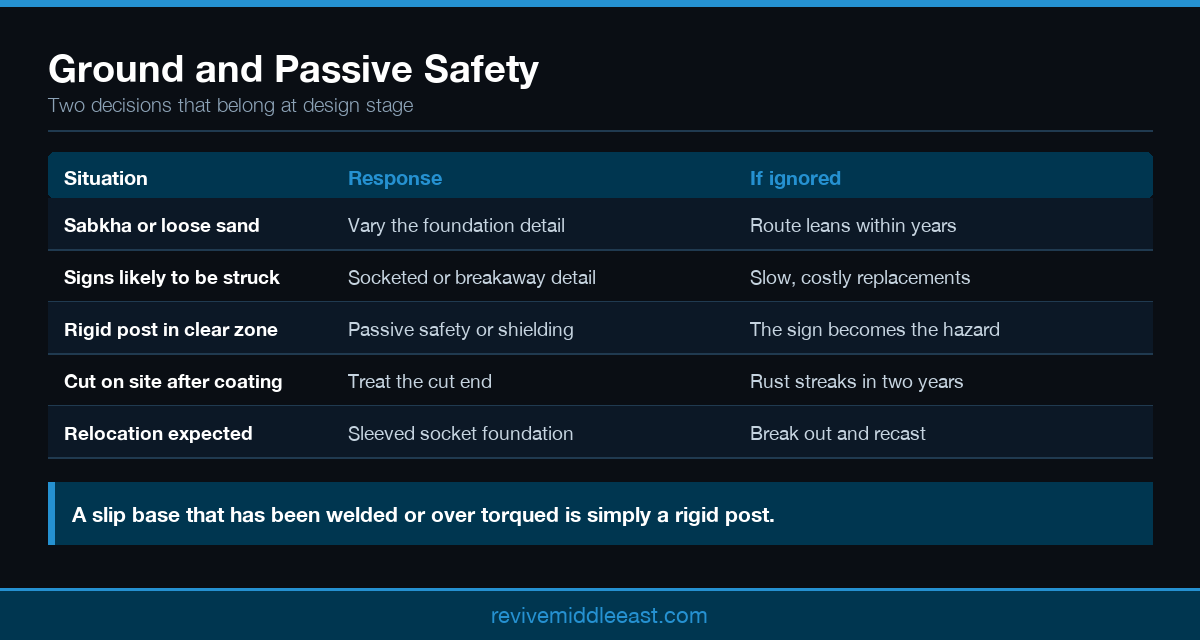
Foundation depth, ground type and passive safety choices
Installation, Inspection and Replacement
Access for future maintenance is worth a moment at design stage. A sign that can only be reached from a live lane will be inspected less often and replaced later than one reachable from a verge, and that difference compounds across a route over an asset life measured in decades.
Installation quality determines a large share of the eventual service life. Posts set plumb, foundations cured before load is applied, fixings torqued to specification and cut ends treated are the four checks that matter, and all four are quick to verify at the time and expensive to correct later.
Inspection should cover the structure rather than only the face. Post plumb, foundation condition, fixing tightness, corrosion at cut edges and impact damage are the items, and they can be combined with the reflectivity survey described in the guide to road signage maintenance and inspection so that one visit serves both purposes.
Impact damage deserves its own record. A location where signs are struck repeatedly is telling the owner something about the clear zone, the geometry or the approach speed, and logging strikes by location turns a maintenance log into a safety input rather than a cost record.
Replacement of the structure and replacement of the face are different decisions with different economics. Where the post and foundation are sound and the sheeting has degraded, refacing is substantially cheaper. Where the structure is corroded or the foundation has moved, refacing a sign that will lean again is a waste. Our road signage services page covers both.
Conclusion
Ground mounted road signs are structures first and communications second. Design the support for the real wind speed and exposure, size the foundation for the actual ground, specify galvanising and cut end treatment properly, and decide the passive safety question at design stage. Do that and the sign will still be upright and square when its sheeting is due for renewal. Revive Middle East Paints manufactures and installs signage across the UAE. Contact us.