

Reflective thermoplastic road markings in the UAE do their most important work in the hours when nobody is inspecting
them. A line that looks perfect at noon can be nearly invisible at 2 am, and the difference has almost nothing to do
with the white material itself. It comes down to glass beads, how they are specified, how deep they sit and how
quickly Gulf conditions take them away. This article explains how that system works and how to hold a contractor to
it.
Key Takeaways
- Night visibility comes from glass beads acting as lenses, not from the whiteness of the marking material.
- Embedment depth of roughly half the bead diameter is the target. Too deep and the bead gathers no light. Too shallow
and traffic removes it. - Retroreflectivity should be specified twice, once at handover and once as a maintained minimum through the defects
period.
How a Glass Bead Actually Returns Light
A
glass bead
embedded in a road marking behaves as a small spherical lens. Headlight beams enter the exposed surface of the bead,
refract as they pass through the glass, reflect off the pigmented material behind it, and leave along approximately
the path they arrived on.
That behaviour is called
retroreflection,
and it explains a familiar effect. The marking looks brilliant to the driver whose own headlights are illuminating it,
while looking dull to somebody standing at the roadside. The light is being sent back to its source rather than
scattered evenly. It also explains why a marking loses all its night performance the moment the beads are gone, even
though the white line is still clearly there in daylight.
Bead quality decides how efficiently this happens. Irregular, fractured or cloudy particles do not focus light
properly and contribute almost nothing.
This also explains a common misunderstanding on site. A supervisor who inspects a new marking in daylight and
pronounces it excellent has verified the colour and the geometry and nothing about the property that matters after
dark. Night performance has to be measured with an instrument or inspected at night. There is no way to see it at
noon.
What RL Means and How It Is Measured
Retroreflectivity is quoted as an RL value in millicandelas per square metre per lux. In plain terms, it measures how
much light comes back to the driver eye for a given amount of light going out. Higher numbers mean a brighter line at
night.
European practice under
BS EN 1436
groups performance into classes, with each class setting a minimum RL value that the marking must meet. Measurement is
done with a retroreflectometer, either as a handheld unit walked along the line or as a mobile unit mounted on a
vehicle. The critical point is where readings are taken. A single reading at a convenient location proves nothing.
Readings should be taken at intervals along the run and reported with their chainage.
Specify two values. An initial value demonstrated at handover, and a maintained minimum that must still be met later
in the defects period. Only the second obliges the contractor to have used decent beads.
Where readings are taken matters as much as the value itself. Retroreflectivity varies along a run because bead
placement varies, and a contractor selecting the measurement location will naturally select a good one. Specify that
readings are taken at fixed intervals, that each is reported with its chainage, and that the assessment uses the
average and the lowest reading rather than the best.
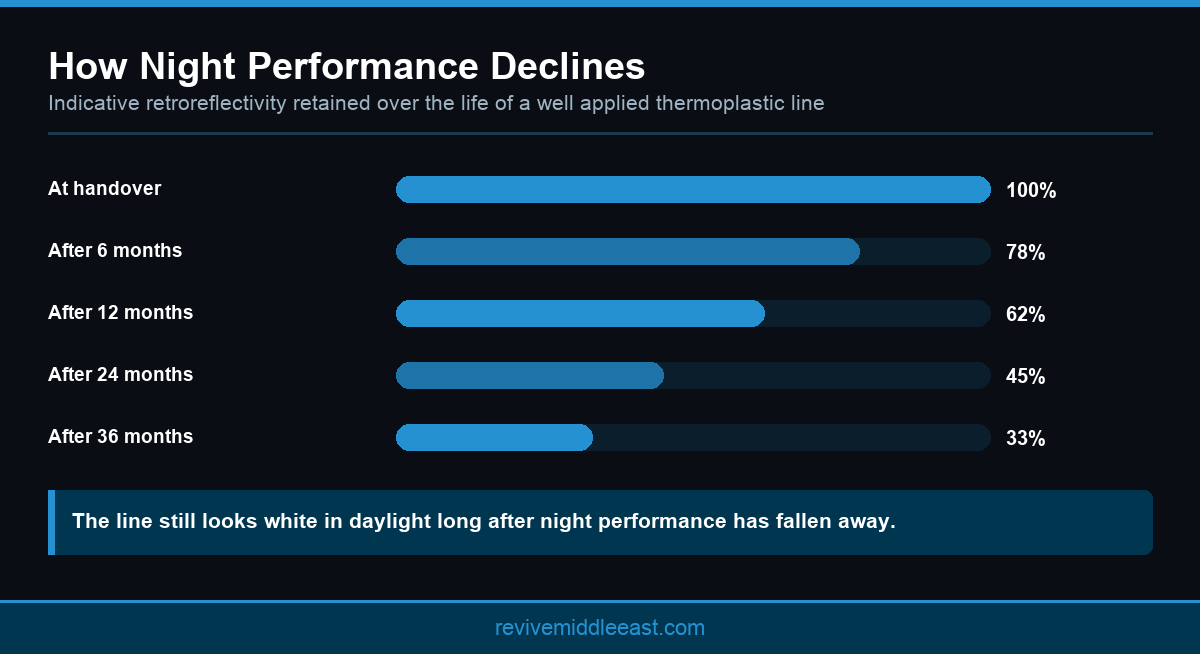
Indicative pattern of retroreflectivity decline, showing why measurement beats visual inspection
Embedment Depth: The Number Nobody Specifies
Embedment is how far the bead sits into the marking material. It is rarely written into a specification and it is one
of the most common reasons a new line underperforms from day one.
If a bead is pressed in too deep, very little of its surface is exposed and it cannot gather enough light to
retroreflect. If it barely touches the surface, there is not enough material gripping it and traffic will sweep it
away within days. The working target sits at roughly half to sixty per cent of the bead diameter below the surface.
Achieving that is a matter of timing. Beads must land while the thermoplastic is still hot enough to accept them and
cool enough to hold them.
This is why bead application is fixed immediately behind the applicator rather than treated as a separate pass. It is
also why a crew that is running behind schedule tends to produce markings with poor night performance.
Application temperature is the lever that controls embedment, and it moves quickly. Material that has cooled slightly
before the beads land will hold them too shallow. Material that is still too hot lets them sink out of reach. This is
why bead dispensers are fixed to the applicator rather than run as a separate operation, and why a crew rushing to
finish before handback tends to produce a line that measures poorly on its first night.
Reflective thermoplastic road markings only perform when the beads sit at the right depth, which makes embedment a
specification issue rather than a site detail.
Intermix Beads Compared With Drop On Beads
Two different bead populations work in a thermoplastic marking, and they do different jobs at different points in the
life of the line.
Drop on beads are applied to the hot surface at the moment of laying. They sit at the top of the film and they provide
all of the retroreflectivity you measure at handover. Intermix beads are blended through the material during
manufacture. They contribute nothing on day one, because they are buried. Their role begins as the surface wears down
and exposes fresh beads that have been waiting inside the film. In effect the marking regenerates its own night
performance as it abrades.
A material with no intermix beads will show a sharp drop in performance once the drop on layer is gone. It is worth
confirming the intermix content when you buy, because it is invisible on site and easy to leave out.
Specifying intermix content is straightforward once you know to ask. State a minimum percentage by weight in the
material specification and require the batch record to confirm it. Because the beads are inside the product rather
than on it, this is one of the few quality attributes that genuinely cannot be checked on site, which makes the
paperwork the only control available to you.

The bead properties worth writing into a specification
Why Retroreflectivity Falls Faster in the Gulf
Two local conditions attack bead performance in ways that temperate specifications never account for, and both act
well before the marking itself wears out.
The first is sand. Fine wind blown particles polish the exposed bead surfaces and, worse, settle into the texture of
the line. A layer of dust across the beads blocks light from entering them at all, which is why a marking can recover
measurably after rain or after mechanical sweeping. The second is surface temperature. A binder that softens in the
heat allows beads to sink further into the film over time, quietly moving them past the useful embedment depth without
any wear taking place.
Both effects mean night performance in the UAE should be measured rather than assumed. The related mechanisms behind
material ageing are covered in our article on
why road markings fade early here.
There is a maintenance opportunity in this that most networks miss. Because dust burial is reversible and bead wear is
not, a scheduled mechanical sweep on exposed routes recovers real performance at a fraction of the cost of remarking.
Building sweeping into the maintenance cycle can extend the useful life of the
road line marking asset by a meaningful margin before
reapplication becomes necessary.
Reflective thermoplastic road markings therefore need periodic measurement in this region rather than an assumption
that they are still working.
Conclusion
Reflective thermoplastic road markings in the UAE succeed or fail on the quality of a system most specifications
barely mention. Beads must be well formed, correctly graded and embedded to the right depth, and there must be
intermix material waiting inside the film for the years after the surface layer has gone. Specify an initial and a
maintained RL value, measure along the run, and treat night performance as something you check rather than something
you hope for. Contact our team to discuss retroreflectivity
requirements on your project.