Road marking removal in the UAE gets far less attention than application, and it causes far more lasting damage when it goes wrong. A badly removed line leaves a scar that drivers still read as a marking at night, which is a genuine safety problem rather than a cosmetic one. This article compares the three removal methods used here, explains the damage each one can do, and sets out how to choose without wrecking the surface underneath.
Key Takeaways
- A ghost marking left after poor removal can still be read by drivers at night, especially in wet conditions.
- Water jetting is the least damaging method on asphalt. Grinding is the fastest and the most destructive.
- Removal method should be selected from the substrate and the marking material, not from whatever plant is already on site.
Why Removal Quality Matters More Than Speed
Removing a marking is not simply the reverse of laying one. The material has bonded into the surface texture, and taking it out always takes some of the road with it.
Two problems follow. The first is the ghost marking, a visible outline left where the removed line used to be. It appears because the road under the marking has been shielded from wear, weathering and dust for years, so it is a different colour and texture from its surroundings. At night, and especially in the wet, drivers can still read that outline as a live marking. The second is surface damage. Aggressive removal opens the asphalt, which then ravels, holds water and deteriorates faster than the surrounding surface.
On a live carriageway, both problems are safety issues rather than presentation issues, which is why removal deserves the same specification attention as application.
There is a commercial dimension as well. Damage caused during removal usually falls outside the marking contract and lands with whoever owns the road, which means it is discovered long after the crew has left. Specifying the removal method, and inspecting the surface immediately after removal rather than after reinstatement, keeps responsibility where it belongs.
High Pressure Water Jetting
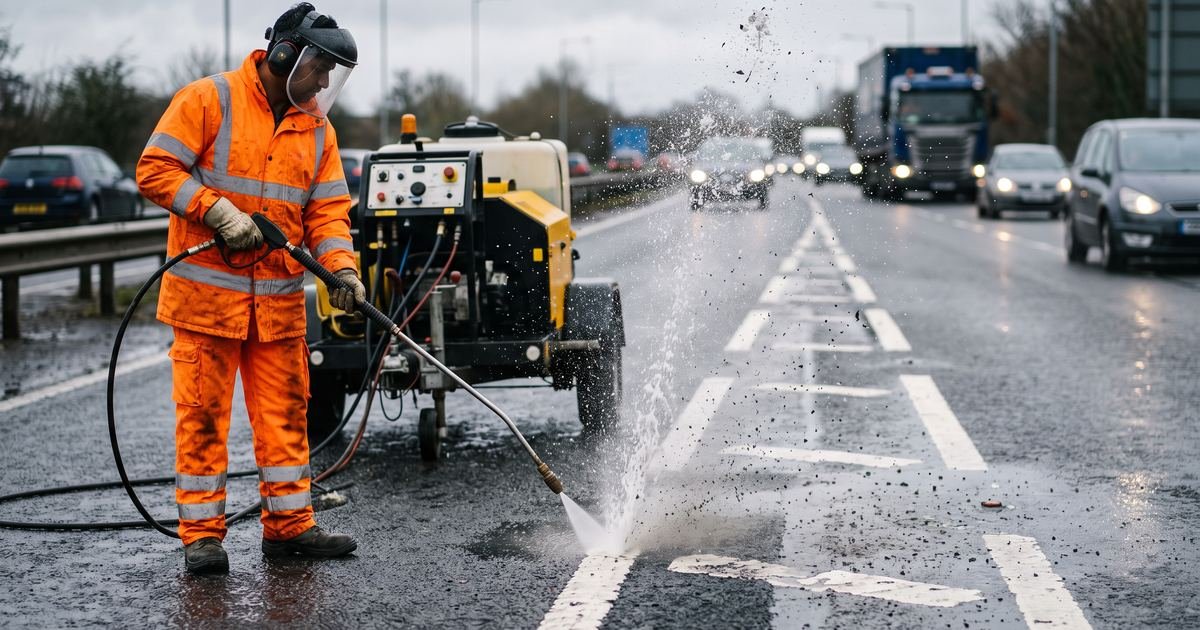
Water jetting, sometimes called hydro blasting, uses water at very high pressure to break the marking material away from the surface without cutting into it.
It is the gentlest of the three methods on asphalt, because water follows the texture of the road rather than machining a flat plane across it. That makes it the preferred choice on a surface that has to stay in service. It removes thermoplastic and cold plastic effectively, it produces very little ghosting when done properly, and it generates no airborne dust. The trade offs are output rate, the need to manage water and paint residue as a waste stream, and a higher cost per square metre than grinding.
For most permanent works on trafficked UAE roads, water jetting is the method that leaves the road in the best condition.
Pressure and nozzle configuration both need controlling. Too little pressure leaves residue keyed into the texture, which then shows as a patchy ghost. Too much begins to cut into the asphalt matrix and undoes the main advantage of the method. This is operator dependent work, and experience with the particular surface type matters more than the rating of the machine.
Water management is the practical constraint on jetting in the UAE. The residue has to be collected rather than allowed to run into a drainage system, and on a long run that means either a vacuum recovery unit working alongside the jetting head or a containment arrangement that adds time to the operation. Pricing that in at tender avoids an awkward conversation on site.
For asphalt that has to stay in service, water jetting is the road marking removal method that leaves the surface in the best condition.
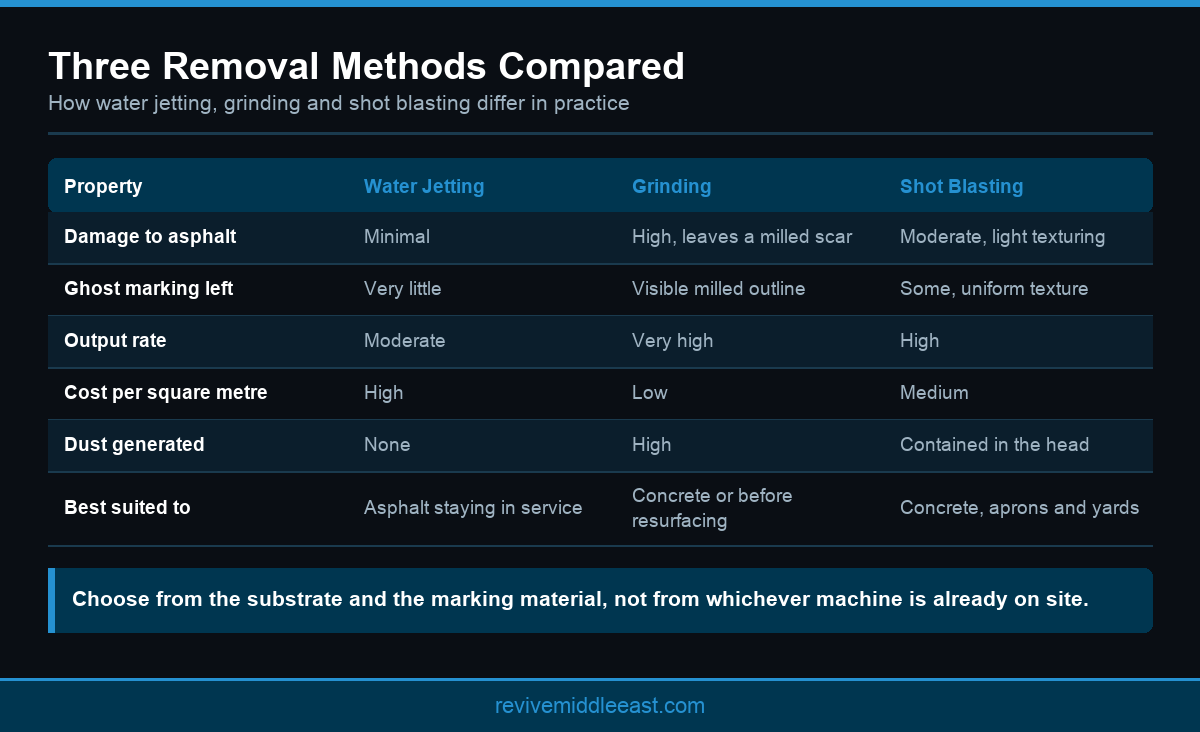
The three removal methods compared on damage, output and cost
Grinding and Scarifying
Grinding uses rotating cutters or a scarifying head to mill the marking off the surface mechanically, taking a thin layer of the road with it.
It is by far the fastest and cheapest method, and on concrete or on a surface that is about to be resurfaced anyway it is entirely reasonable. On asphalt that has to remain in service it is the most damaging option available. It leaves a milled texture that is clearly visible as a scar, it opens the surface to water ingress and ravelling, and it is very unforgiving of operator error since a moment of excessive depth cannot be undone.
Grinding is best reserved for concrete surfaces, for temporary layouts and for sections programmed for resurfacing shortly afterwards.
Grinding also generates significant airborne dust unless the head is enclosed and extracted, which is a real consideration on live roads and in built up areas across the Emirates. Where the works sit near occupied buildings, that alone can rule the method out regardless of its cost advantage. Dust control obligations normally sit inside the wider traffic management and site safety arrangements for the works.
Shot Blasting
Shot blasting propels steel abrasive at the surface within an enclosed head and recovers both the shot and the debris as it works.
It sits between the other two methods on aggression and on cost. It removes thermoplastic well, it leaves a uniform texture rather than the directional scoring that grinding produces, and the enclosed head controls dust and allows the abrasive to be recycled. It is more aggressive than water jetting and will lightly texture the road surface, which on a sound asphalt is usually acceptable and on a fragile or thin surface is not.
It performs particularly well on concrete and on large open areas such as aprons and yards, where output matters and the substrate can take it.
Recovery of the abrasive is what makes shot blasting practical at scale. The head collects the shot along with the removed material, separates the two and returns the shot to the hopper, so consumption stays low across a large area. That closed loop also keeps the working area much cleaner than open blasting, which matters when the adjacent lane is carrying traffic.
Selecting a road marking removal method from the substrate rather than from the available plant is what prevents long term damage.
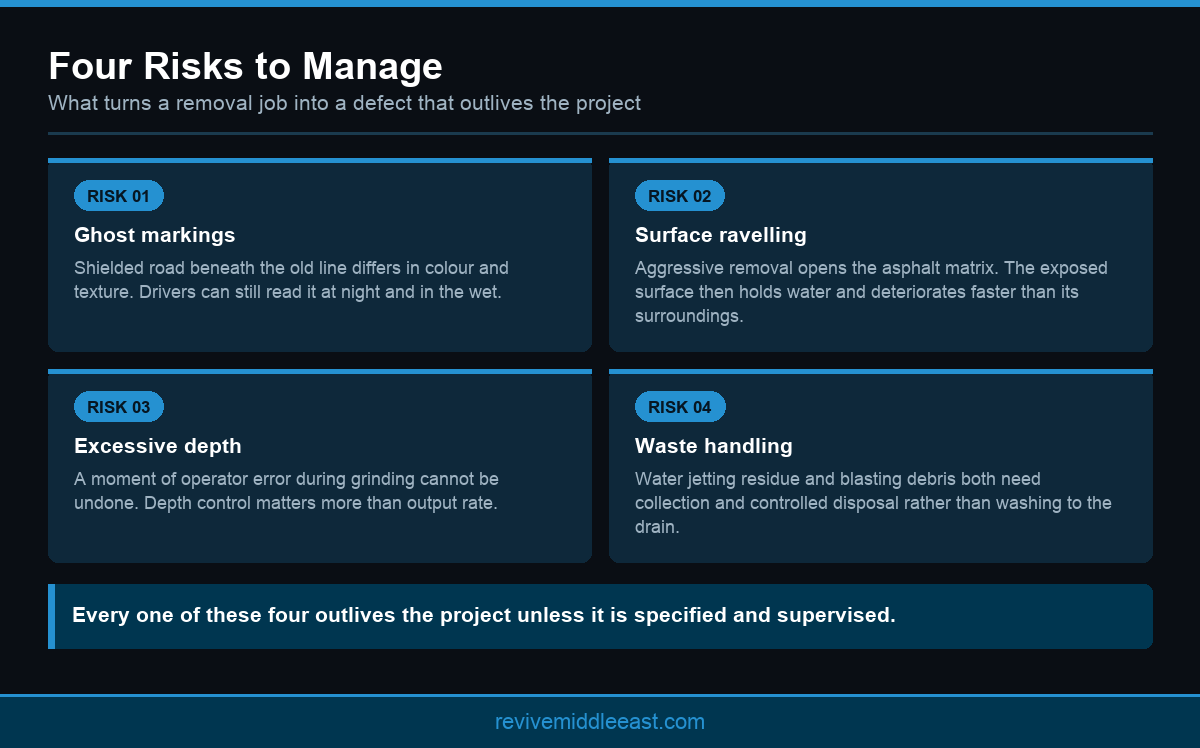
The four risks that turn a removal job into a long term road defect
Choosing a Method Without Scarring the Road
The choice should start with two facts. What is the marking made of, and what is it sitting on. Those two answers narrow the options quickly.
Thermoplastic and cold plastic on asphalt that must stay in service point firmly toward water jetting. Any material on concrete tolerates shot blasting or grinding comfortably. Thin cold applied paint often needs far less aggression than crews assume, and over specifying the method causes unnecessary damage. Where the section is due for resurfacing shortly, grinding becomes the sensible economic choice because the scar disappears under the new layer.
Whichever method is selected, plan the reinstatement at the same time. If a new marking is going back in the same place, the removal has effectively become surface preparation and should be treated to that standard. Our road line marking services cover removal and reapplication as a single sequence.
Whatever method is chosen, plan for the ghost. If a marking is being permanently removed rather than replaced, the shielded strip left behind will remain visible for a long time and drivers will read it, particularly at night and in the wet. Surface treatment over the removed line is sometimes the only honest answer, and it needs to be priced at tender rather than discovered afterwards. The principles behind road surface marking visibility apply just as much to a line you are trying to erase.
Removal is also the moment to check the surface beneath. Once the old marking is off, defects that were hidden under it become visible, and repairing them before the new line goes down is far cheaper than reopening the closure later.
Plan road marking removal and reinstatement as a single sequence inside the same closure wherever the programme allows it.
Conclusion
Road marking removal in the UAE deserves the same specification discipline as application, because the consequences of getting it wrong stay on the road for years. Water jetting protects asphalt that has to remain in service. Shot blasting suits concrete and open areas. Grinding is fast and cheap and belongs where the surface is about to be replaced. Choose from the substrate rather than from the plant on site. Contact Revive Middle East Paints to discuss removal and remarking on your network.