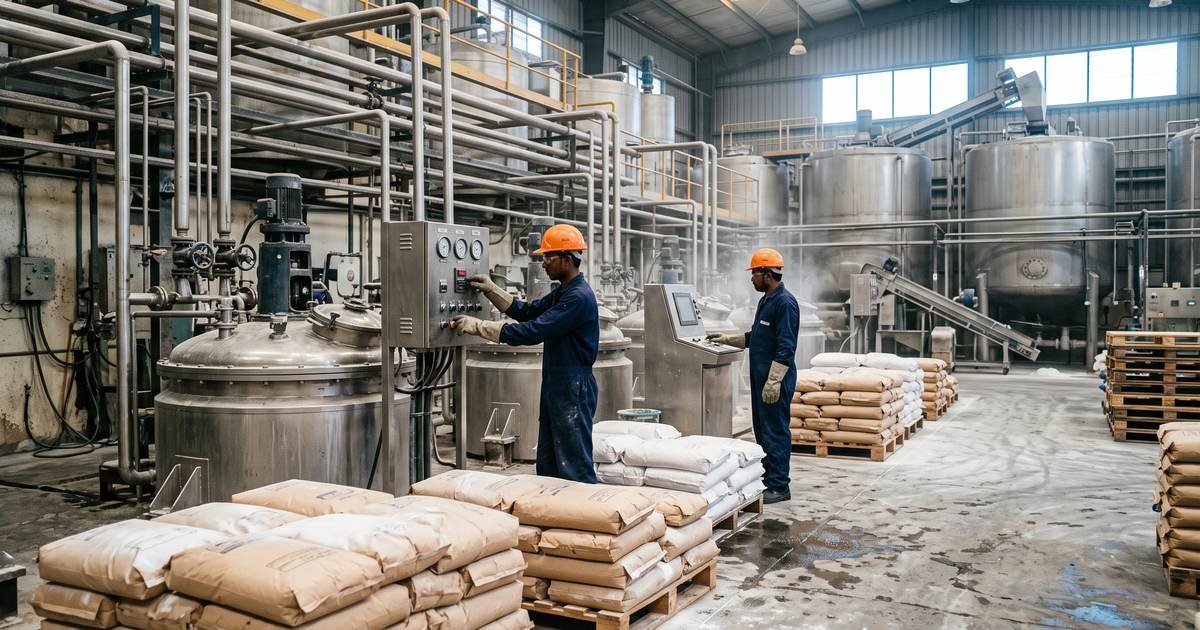
Most specifiers never see where their road marking material comes from, and manufacturers of thermoplastic paints rarely open the doors. That is a shame, because almost every property you will later argue about on site is fixed inside the plant. Binder grade, pigment loading, bead content and batch consistency are all decided long before a kettle is lit. This article walks through what actually happens in production and what it means for the material arriving at your works.
Key Takeaways
- Thermoplastic is manufactured as a dry blend. There is no solvent, so formulation controls performance almost entirely.
- Batch records tie a delivered pallet back to specific raw materials and test results, which is the basis of any real warranty claim.
- A trader can supply the same looking product without any ability to explain or repeat what is inside it.
What Actually Goes Into the Batch
A thermoplastic road marking material is a dry blend of four component groups, and the proportions between them decide almost everything about how the finished line behaves.
The binder is a hydrocarbon resin system, often modified with plasticiser and oil to control brittleness at low temperature and softening at high temperature. Filler, usually calcium carbonate or graded quartz sand, makes up the bulk and supplies abrasion resistance. Pigment provides colour, with titanium dioxide doing the work in white formulations and chrome free pigments in yellow. Glass beads are added as intermix so that the material can renew its own night performance as it wears.
For the Gulf market, binder grade is the decision that matters most. It is also the one most easily downgraded without any visible change to the product.
Yellow formulations follow the same structure with a different pigment package. The change sounds trivial and is not, because yellow pigments differ from titanium dioxide in opacity, in cost and in how they age under ultraviolet light. A yellow line will normally carry a lower retroreflectivity target than a white one for exactly this reason, and specifying the same value for both is a common specification error.
Raw Material Intake and Testing
Production quality starts at the gate. Every incoming raw material is sampled and checked against the specification the formulation depends on, and no batch is released into production before those checks pass.
Resin is checked for softening point and colour, because a resin that is off grade will shift the behaviour of the finished material at exactly the temperatures that matter here. Filler is checked for particle size distribution and moisture, since damp filler causes problems in the melt. Pigment is checked for whiteness and consistency, because low pigment loading produces a slightly grey line that will fail a luminance test. Glass beads are checked for roundness and gradation.
Each accepted delivery is logged against a lot number. That number is what later allows a finished pallet to be traced back to the exact materials that went into it.
Storage between intake and production is part of the quality chain and is easy to neglect. Filler and finished material both need to stay dry, because moisture trapped in the product causes foaming and poor flow the moment it reaches kettle temperature on site. A plant that tests raw materials carefully and then stores them badly has gained nothing.
Supplier qualification sits behind all of this. A plant that buys resin from whichever source is cheapest each quarter will produce material that varies from batch to batch, however carefully it tests. Stable supply relationships are unglamorous and they are a large part of why one manufacturer delivers consistent product and another does not.
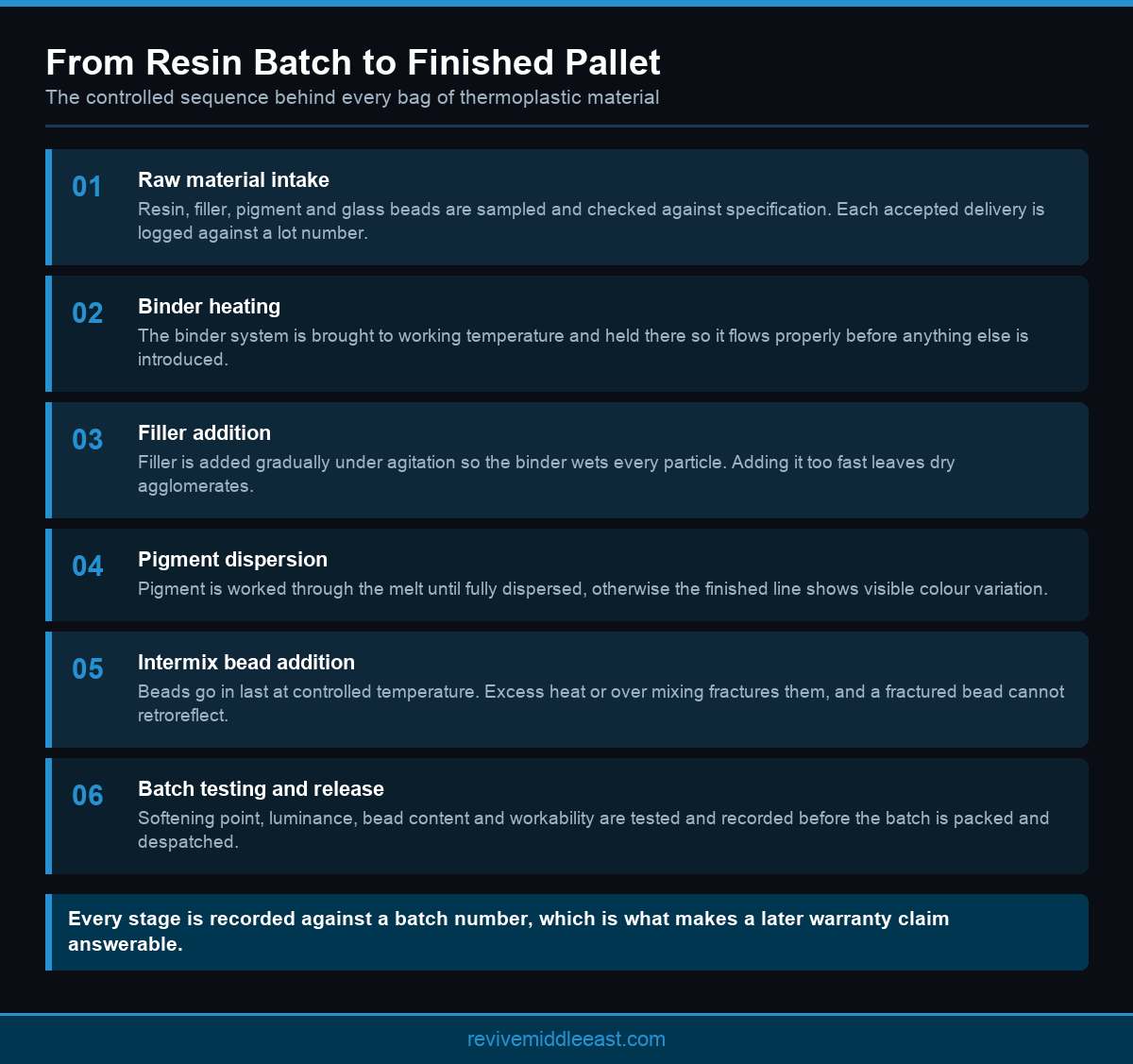
From raw material intake to a traceable pallet leaving the plant
Hot Blending and Why Sequence Matters
Blending is done hot, in a heated mixer, and the order in which materials are introduced changes the result. This is process knowledge rather than recipe knowledge, and it is where experienced manufacturers separate themselves.
The binder is brought up to temperature first and held there so it flows properly. Filler is then introduced gradually under agitation so that the binder fully wets every particle. Adding filler too quickly leaves dry agglomerates that show up later as weak points in the applied line. Pigment follows, and it must be dispersed completely or the finished marking will show colour variation. Intermix beads go in last and at controlled temperature, because excessive heat or over mixing fractures them and a fractured bead does not retroreflect.
Mixing time and temperature are both recorded. Over processing degrades the binder just as surely as under processing leaves it poorly blended.
Temperature control during blending is the other constant. Holding the melt too hot for too long degrades the binder, which shows up later as a line that becomes brittle sooner than it should. Every batch therefore has a time and temperature envelope rather than simply a target, and staying inside it is a matter of process discipline rather than equipment.
This is where experienced manufacturers of thermoplastic paints separate themselves from operations that simply follow a recipe.
Batch Quality Control Before Release
A batch is not finished when the mixer stops. A sample is drawn and tested against the approved formulation before any of it is packed for despatch.
Softening point confirms that the binder system will hold its shape at road surface temperature rather than tracking under traffic. Whiteness or luminance is measured against the target so the material will pass a colour requirement on site. Bead content is verified, since it cannot be checked once the material is packed. Flow and workability are assessed to confirm the material will lay properly through screed or extrusion equipment at normal application temperature.
Results are recorded against the batch number and retained. If a question arises about material performance two years later, this record is the only thing that can answer it.
Retained samples matter as much as the test results. Keeping a physical sample from each batch means a question raised in eighteen months can be answered by testing the original material rather than by argument. It is inexpensive to do and it is one of the clearest signals that a supplier expects to stand behind what it produces.
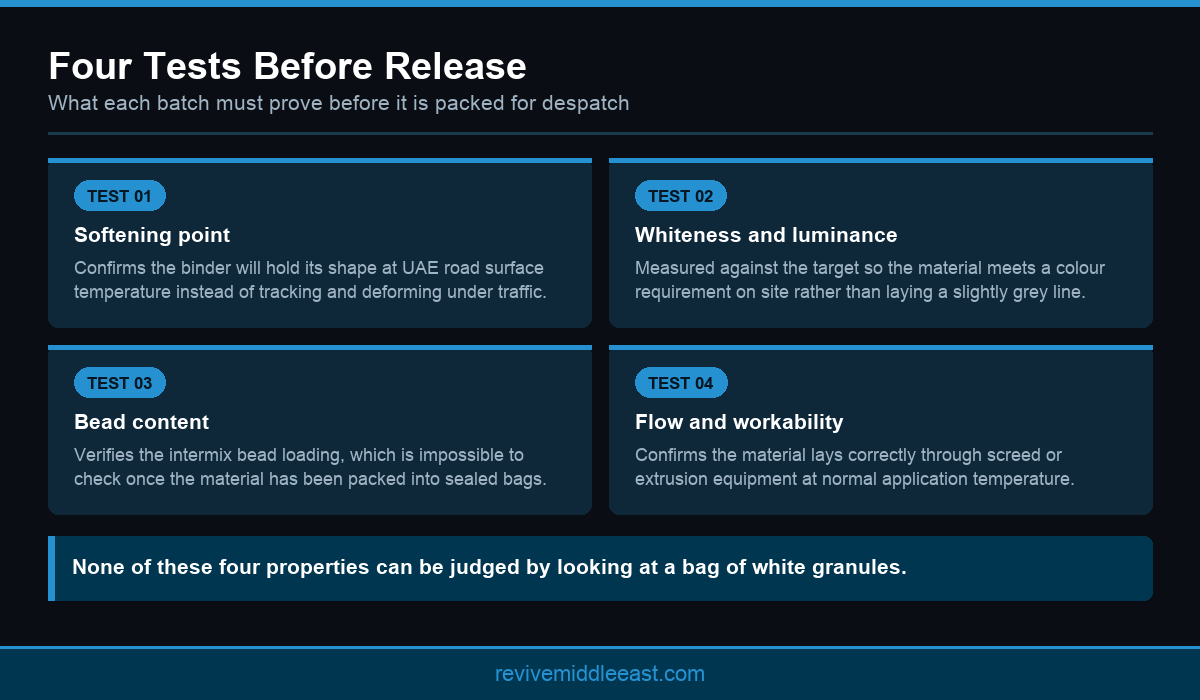
What a batch is tested for before it is allowed to leave the plant
What Traceability Gives You on Site
Traceability sounds like paperwork until something goes wrong, at which point it becomes the difference between a resolved problem and an unresolvable argument.
If a section of marking underperforms, a batch record lets you establish whether the material met specification when it left the plant. That single fact separates a material problem from an application problem, and the two have completely different remedies. It also lets a manufacturer reproduce the same formulation for a later phase of the same road, so that markings installed two years apart still match in colour and performance. A trader buying from whichever source is cheapest that quarter cannot offer either guarantee.
Revive Middle East Paints manufactures thermoplastic material at its plant in Emirates Industrial City, Sharjah, and installs it across the Emirates. You can see the projects we have delivered for context.
There is a second, less obvious benefit for a road authority. Consistent formulation across phases means the network ages predictably, which makes a planned remarking programme possible. When material varies from batch to batch, sections installed in the same month start failing at different times and maintenance becomes reactive. Our overview of traffic management services explains how that planning works in practice.
In short, ask three questions of any supplier. Where was this made, what is in it, and can you make it again next year to the same specification. A manufacturer answers all three from records. A trader can usually answer none of them.
Manufacturers of thermoplastic paints who retain batch records can answer a performance question years later, which a trading intermediary cannot.
Conclusion
Manufacturers of thermoplastic paints decide most of what happens on your road long before the material reaches site. Raw material control, blending discipline and honest batch testing are what make one white granular product behave differently from another that looks identical. When you are buying, ask where the material was made, ask for the batch record, and ask whether the supplier can reproduce the same formulation next year. Get in touch to discuss supply for your project.