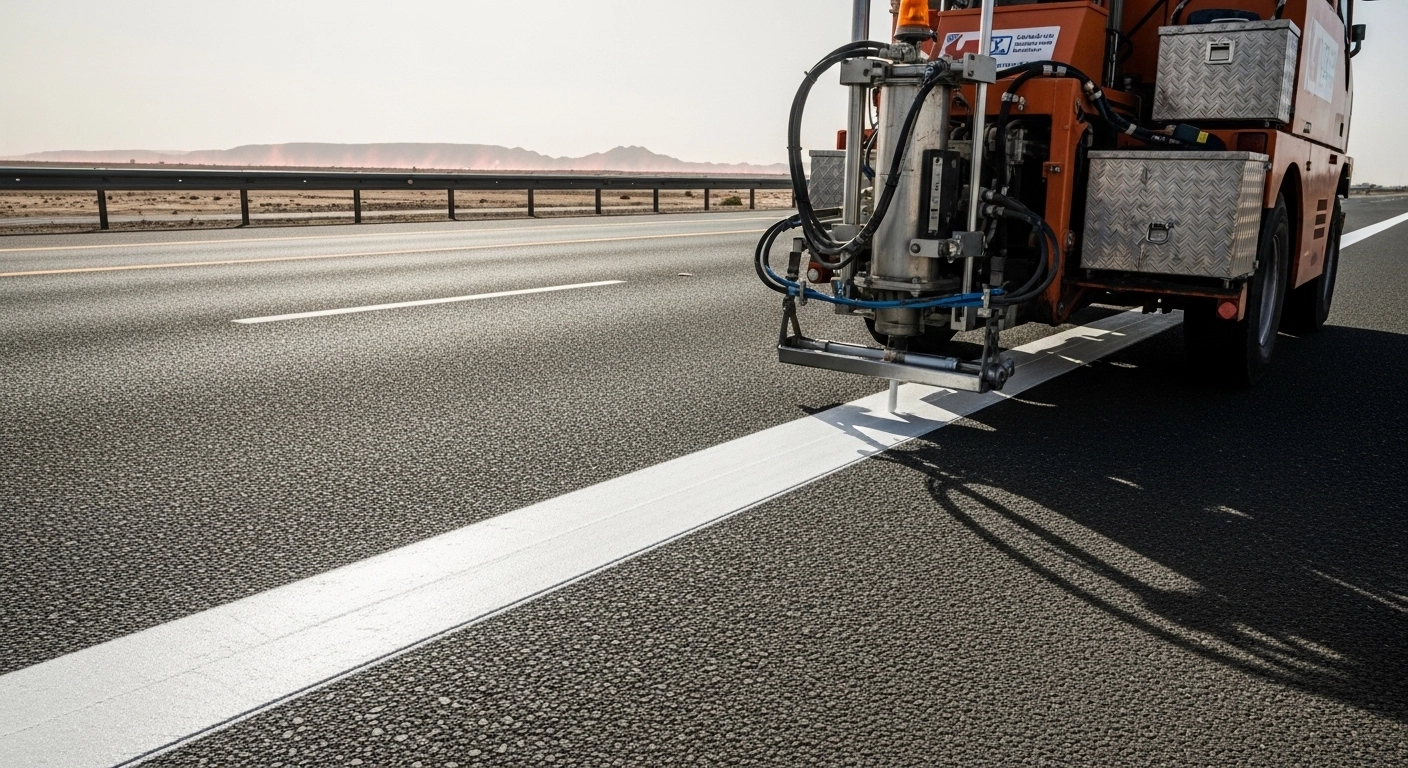

Thermoplastic road markings carry the entire burden of lane discipline on a UAE highway, and they do it in one of the harshest road environments on earth. Surface temperatures on exposed carriageways climb far beyond the conditions this material was first developed for in northern Europe. Wind blown sand scours the line every day. Traffic volumes across the Emirates keep rising. This guide sets out what the material is, how a specification is written, how it is applied, and what separates a marking that holds for five years from one that fails in its first summer.
Key Takeaways
- Thermoplastic is a hot applied material laid at roughly 2 to 3 mm, which is why it outlasts conventional road markings applied as thin paint films.
- Night time performance comes from glass beads, not from the white material itself. Bead quality and embedment depth decide whether the line is visible at 2 am.
- In the UAE, binder grade, surface preparation and application temperature matter more than brand. Most early failures trace back to the substrate, not the material.
What Thermoplastic Road Marking Material Actually Is
A thermoplastic road marking is not paint in any ordinary sense. It arrives on site as a dry granular solid or in block form, it is heated in a kettle until it becomes a workable melt, and it is laid onto the road while hot. It then cools and solidifies in well under three minutes. Nothing evaporates. There is no solvent flashing off and no water leaving the film, which is why the applied thickness is almost the same as the thickness you specified.
The binder system
The binder is the part that holds everything together and bonds the line to the road. Most road grade material uses a hydrocarbon resin, sometimes modified with a plasticiser and a small amount of oil to control brittleness. Binder grade is the single most important choice for Gulf conditions. A binder formulated for a temperate climate softens at UAE surface temperatures, which allows the line to pick up tyre rubber, deform under braking and track in slow moving lanes. A correctly graded binder holds its shape through the summer and still resists cracking when the surface cools sharply at night.
Fillers, pigment and beads
Filler is usually calcium carbonate or a graded quartz sand, and it makes up the bulk of the material. It provides body, abrasion resistance and much of the surface texture. Titanium dioxide provides the whiteness, and the amount used has a direct effect on both daytime contrast and cost. Chrome free yellow pigments handle the yellow lines. Glass beads are then present in two places at once. Intermix beads are blended through the material so that fresh reflective surfaces are exposed as the line wears down. Drop on beads are applied to the hot surface immediately behind the applicator, and they provide the reflectivity you get on day one.
The proportions between these four groups are what separate one white granular product from another that looks identical in the bag. A high filler loading lowers cost and raises abrasion resistance, but taken too far it produces a brittle line that chips at the edges. A generous binder content improves flexibility and adhesion but softens the material in heat. Every formulation is a balance between those pressures, and the balance that suits a European winter is not the balance that suits a Sharjah summer.
In short, thermoplastic road markings are a manufactured system rather than a coating, and the proportions inside that system decide how the finished line behaves on the road.
Why the UAE Climate Changes the Specification
A specification copied from a European standard without adjustment will underperform here, and the reason is straightforward. Air temperature is not the number that matters. Dark asphalt absorbs solar radiation and runs far hotter than the air above it. On an exposed carriageway in July the road surface can sit well above 60 degrees Celsius for hours. Every property of the marking is being tested at that temperature, not at the 45 degrees showing on a weather station.
Sand adds a second load that temperate specifications never anticipate. Fine wind blown particles act as a continuous abrasive across the line surface. They also bury beads, which reduces reflectivity long before the material itself has worn away. On desert routes the abrasive load is severe enough to shorten service life by years compared with a sheltered urban road carrying similar traffic.
Humidity along the coast introduces a third factor. Overnight condensation leaves a film of moisture on the road surface that is not always visible at first light. Applying hot material over that moisture traps steam at the interface and destroys the bond. This is one of several reasons why marking crews in the Emirates plan their working windows around substrate condition rather than around the clock. We cover the failure mechanisms in detail in our guide to why road markings fade early in the UAE.
There is a fourth factor that is easy to overlook. Most marking work in the Emirates happens at night, because daytime surface temperatures make application impractical and because closures are easier to obtain after dark. That pushes the whole operation into a window where the surface is cooling rapidly, humidity is rising and light is artificial. A specification that assumes daytime working conditions is describing a job that will not actually take place.
Getting binder grade right is what allows thermoplastic road markings to hold their specification through a Gulf summer rather than merely surviving it.
How Thermoplastic Compares With Other Marking Materials
Three material families dominate permanent road marking work. Cold applied paint is a thin wet film, typically laid between 0.3 and 0.5 mm. It is cheap, it is fast, and on a high volume carriageway in this climate it is often gone within a year. It still has a proper role in car parks, in temporary layouts and anywhere the marking is expected to change.
Thermoplastic sits in the middle on cost and at the top on value for most road applications. At 2 to 3 mm it carries enough material to survive years of traffic, and its surface texture holds beads well. It sets fast enough to reopen a lane within minutes, which matters enormously when the works are running inside a night time closure.
Methyl methacrylate cold plastic is the premium option. It cures by chemical reaction rather than by cooling, it bonds exceptionally well, and it performs on concrete where thermoplastic can struggle. It also costs considerably more and demands careful mixing on site. Most schemes use it selectively, on high stress areas such as roundabout approaches and pedestrian crossings, rather than across the whole layout. Our detailed comparison of the three materials works through the decision by traffic volume and substrate.
Preformed thermoplastic sits slightly outside this comparison but deserves a mention. It arrives as a cut sheet, already shaped into an arrow, a symbol or a legend, and it is bonded to the road with a heat torch. It costs more per square metre than laid thermoplastic and it is far quicker to install, which makes it useful for symbols inside very short closures and for repairs to individual markings without mobilising a full crew.
Whichever family is selected, the same rule holds. The material is only ever as good as the surface it is bonded to, and no formulation compensates for a road that was not properly prepared before the crew arrived.
Set against the alternatives, thermoplastic road markings remain the practical default for permanent work on a public carriageway in this region.
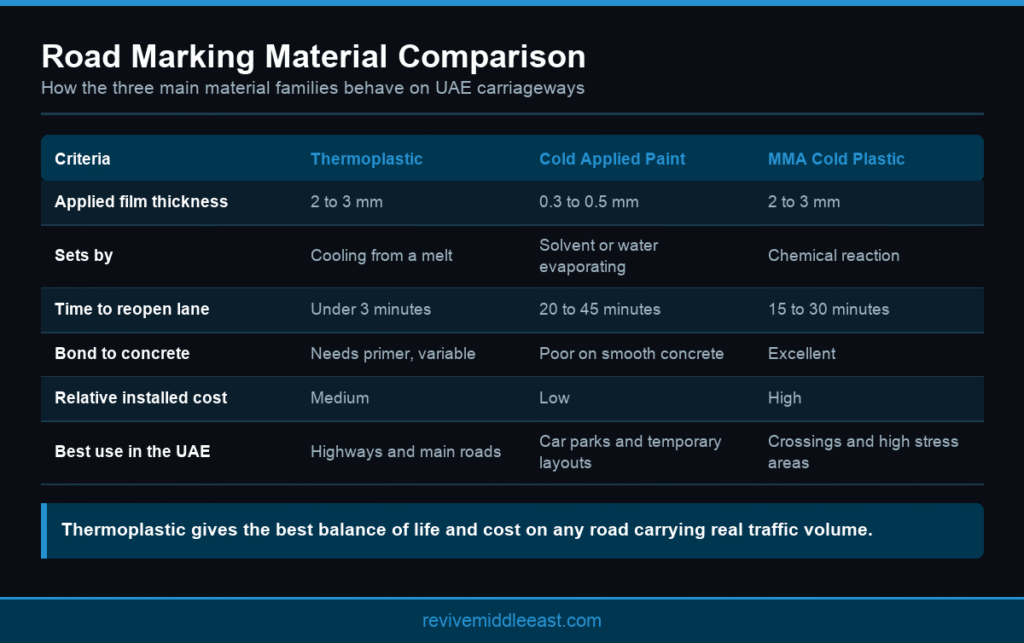
How the three main road marking material families compare on UAE carriageways [Alt: Infographic comparing thermoplastic road markings, cold applied paint and MMA cold plastic across service life, thickness, set time and cost] | File: infographic-1-material-comparison.png
Reading a Road Marking Specification Line by Line
A specification that only says thermoplastic to approved standard is not a specification. It gives the applicator no obligation and gives you no basis for rejection. Four numbers carry most of the weight.
Applied film thickness
Thickness is measured on the wet line as it is laid, using a comb or a wet film gauge. Screed and extrusion applications normally sit between 2 and 3 mm. Spray applied thermoplastic is thinner by design. Specifying a thickness without specifying the application method invites confusion, because the two are linked. Thickness is also the number most commonly cut when a contractor is under price pressure, and a shortfall of half a millimetre is invisible on day one and obvious in year two.
Retroreflectivity
Retroreflectivity is expressed as an RL value in millicandelas per square metre per lux. It describes how much of a headlight beam returns to the driver eye. European practice under BS EN 1436 groups performance into classes, with higher classes demanding higher returned light. Specify both an initial value to be achieved at handover and a minimum value to be maintained through the defects period. Only the second number protects you.
Skid resistance and colour
Skid resistance matters because a wide thermoplastic line at a crossing or a stop bar becomes a slip surface when wet if the texture is wrong. It is measured with a pendulum tester and quoted in British Pendulum Number units. Colour is specified by chromaticity coordinates and luminance factor rather than by eye, so that white actually means white rather than a slightly grey off white that a low pigment formulation would deliver.
Where the numbers get tested
Values written into a specification only bite if the contract says when and how they will be verified. State that wet film thickness will be measured at stated intervals during application, that retroreflectivity will be measured after cure and again before the end of the defects period, and that the records will be issued as part of handover. Without that, every number above becomes an aspiration that nobody is obliged to demonstrate.

The six values that turn a vague marking clause into an enforceable specification [Alt: Infographic showing the six values that must appear in a thermoplastic road markings specification] | File: infographic-2-specification-checklist.png
Glass Beads and Night Time Visibility
Almost everything a driver relies on after dark comes from glass beads, not from the white material underneath. A bead works as a spherical lens. Light from the headlight enters the bead, refracts, reflects off the pigmented material behind it and returns along roughly the path it came from. That behaviour is called retroreflection, and it is the reason a marking looks bright to the driver whose lights are hitting it while looking dull from the roadside.
Embedment depth decides whether this works. A bead pressed too deep into the material has no exposed surface to gather light. A bead sitting on top with almost no material holding it will be swept away by the first week of traffic. The working target is roughly half to sixty per cent of the bead diameter buried in the line. Achieving that depends on the material being at the correct temperature when the beads land on it, which is a matter of application discipline rather than material quality.
Bead specification also covers roundness, refractive index and the presence of a surface treatment that helps the bead bond and shed water. Cheap beads contain a high proportion of irregular and fractured particles that do not retroreflect at all. Our article on glass beads and retroreflectivity explains how these values are measured and maintained on UAE roads.
Wet weather deserves separate thought. A flat marking covered by a film of water loses most of its retroreflection, because the water surface redirects the light away rather than letting it reach the beads. Profiled and ribbed markings raise part of the line above the water film so that some beads stay exposed. On routes where rain is infrequent but heavy, that difference matters more than the annual rainfall figure suggests.
This is why thermoplastic road markings are judged at night with an instrument rather than in daylight by eye.
What Actually Happens on Site
A marking crew spends far more time preparing than marking. The sequence starts with setting out. Control points are established from the approved drawing, chalk lines are struck, and the layout is checked before any material is heated. Correcting a misplaced line after it has cured is expensive and leaves a visible scar on the road.
Surface preparation follows. The road is swept mechanically, and on concrete or aged asphalt it may need blasting to open up the surface. A primer is applied where the substrate demands it. Dust is the enemy at this stage. A thin layer of fine sand acts as a release film between the line and the road, and it produces the classic failure where a whole section of marking lifts cleanly away with no material left behind. Our guide to road marking surface preparation covers this in depth.
Weather and timing govern when the crew can actually work. Substrate temperature has to sit inside the range the material was designed for, the surface has to be dry, and wind matters more than most people expect because it blows sand back across a swept surface and disturbs bead placement behind the applicator. A crew that walks away from a shift because conditions were wrong is protecting the specification, not missing a target.
Material is then heated in a kettle under controlled agitation and transferred to the applicator. Screed application uses a box dragged along the line and suits wide markings and symbols. Extrusion pushes material through a shaped die and gives excellent edge definition on long runs. Spray suits thinner applications over large areas. Beads are dropped immediately behind the applicator while the surface is still receptive. The line is protected until it has cooled, and the lane is then handed back. The three application methods each produce a different film thickness, so the method should be chosen before the specification is finalised.
Traffic management runs alongside all of this and frequently costs more than the marking itself. The closure has to be approved, laid out, staffed and removed within a fixed window, and the marking crew has no control over most of that programme. Sequencing the work so that the crew is never waiting for the closure, and the closure is never waiting for the crew, is where experienced contractors earn their fee.
Applying thermoplastic road markings well is therefore a matter of sequence and timing as much as of material quality.

Approvals, Testing and Handover in the UAE
Road marking work in the Emirates sits inside an approval framework that varies by authority. Works on Dubai roads fall under the Roads and Transport Authority. Abu Dhabi works fall under the Department of Municipalities and Transport, and Sharjah works fall under the Sharjah Roads and Transport Authority. Each has its own registration, submission and inspection expectations. A contractor who is approved in one emirate is not automatically accepted in another, and that is a question worth asking before award rather than after.
Testing usually runs at three points. Material is verified before it comes to site, ideally against a batch certificate that ties the delivered product to a production record. Application is checked live, with wet film thickness readings taken across the run. Performance is measured after the line has cured, with retroreflectivity readings taken along the length rather than at one convenient spot.
Handover documentation is where many packages fall short. Ask for the batch certificates, the thickness records, the retroreflectivity readings with their locations, and a marked up drawing showing what was actually installed. A contractor who manufactures the material as well as installing it can produce that chain of evidence without going back through a trader.
Be explicit about the defects period as well. A marking that meets its initial retroreflectivity at handover and falls below the maintained minimum eight months later has not performed, and the contract should say what happens next. Tie the obligation to a measured value at a stated date rather than to a general undertaking about workmanship, because a general undertaking is very difficult to enforce against a line that still looks white.
Authorities across the Emirates inspect thermoplastic road markings against the approved submission rather than against general good practice.
Whole Life Cost and Knowing When to Remark
Comparing marking options on the rate per square metre alone will almost always select the wrong material. Cold paint wins on that number and loses badly on any horizon longer than a year, because each repaint carries its own traffic management cost. On a live carriageway, closing the lane is frequently more expensive than the material being installed inside it.
The honest comparison divides the total installed cost, including diversion and night working, by the number of years the marking will actually perform. On that basis thermoplastic normally comes out ahead on any road carrying meaningful traffic, and cold paint retains its advantage only where the layout is expected to change.
Deciding when to remark should be driven by measurement rather than by appearance. Retroreflectivity falls long before a line looks worn in daylight, and by the time a marking looks bad to a driver at noon it has usually been performing poorly at night for a considerable time. Road safety research has long linked marking visibility to driver performance in low light, and night time visibility is exactly the condition most UAE drivers meet on intercity routes. A periodic survey with a retroreflectometer, feeding a planned remarking programme, costs far less than reacting to complaints. Our road marking removal and reapplication guide covers how to take the old line off without damaging the surface underneath.
A planned programme also unlocks a saving that reactive maintenance never reaches. Once you know which sections are approaching their threshold, the work can be batched into fewer closures across a wider area. Since the closure is usually the dominant cost, consolidating six small interventions into one planned night reduces the total bill considerably while the markings are still performing rather than already failed.
One further point applies specifically to networks rather than to single schemes. Markings installed across a corridor in one campaign will reach their threshold at roughly the same time, which creates a large and predictable maintenance liability several years out. Recording installation dates alongside condition readings turns that from a surprise into a budget line, and it lets the remarking be phased rather than arriving all at once.
Judged over the life of a road, thermoplastic road markings almost always cost less than repeated cycles of thin paint.
Conclusion
Thermoplastic road markings reward attention to detail and punish shortcuts. The material is well understood, but its performance in the UAE depends on binder grade, on honest film thickness, on bead quality and embedment, and above all on the state of the surface it is laid onto. Specify the numbers that matter, ask for the evidence at handover, and measure performance rather than judging it by eye. Revive Middle East Paints manufactures and installs thermoplastic material from its plant in Sharjah. Talk to our team about your scheme.
Frequently Asked Questions
How long do thermoplastic road markings last in the UAE?
On a well prepared highway surface, a correctly specified thermoplastic line commonly performs for several years. Sand exposure, traffic volume and application quality move that figure considerably in either direction. Measured retroreflectivity, not appearance, should decide when it is replaced.
What is the difference between thermoplastic and normal road paint?
Thermoplastic is applied hot at around 2 to 3 mm and solidifies by cooling. Conventional paint is a thin wet film under half a millimetre that dries by evaporation, so it wears away far more quickly. That thickness gap drives the performance difference.
Why do road markings look bright at night?
Glass beads embedded in the surface return headlight beams toward the driver. The white material itself contributes very little. Once beads are worn or buried, night visibility drops even if the line still looks solid. Bead quality and embedment therefore matter more than whiteness.
Can thermoplastic be applied to concrete?
Yes, but concrete needs a suitable primer and often mechanical preparation first. Without that, adhesion is unreliable. Many specifiers choose cold plastic for concrete surfaces carrying heavy turning loads. Many specifiers choose cold plastic instead where turning loads are heavy on concrete.
What thickness should thermoplastic road markings be?
Screed and extrusion work usually falls between 2 and 3 mm applied thickness. Always state the method alongside the thickness, because spray applied material is thinner by design and cannot meet the same figure. Spray applied material is thinner and cannot meet that figure.
How soon can traffic run over a new thermoplastic line?
The material cools and sets in well under three minutes in most conditions. That fast set is a large part of why it suits night time lane closures on busy UAE roads. Ambient and surface temperature both affect that figure slightly on the day.
Do I need authority approval for road marking works?
Yes. Works on public roads require approval from the relevant authority, and requirements differ across the emirates. Check contractor registration before award. Our road safety contractor guidance explains what to verify. Approval in one emirate does not automatically carry across to another.
What causes new road markings to peel off?
Almost always the surface, not the material. Dust, trapped moisture, oils still leaving fresh asphalt, or a missing primer will all prevent a proper bond and cause the line to lift in sheets. A clean lift means the bond never formed at all.
Are yellow and white markings made from the same material?
The base formulation is the same. Only the pigment differs. Yellow lines use chrome free yellow pigments, and their retroreflectivity targets are generally set lower than those for white. Both share the same binder, filler and glass bead system underneath the pigment.
Who supplies thermoplastic road marking material in the UAE?
Both manufacturers and traders supply the market. A manufacturer can provide batch traceability and formulation control that a trader cannot. See our range of road safety products for what we produce in Sharjah. Ask where it was made and request the batch record.