Road marking surface preparation is the least glamorous part of a marking package and the part that decides whether the line survives. When a new marking lifts away in sheets, the material is almost never at fault. Something was left on the road that stopped the bond forming. This article covers the four preparation failures that cause most adhesion problems in the UAE, and what a competent crew does about each of them before any material is heated.
Key Takeaways
- Most marking failures are substrate failures. A perfect material on a dusty road will still lift away cleanly.
- Trapped moisture is the failure you cannot see, and it is worst in coastal areas after overnight condensation.
- Primer must be matched to the substrate. One primer does not suit both concrete and aged asphalt.
Why Most Marking Failures Are Substrate Failures
There is a simple diagnostic when a marking fails early. Look at the underside of the material that came away, and look at the road it came off.
If the marking lifts cleanly and the road beneath is bare, the bond never formed and the cause is preparation. If material has torn and left fragments keyed into the surface, the bond was sound and the material itself was overloaded or wrongly graded. In practice the first pattern is far more common. A thin layer of dust, a film of moisture or a trace of oil acts as a release layer between the hot material and the road, and no amount of material quality compensates for it.
This matters commercially as well as technically, because the two patterns point to completely different parties and completely different remedies.
There is a third pattern worth recognising. If the marking has lifted and taken a thin layer of the road surface with it, the bond was stronger than the road. That points to a weak or friable surface rather than to preparation or material, and the remedy sits with the surfacing rather than with the marking contractor. Identifying which of the three patterns you are looking at takes about a minute on site and settles most disputes.
Cleaning: Sweeping, Blasting and Dust
Cleaning is where most of the preparation effort goes, and in the UAE it has to deal with a dust load that most specifications were never written for.
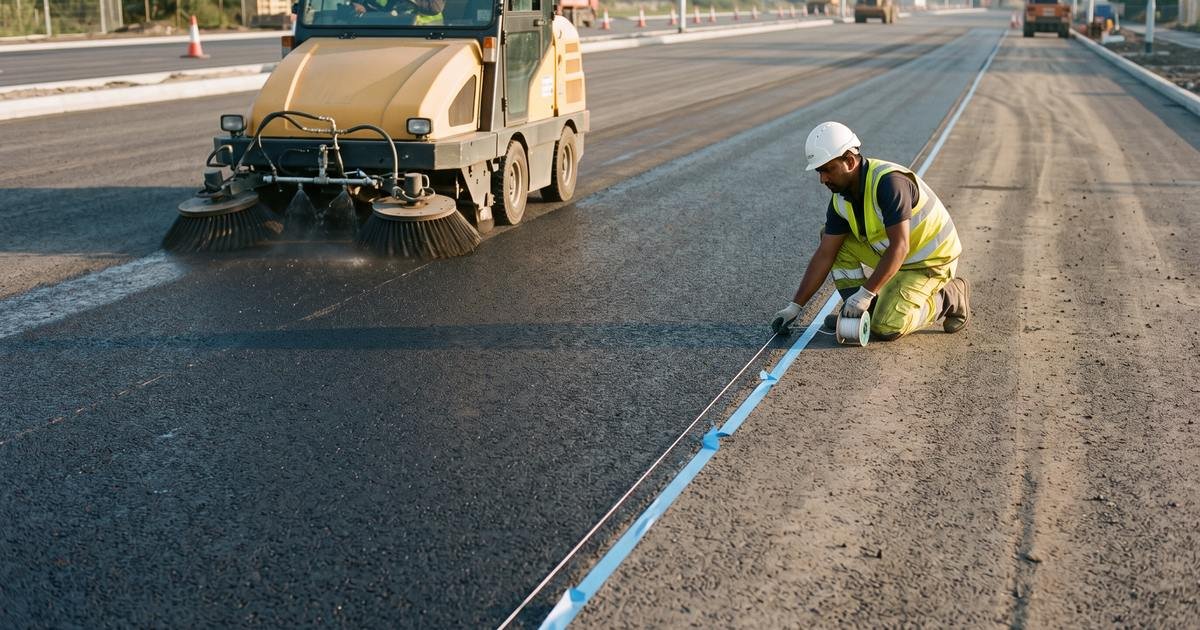
Mechanical sweeping is the baseline and removes loose debris and the bulk of surface sand. It is rarely sufficient on its own for aged surfaces. Where the road is polished, contaminated or carries old marking residue, abrasive blasting or a mechanical sweep with a wire brush opens the surface and restores texture for the material to key into. Compressed air is used for the final pass immediately before application, because sand blown back across a swept surface by wind or by passing traffic will undo the earlier work within minutes.
The practical rule is that the final clean happens as close to application as the sequence allows, not at the start of the shift.
Old marking residue is a category of its own. A previous line that has been partly removed leaves a patchwork of bonded fragments and bare road, and material laid over that will bond well in some places and not at all in others. The result is a line that fails in patches for no visible reason. Where an old marking is being replaced, the removal has effectively become the surface preparation and needs to meet the same standard.
Thorough road marking surface preparation is the cheapest durability improvement available on any marking package.
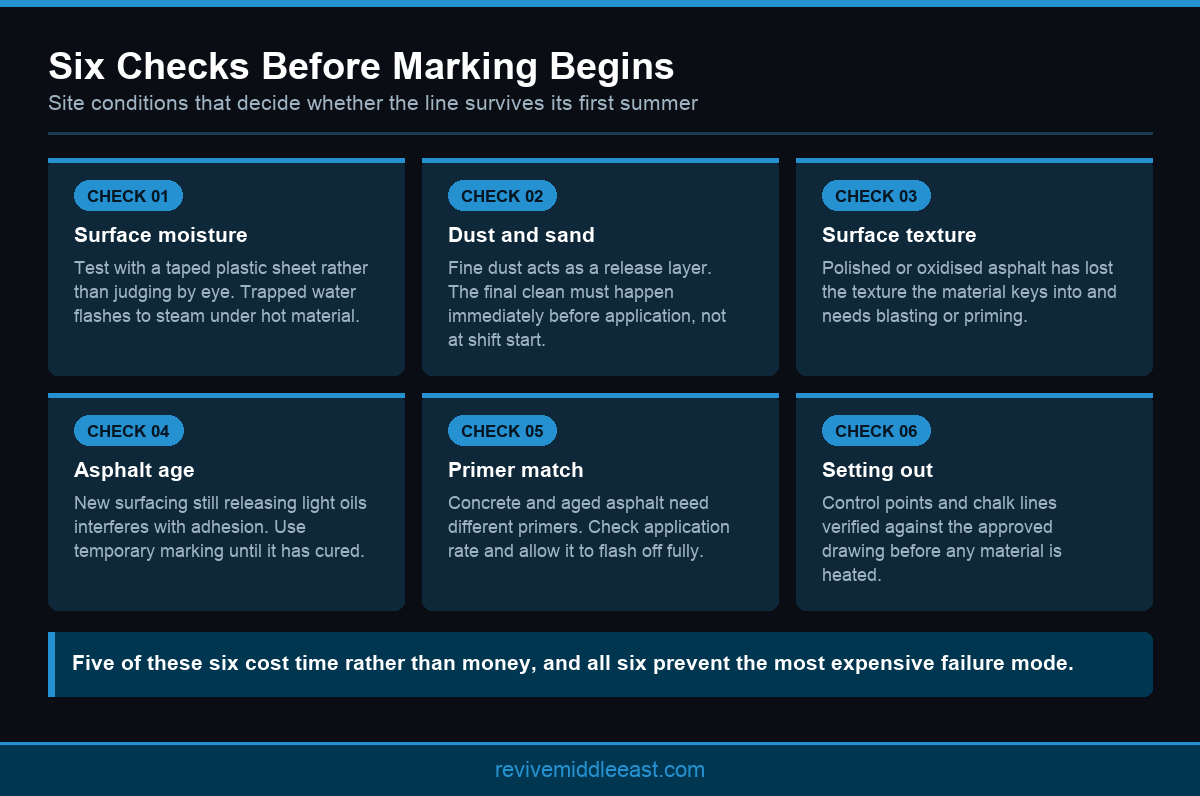
The six checks that decide whether a marking bonds or lifts
Moisture: The Failure You Cannot See
Moisture is the most damaging contaminant precisely because it leaves no trace a supervisor can point to.
When hot thermoplastic is laid over a damp surface, the trapped water flashes instantly to steam at the interface. That steam has nowhere to go and forces the material away from the road as it forms, producing a bond that looks perfect for weeks and then releases under traffic. Coastal humidity across the Emirates makes this a routine risk, because overnight condensation leaves a film on the surface that is often invisible by first light while the substrate is still holding moisture in its texture.
Competent crews test rather than judge. A simple plastic sheet taped down for a short period will reveal moisture rising out of the surface, and the application window is set from that rather than from the appearance of the road.
Timing the working window around moisture is a planning decision rather than a site decision. On coastal routes the surface may not be reliably dry until well into the morning, which conflicts directly with the desire to work at night when the road is cooler and closures are easier. Resolving that conflict sensibly is one of the genuine skills in programming marking work in the Emirates.
New Asphalt and the Curing Question
Freshly laid asphalt presents the opposite problem. The surface looks ideal, clean and textured, but it is still releasing light oils from the bitumen binder.
Those oils migrate to the surface and interfere with adhesion, and they can also soften the marking material from below over time. This is why permanent markings are normally held back for a curing period after surfacing, and why temporary markings are often used in the interim to keep the road operating. The required period depends on mix design, layer thickness and weather, and in Gulf conditions high surface temperatures both accelerate the release of those oils and increase the risk while they are still present.
Where programme pressure makes waiting impossible, the honest answer is a temporary marking followed by permanent work later, not a permanent marking installed early and hoped for.
The same logic applies to newly laid concrete, which holds mix water for far longer than most programmes assume. Concrete surfaces need both a curing period and mechanical removal of the weak surface layer before any marking is considered. Rushing either step produces a line that lifts cleanly within months.
Primer Selection by Substrate
Primer is not a universal product and using the wrong one is close to using none at all.
Sound, textured asphalt in good condition often needs no primer, because thermoplastic keys mechanically into the surface. Aged, polished or oxidised asphalt has lost that texture and benefits from a primer that penetrates and re establishes a bonding layer. Concrete is a different problem entirely. It is smooth, it is chemically distinct, and it usually carries surface laitance that must be removed mechanically first. Concrete needs a primer formulated for it, and even then many specifiers choose cold plastic instead where loading is heavy.
Application rate and drying time both matter. Over applying primer creates a soft layer that fails under the marking, and marking over primer that has not flashed off traps solvent at the interface. Our material comparison guide covers when to change material rather than persist with primer.
A short verification step protects everything above. Before the crew mobilises, walk the section and confirm the substrate is what the specification assumed. Surfaces change between design and construction more often than anyone expects, and a primer chosen for asphalt that turns out to be laid on a concrete apron will fail regardless of how carefully it is applied.
Where preparation is genuinely impossible within the available window, the honest response is to reprogramme rather than to proceed. A marking installed onto a surface that was not ready will fail, and it will fail after the crew has demobilised and the closure has been surrendered. Our road line marking services are sequenced so that preparation and application sit inside the same closure wherever the programme allows it.
Treat road marking surface preparation as a specified activity with its own hold points, not as something the crew fits in before the real work starts.
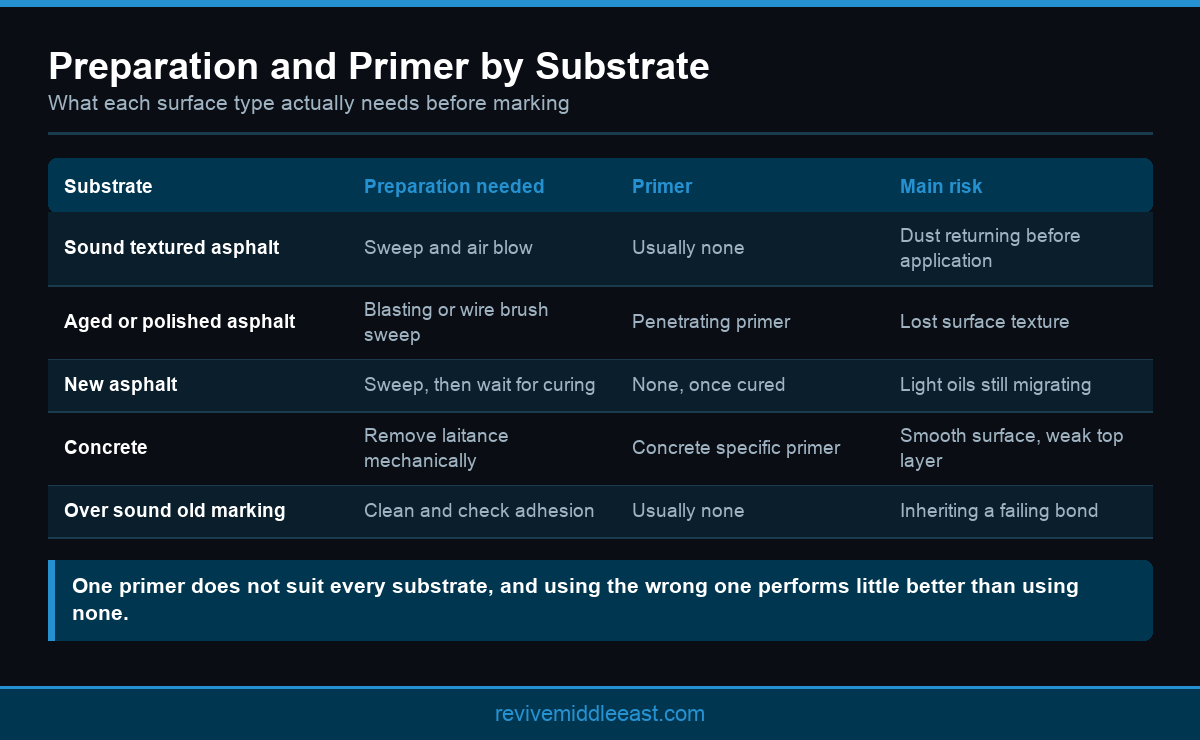
Primer selection and preparation requirement by substrate
Conclusion
Road marking surface preparation costs time rather than money, and it delivers more durability per dirham than any other decision on a marking package. Clean thoroughly and clean late, test for moisture rather than judging it by eye, respect the curing period on new asphalt, and match primer to substrate. Do those four things and the material will do what the specification promised. Speak to our team about preparation requirements on your project.