Choosing a thermoplastic paint road marking over cold applied paint or MMA cold plastic is one of the earliest decisions on a road package, and it is regularly made on price alone. That is a mistake in the UAE, because the three materials behave very differently once surface temperatures climb and sand starts working on the line. This article sets the three families side by side and gives you a way to choose based on traffic volume, substrate and how long the layout needs to last.
Key Takeaways
- Cold paint is the cheapest to install and the most expensive to maintain on any road carrying real traffic.
- Thermoplastic is the default for UAE carriageways because it combines depth of material with a set time short enough for night closures.
- MMA earns its premium on concrete and on high stress areas, not across a whole scheme.
The Three Material Families at a Glance
Permanent road marking in the UAE is dominated by three material families, and they differ in how they set rather than in what they look like. Cold applied paint dries by evaporation. Thermoplastic solidifies by cooling from a melt. MMA cold plastic cures through a chemical reaction between a resin and a hardener.
That difference in setting mechanism drives everything else. A material that dries by evaporation loses most of its wet volume, so a coat laid at half a millimetre wet finishes far thinner. A material that solidifies by cooling loses almost nothing, so specified thickness and delivered thickness stay close. A material that cures chemically forms a bond with the substrate rather than simply sitting on it, which is why it holds on surfaces where the others struggle.
Understanding those three mechanisms is enough to predict most of the performance differences you will see on site. Everything in the sections below follows from them.
One practical consequence is worth stating early. Because cold paint loses most of its wet volume as it dries, the figure quoted in a specification and the figure left on the road are two different things. Thermoplastic and cold plastic both keep almost all of what is laid. When you compare a paint thickness against a thermoplastic thickness you are not comparing like with like, and the gap in delivered material is wider than the numbers suggest.
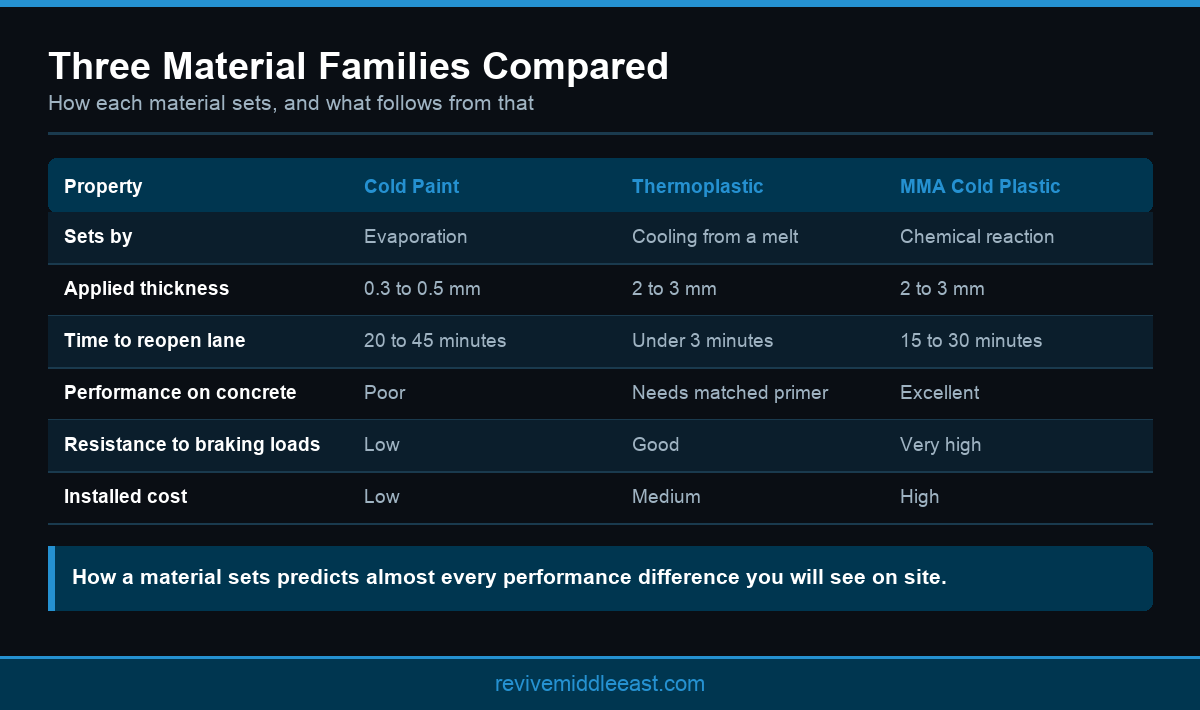
The three material families compared on the properties that decide performance
Cold Applied Paint: Cheap, Fast and Short Lived
Cold applied paint arrives ready to use and goes down through a spray unit at roughly 0.3 to 0.5 mm wet. It is the fastest material to mobilise, it needs the least equipment, and its rate per square metre is unmatched. On a car park or a temporary layout it is often exactly the right answer.
On a trafficked carriageway in this climate the picture changes quickly. Once the solvent or water has left the film there is very little material holding the beads or resisting abrasion. Wind blown sand removes the surface within months, and the line loses night time performance long before it looks worn in daylight. Repainting then carries its own traffic management cost, which is frequently larger than the paint itself.
Cold paint keeps a genuine role wherever the marking is meant to change. Car park bay layouts, phased diversions and trial arrangements all favour a material that is cheap to install and easy to remove.
Removal cost belongs in the comparison too. Thin paint comes off easily, which is exactly why it suits layouts that will change. A thermoplastic line laid in the wrong place has to be taken off with water jetting or blasting, and that work is slower, more expensive and carries a risk of marking the road surface. Our guide to road marking removal covers what each material demands.
Thermoplastic: The Default for UAE Carriageways
Thermoplastic is supplied as a granular solid, heated on site and laid hot at roughly 2 to 3 mm. That depth of material is the whole point. It carries intermix beads through its full thickness, so fresh reflective surfaces keep being exposed as the line wears down.
The second advantage is set time. A thermoplastic line cools and hardens in well under three minutes, which means a lane can be reopened almost immediately. On UAE roads, where most marking work happens inside a night time closure with a fixed handback time, that property is worth as much as the durability. Binder grade still needs attention, because a formulation intended for a temperate climate will soften and track at Gulf surface temperatures.
For highways, main roads, junctions and any layout expected to stay put, thermoplastic is the sensible default. Our complete guide to thermoplastic road markings covers the specification detail behind that choice.
Binder grade is the detail that decides whether thermoplastic performs as intended here, and it never appears on a delivery note. Two bags of white granules from different sources can behave completely differently once the road surface passes 60 degrees. Asking a supplier which grade they are providing, and asking for the batch record that supports it, separates a manufacturer from a trader within about two questions.
For most UAE carriageway work, a thermoplastic paint road marking is the specification that balances installed cost against the number of closures the road will need over its life.
MMA Cold Plastic: Where the Premium Is Justified
Methyl methacrylate cold plastic cures by reaction rather than by cooling or drying. The result is a marking that chemically keys into the surface, resists deformation under braking and turning loads, and performs reliably on concrete where thermoplastic adhesion can be inconsistent.
The trade offs are cost and site discipline. MMA is considerably more expensive per square metre, it must be mixed accurately on site, and it has a working window that punishes delay. It is also unforgiving of poor preparation, although in fairness so is everything else. Most schemes use it selectively rather than universally.
The places it usually earns its price are roundabout approaches, pedestrian crossings, bus stop boxes, concrete aprons and any location where vehicles brake, turn or stand repeatedly on the same piece of marking.
Site discipline is the practical limit on MMA. The resin and hardener must be mixed in the correct proportion and used within a working window that shortens as the temperature rises. In UAE summer conditions that window can be very short indeed, which makes MMA a material for planned, well supervised work rather than for improvised repairs at the end of a shift.
Choosing by Traffic Volume and Substrate
A workable decision rule starts with two questions. How much traffic will cross this marking, and what is it being laid onto. Traffic volume sets the minimum material depth you need. Substrate decides whether adhesion will be straightforward or will need help.
On asphalt carrying heavy traffic, thermoplastic is the working answer, with MMA reserved for the stress points within the same scheme. On concrete, MMA moves from optional to preferred, and thermoplastic needs a properly matched primer and mechanical preparation to compete. On interior floors, in car parks and in any layout that will be revised within a year or two, cold paint is both cheaper and easier to remove later.
One more factor belongs in the decision. If the marking sits inside a live carriageway, set time affects the cost of every future intervention. Choose the material that lets you hand the lane back quickly, and you reduce the cost of every remarking cycle for the life of the road. Our road line marking service page sets out how these choices apply by site type.
Programme should influence the decision as much as engineering does. If the road is due for resurfacing within two years, spending on a marking designed to last six is money that will be milled away. Equally, choosing cold paint on a carriageway that will not be touched for a decade guarantees repeated closures that each cost more than the material being installed. Match the marking life to the surfacing life and most of the decision makes itself.
Where the layout is permanent and the traffic is heavy, a thermoplastic paint road marking remains the sensible default.
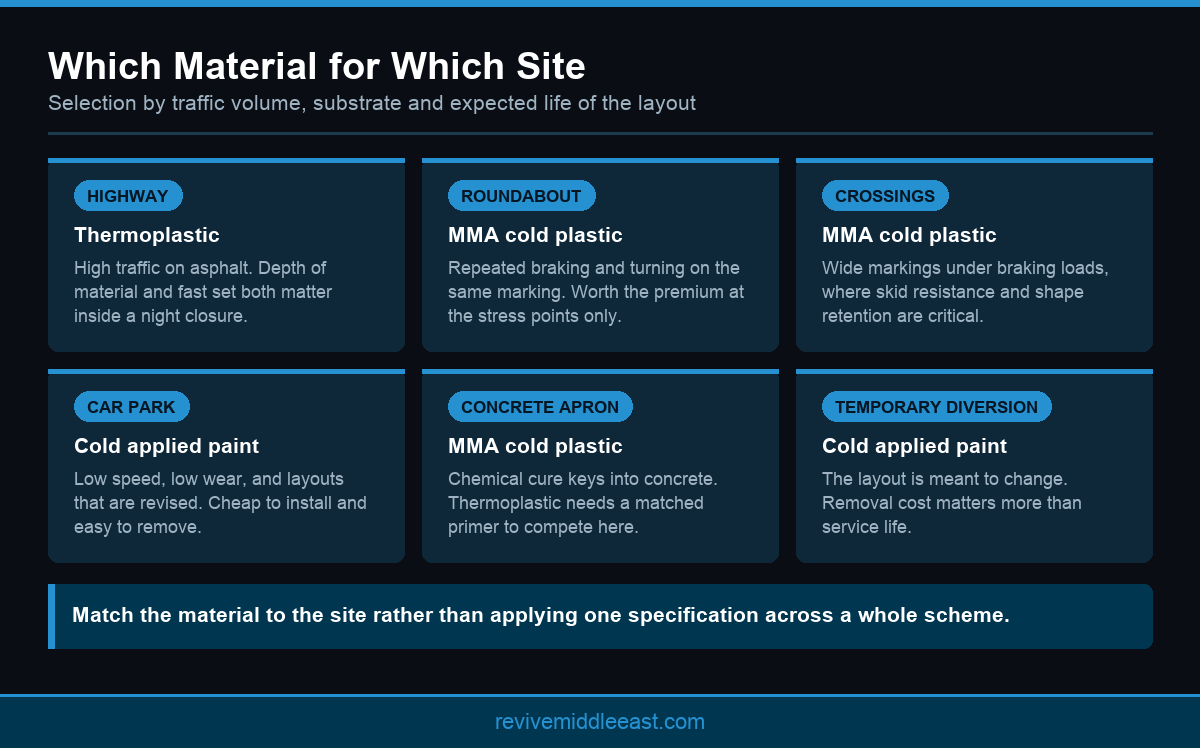
A working selection guide by site type and substrate
Conclusion
There is no single best road marking material, only a best fit for the traffic, the substrate and the intended life of the layout. Cold paint suits temporary and low wear work. A thermoplastic paint road marking suits almost everything on a public carriageway in the UAE. MMA earns its cost at the stress points. Get the match right at specification stage and you avoid the far larger cost of remarking early. Speak to Revive Middle East Paints about the right material for your scheme.