
Every mark on a carriageway is an instruction, and drivers obey them without consciously reading them. Highway line marking works because the vocabulary is consistent: a broken line means one thing everywhere, a continuous line means another, and a hatched area means keep out. This guide takes the elements one at a time, explains what each is telling the driver, and sets out what the specification has to say for the finished line to do its job at night and in its third year rather than only on the day it is laid.
Key Takeaways
- Longitudinal lines carry the lane discipline. Their width, cycle length and colour are what separate guidance from prohibition.
- Hatching and chevrons are not decoration. They allocate space at merges and divergences and reduce the severity of a lane change gone wrong.
- Night performance comes from beads and film thickness, not from the whiteness of the material, so both belong in the specification.
Longitudinal Lines: Lane, Centre and Edge
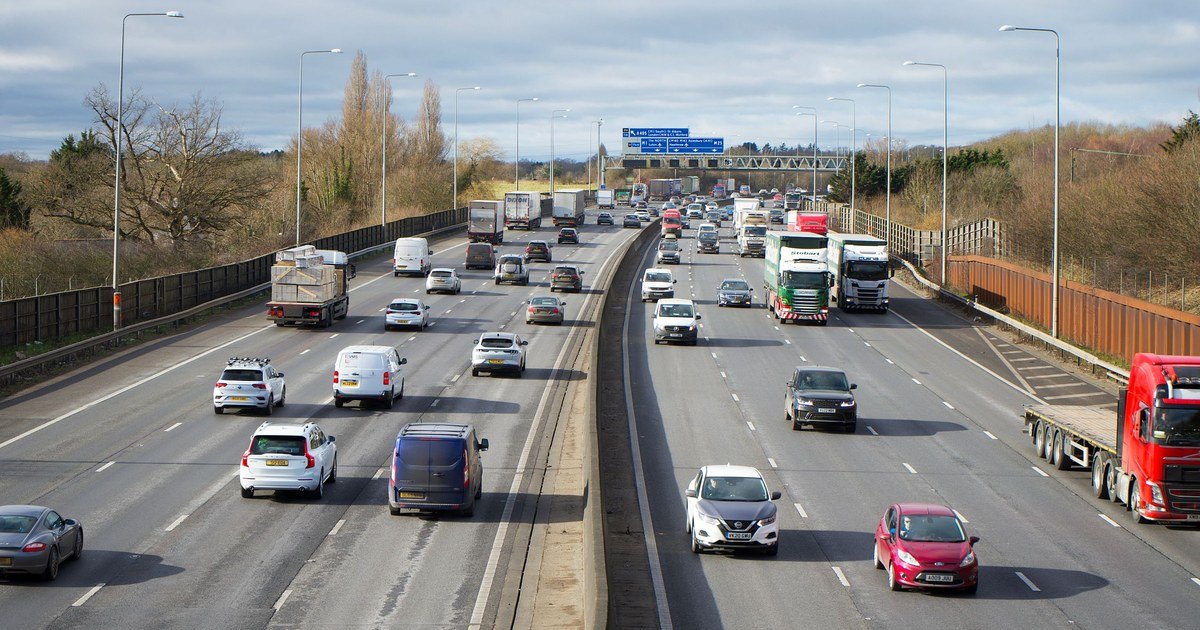
Longitudinal markings run with the direction of travel and do most of the work in any road line marking scheme. A broken lane line separates traffic moving the same way and permits a lane change. A continuous line prohibits it. A double line, or a combination of continuous and broken, sets different permissions for each direction. The cycle length of a broken line matters more than drivers realise, because the ratio of mark to gap communicates urgency: a shorter mark with a longer gap reads as ordinary lane discipline, while a short cycle warns of an approaching hazard.
Edge lines define the usable carriageway and are the element that carries most of the value at night and in poor visibility. On an unlit desert highway an edge line is often the only cue a driver has to the road’s alignment, which is why edge line retroreflectivity is usually specified more tightly than anything else on the road.
Line width is a specification decision rather than a default. Wider lines are more visible at speed and hold more beads, but they consume proportionally more material and cost more per kilometre. The practical answer is to widen where speed and geometry demand it and to keep the standard width elsewhere.
Colour follows convention and should never be improvised. White carries the ordinary lane and edge functions; yellow is reserved for the meanings the local authority assigns to it, commonly restriction or temporary works. Introducing a colour that the local convention does not use creates hesitation exactly where highway line marking is meant to remove it.
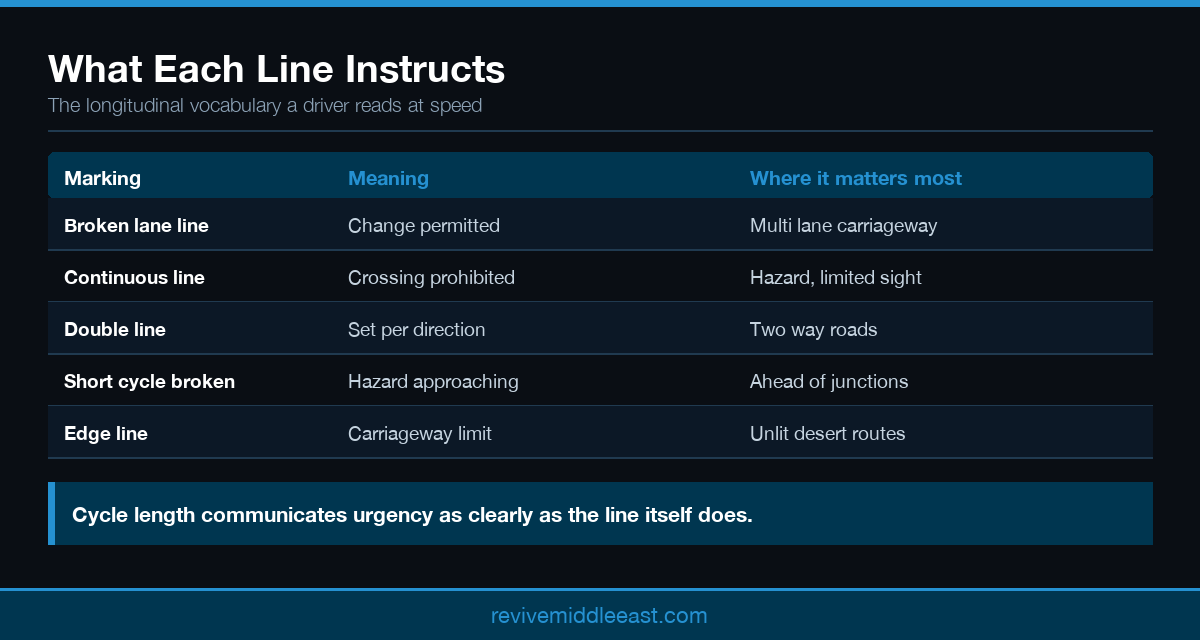
What each longitudinal marking type instructs the driver to do
Transverse Markings and Junction Elements
Transverse markings run across the carriageway and generally require an action rather than describing a permission. Stop lines, give way lines, yield triangles and box junction hatching all sit in this family, and they share a common problem: they are laid exactly where vehicles brake, which is the most punishing loading any marking receives.
That loading has a direct specification consequence. A stop line laid in the same material and thickness as the straight lane line either side of it will wear out several times faster, and the road will look neglected long before the general marking needs attention. Upgrading the material at braking areas is not gold plating, it is matching the specification to the load.
Give way and yield markings need to be legible on approach rather than only from directly above, which affects their proportions. A triangle that reads correctly in plan can be almost invisible at a shallow approach angle, so the drawn dimensions matter and should not be adjusted on site to fit an awkward geometry.
Box junctions and keep clear areas do a job that signage alone cannot. They mark space that must remain available, and their effectiveness depends on the outline being unambiguous and the internal hatching being complete. A partially worn box junction is worse than none, because drivers will treat the space as available.
Chevrons, Hatching and Diverging Areas
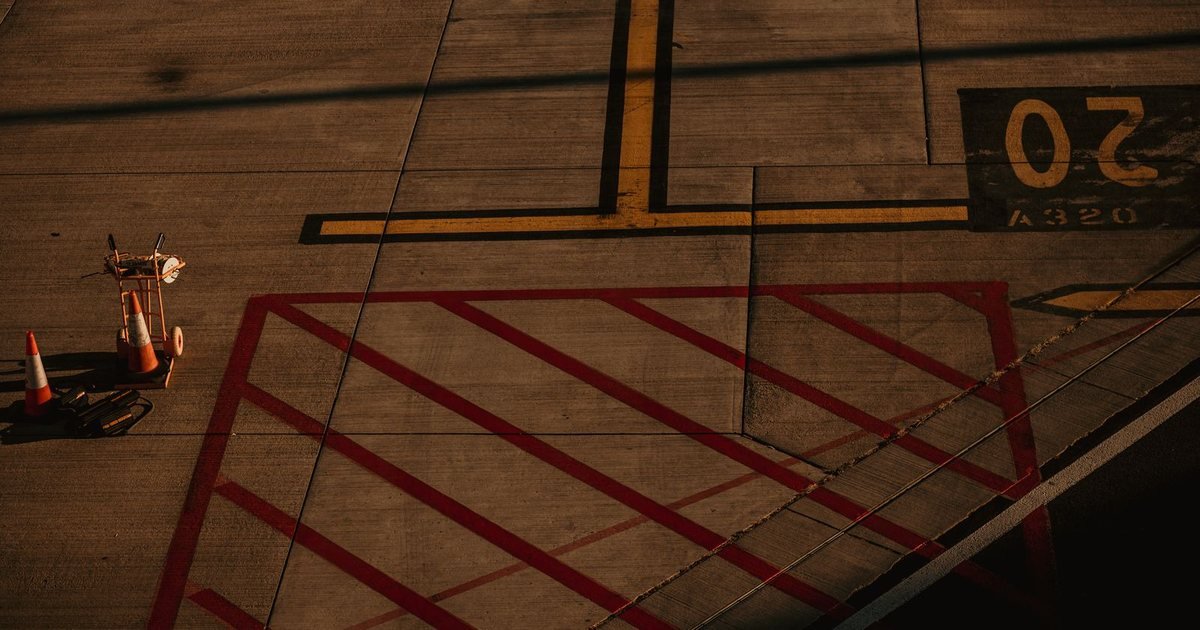
Chevrons and hatched areas appear where traffic streams separate or converge, and they allocate space that no vehicle should occupy. Their real function is to give a driver who misjudges a merge somewhere to go, and to make the geometry of the junction legible at speed rather than only on a plan.
The distinction between the two matters. Hatching bordered by a broken line marks an area a driver may enter if it is safe to do so. Hatching bordered by a continuous line marks an area that must not be entered at all. Getting that border wrong changes the legal meaning of the marking while leaving its appearance almost unchanged, which makes it one of the more consequential drafting errors on a highway drawing.
Chevron angle and spacing are set by approach speed. At higher speeds the chevrons are longer and more widely spaced, because a driver reads the pattern rather than the individual elements. Compressing a high speed chevron layout to fit a shorter available length destroys the effect it was drawn to produce.
These areas are also large, which makes them expensive and makes surface texture relevant. A wide continuous painted area can become slippery when wet, so anti skid aggregate is commonly specified alongside the drop on beads, and it should be stated in the item description rather than assumed.
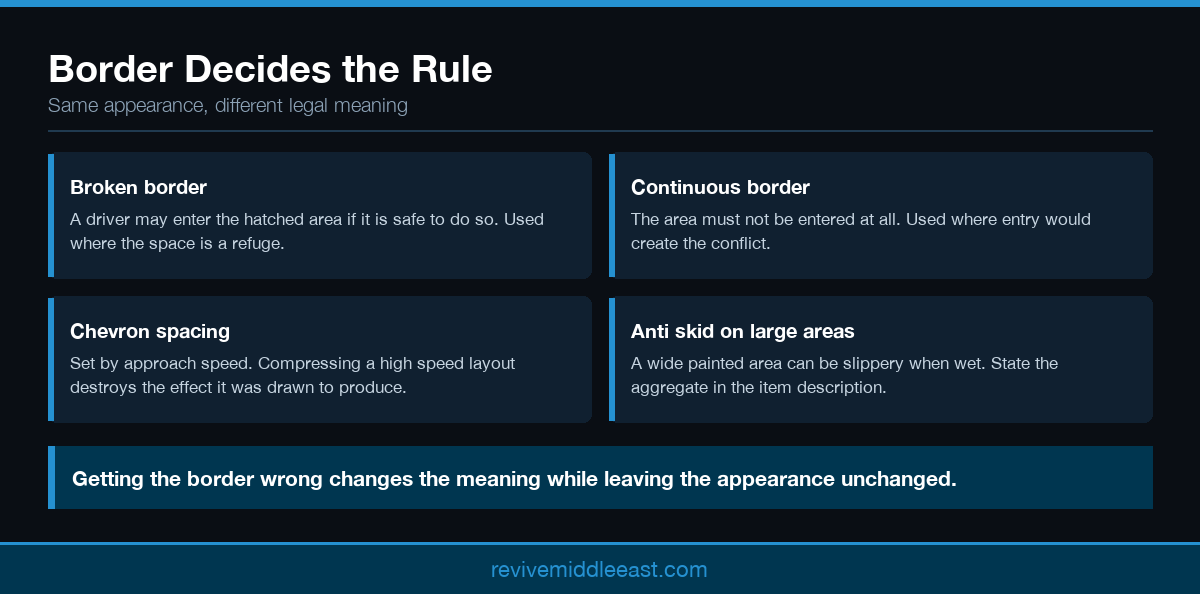
Broken border or continuous border, and what changes
Rumble Strips and Tactile Treatments
A rumble strip works through sound and vibration rather than vision, which makes it the only marking that functions with the driver’s eyes elsewhere. Transverse rumble strips warn of an approaching hazard such as a junction or a speed change. Longitudinal ones warn that a vehicle is drifting out of lane or onto the shoulder, and on long unlit desert routes they address exactly the failure mode that causes the most serious collisions.
There are two ways to build them. Milled or cut rumble strips are formed in the pavement itself and last as long as the surface does. Raised or profiled thermoplastic strips are applied on top and can be laid without touching the pavement structure, which suits retrofitting an existing road. The applied version also carries beads, so it works visually as well as audibly.
Placement needs care. Rumble strips near residential frontage generate noise complaints, and the standard mitigation is to shorten the treated length or move it further from housing rather than to remove it. On the shoulder side, the strip must leave enough clear width for a cyclist or a broken down vehicle.
As a general rule, profiled treatments cost more per metre than flat marking and are worth it only where the specific failure they address is present. Applying them everywhere dilutes the warning and increases maintenance without a matching safety return.
Specifying Highway Marking Properly
A highway marking specification has to state four things before anything else: the material, the applied film thickness, the bead type and drop rate, and the required retroreflectivity at handover. Everything else is dimensional and comes from the drawing. Leaving any of the four open invites a bid that assumed the cheapest version, and the difference will not be visible on the day.
Thermoplastic is the usual answer on UAE carriageways because it combines depth with a set time short enough to reopen a lane quickly, and the reasoning is set out in the comparison of thermoplastic, cold paint and MMA. Where a section takes exceptional braking or turning loads, upgrading that area alone is more economical than upgrading the whole scheme.
Retroreflectivity should be stated as a value to be achieved and verified, not as an adjective. The measurement basis and the classes in BS EN 1436 give a common language for it, and the practical detail of how beads deliver that performance is covered in the guide to glass beads and retroreflectivity.
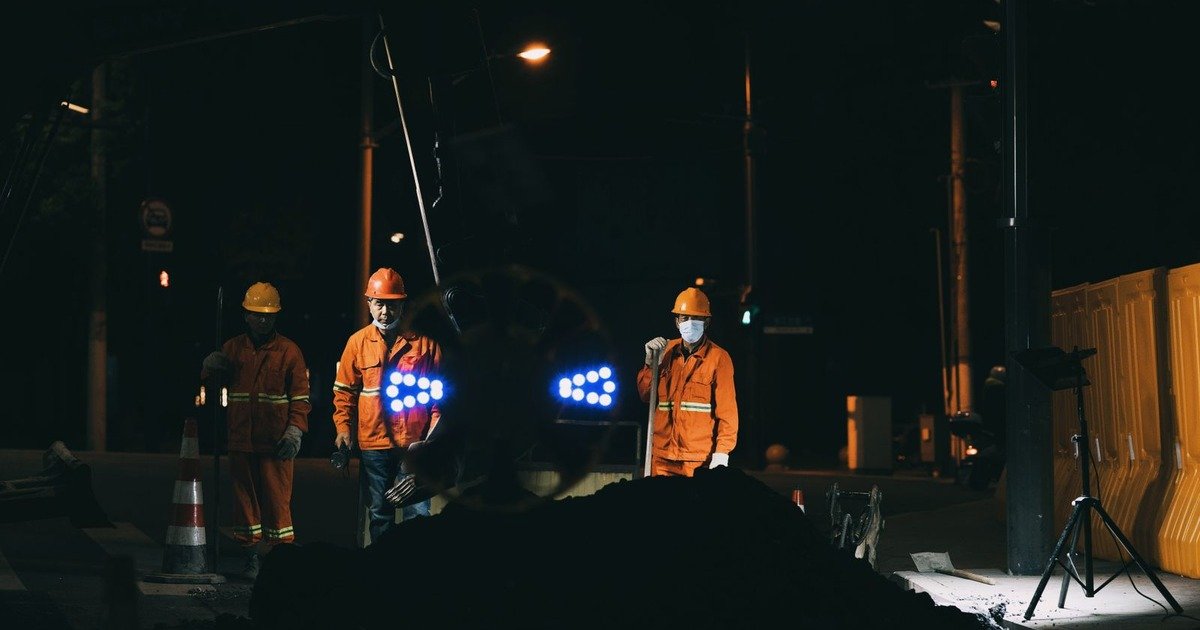
Finally, the specification should say when the work will happen. Most highway line marking in the UAE is laid at night behind an approved closure, and the sequence of that work affects both quality and cost. Planning it deliberately is covered in the guide to night works and lane closures, and the approval that permits it is covered in traffic diversion plan approval.
Conclusion
Highway line marking is a language, and the specification is what keeps it legible. State the material, the thickness, the beads and the retroreflectivity, draw the hatching borders correctly, and upgrade the braking areas rather than the whole road. Do that and the marking will still be doing its job at night in its third year. Revive Middle East Paints manufactures its own thermoplastic in Sharjah and marks highways across the Emirates. Speak to our team about your scheme.