Markings and signs wear out on a schedule nobody can ignore in the UAE. Heat, sand and heavy traffic shorten their life, so owners increasingly buy upkeep as a road marking maintenance contract rather than as a series of one off jobs. This guide explains why markings and signage are often combined, how preventive and corrective scope differ, how rates and measurement work, how repaint cycles link to retroreflectivity, and which response times and KPIs actually improve performance. It is written for road authorities, master developers, free zones and facility managers.
Key Takeaways
- A road marking maintenance contract works best when it combines preventive cycles with clearly priced corrective work.
- Repaint cycles should be triggered by measured retroreflectivity and condition, not by the calendar alone.
- A short list of measurable KPIs with fair response times beats a long list of penalties.
Why Markings and Signs Belong in One Contract
Markings and signs work as a single message to the driver. When one is renewed and the other is not, the message breaks down. Combining them under one road marking maintenance contract gives one team responsibility for both, one inspection regime and one closure for each location.
The scale involved is significant. Dubai’s Roads and Transport Authority describes its 2025 renewal of markings at 89 locations as part of an annual preventive maintenance plan covering line marking and road signage together, with over 30,000 linear metres of markings repainted.
Signage volumes are just as large. The authority reported maintenance on 67,816 traffic and directional signs over six months in 2023. Private networks face the same logic at a smaller scale: communities, industrial estates, ports and logistics parks all have markings and signs that age together.
Combining scope also makes procurement simpler. One tender, one evaluation and one set of insurances replace several, and the owner deals with a single supervisor who knows the whole network rather than a different contact for every trade.
For an owner, the main benefit is predictability. A planned contract turns a stream of unplanned repair requests into a budget line with known rates, known cycles and a single point of accountability, which is far easier to defend in an annual review.
Preventive and Corrective Scope
Preventive work is planned: scheduled inspections, cleaning, repainting on a cycle and replacing signs that have reached the end of their service life. Corrective work is reactive: damaged signs after an impact, markings lost after resurfacing or utility trenching, and urgent safety defects reported by the public or the police.
A good road marking maintenance contract prices both separately. Preventive work is usually a programmed quantity, while corrective work sits in a schedule of rates called off as needed. Mixing them in one lump sum hides the real cost of each and encourages corners to be cut on whichever is less visible.
Define what counts as an emergency, which locations are critical, and what happens to removed signs and old markings. Removal methods matter on concrete and fresh asphalt, so the scope should state the acceptable technique.
Asset boundaries need equal clarity. State which roads, car parks, service lanes and internal estate roads are included, and whether sign posts, foundations and gantries sit inside the scope or with another contractor. Gaps between contracts are where faded markings and leaning signs are left for months.
Coordination with other works should be written in as well. Resurfacing, utility trenching and landscaping all destroy markings or obscure signs, and the contract should say who reinstates them, how quickly and at whose cost.
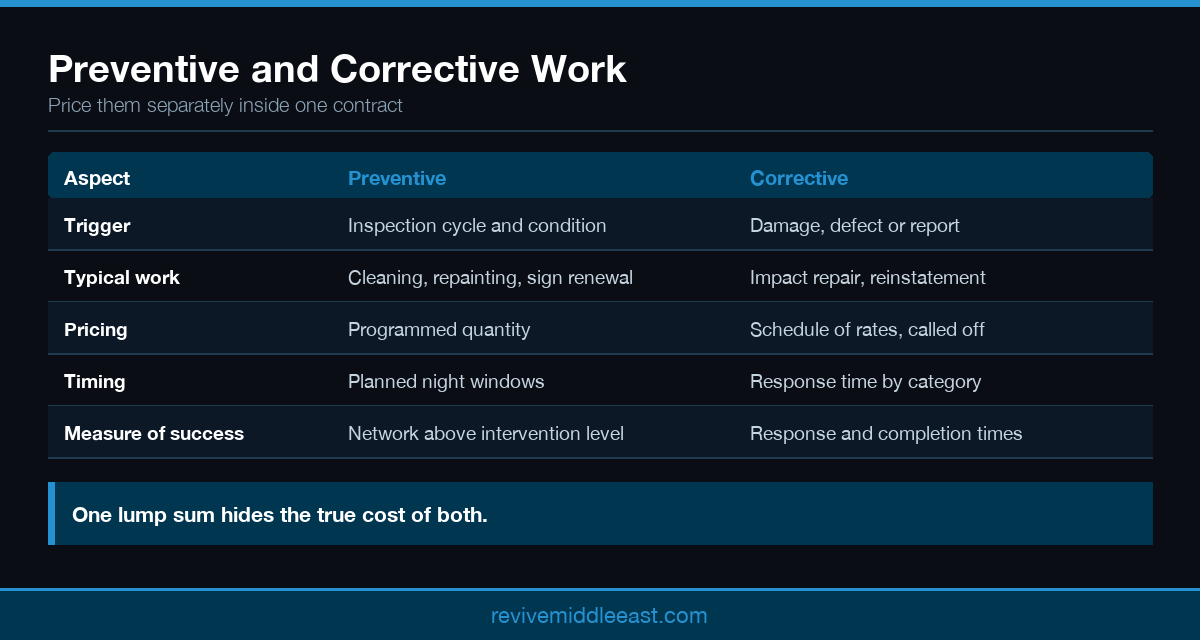
How preventive and corrective work differ inside one contract
Rates, Measurement and Repaint Cycles
Rates should follow how the work is measured: linear metres for lines by width, square metres for symbols, words and hatched areas, and a unit rate per sign by size and type. Each item needs a material specification, film thickness and bead requirement, otherwise bidders price different work. Our breakdown of what drives the rate per square metre explains the variables.
Cycles should be condition led. Measure retroreflectivity and visual condition on a sample of each road type, then repaint when values approach the agreed intervention level. High traffic junctions may need attention long before quiet residential streets.
Material choice changes the cycle. Thicker thermoplastic with good bead retention lasts longer between repaints than thin paint, which is why the cheapest rate can produce the most expensive contract. Our article on why lines wear out early in Gulf conditions explains the failure modes, and our guide to how glass beads build night visibility covers retroreflectivity.
A baseline survey at the start of the contract makes cycles fair. It records the condition, age and retroreflectivity of markings and signs across the network, so both parties agree what was inherited and what the contractor is responsible for improving.
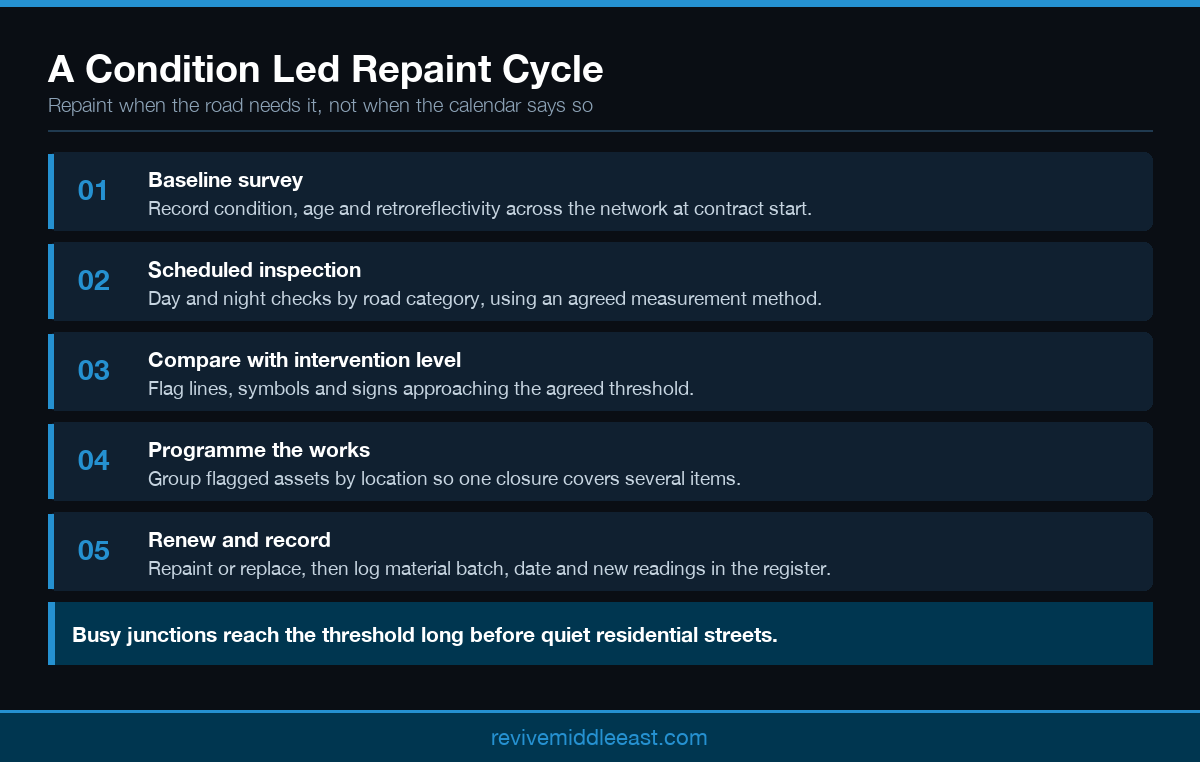
A condition led repaint cycle
Response Times, Night Work and KPIs
Response times should match risk. A missing stop sign or a fallen sign in a live lane needs a response within hours. A faded edge line on a quiet street can wait for the next programmed visit. Spell out categories, response and completion times, and how the clock starts.
Most maintenance on busy roads happens at night under lane closures, which affects productivity and price. Our guide to night possessions and lane closures for marking crews explains how those windows shape a programme.
Keep KPIs few and measurable: percentage of the network above the retroreflectivity intervention level, response times achieved by category, inspection completion and defects reopened within a set period. A service level framework with fair measurement and a joint monthly review usually improves performance more than heavy penalties.
Penalties still have a place for repeated failure, but they should be proportionate and linked to outcomes the contractor controls. Withholding payment for delays caused by a closure the authority refused simply raises future bid prices without improving the road.
Inspection, Records and Renewal of the Contract
Inspection is the heartbeat of any maintenance agreement. Agree the frequency by road category, the method for measuring retroreflectivity and the format of the report, then keep to it. Night drive inspections remain the quickest way to see what drivers see.
Records should be location based. Each line, symbol and sign belongs to a referenced asset, with its material, installation date, last measurement and next planned action. That register lets the owner forecast spending and lets a new contractor take over without starting from zero.
Handover at the end of the term deserves its own clause. The outgoing contractor should return the updated asset register, inspection history and outstanding defect list, and the network should meet the agreed condition levels on the final day. Planning for renewal from the first month avoids the decline that often appears in the last year of a contract.
Digital tools help, but they are not essential. A shared spreadsheet with asset references, photographs and dates does most of the job for a modest network. Larger networks benefit from a mapping based system that lets inspectors log defects on a tablet at the roadside, with the location captured automatically and the repair order raised the same night.
Material traceability belongs in the same record. Note the batch of thermoplastic or the sheeting grade used for each repair, so that early failures can be traced to a material, a crew or a surface condition rather than argued about.
Finally, review the contract each year. Traffic grows, new roads are added and materials improve, so cycles, quantities and KPIs that suited the first year may not suit the third. A short annual workshop between owner and contractor, using the inspection data, is usually enough to reset priorities for the coming year.
Conclusion
A road marking maintenance contract keeps markings and signs working as one system for drivers, provided it separates preventive and corrective work, prices both by clear measurement, links repaint cycles to measured condition and tracks a small set of fair KPIs. Revive Middle East Paints manufactures thermoplastic material and signs and maintains them across the Emirates, so one team can carry the whole scope. See the services we deliver across the Emirates or talk to our team about a maintenance programme.
Frequently Asked Questions
What is a road marking maintenance contract?
It is an agreement under which a contractor inspects, repaints and repairs road markings, often together with signs, over a set period. It usually combines a programmed preventive scope with corrective work priced through a schedule of rates.
Why combine road markings and signage in one contract?
Drivers read markings and signs together, so renewing one without the other breaks the message. One contractor gives single responsibility, one inspection regime and fewer lane closures, which lowers both the safety risk and the overall cost.
How often should road markings be repainted in the UAE?
It depends on traffic, material and exposure. Busy junctions may need renewal far sooner than quiet residential streets. Best practice is to repaint when measured retroreflectivity and visual condition approach an agreed intervention level for that road.
How are maintenance works measured and paid?
Lines are normally measured in linear metres by width, symbols and hatched areas in square metres, and signs per unit by size and type. Each rate should state material, thickness and bead specification so bids are comparable.
What KPIs work for marking and signage maintenance?
Useful KPIs include the share of the network above the retroreflectivity intervention level, response times achieved by category, inspections completed on schedule and defects reopened. Keep them few, measurable and reviewed jointly by both parties each month.
What response times are reasonable?
Critical safety defects such as missing regulatory signs need a response within hours. Routine wear can be handled at the next programmed visit. The contract should define categories, response and completion times and when the clock starts.
Does sign sheeting grade affect maintenance cycles?
Yes. Higher grade sheeting keeps its retroreflectivity for longer and reduces how often signs must be replaced. Our guide to choosing sheeting grades for night visibility explains how grade, approach speed and street lighting interact.
Can one company supply and maintain both signs and markings?
Yes, and it reduces interface risk between trades. Revive manufactures thermoplastic material and fabricates signs, so one team can maintain both. Browse our sign product range to see the types we produce, install and maintain.
Who uses a road marking maintenance contract?
Road authorities, master developers, free zones, ports, industrial estates and large facility owners all use them. Any network where markings and signs age together benefits from planned, condition led maintenance rather than one off repairs.