
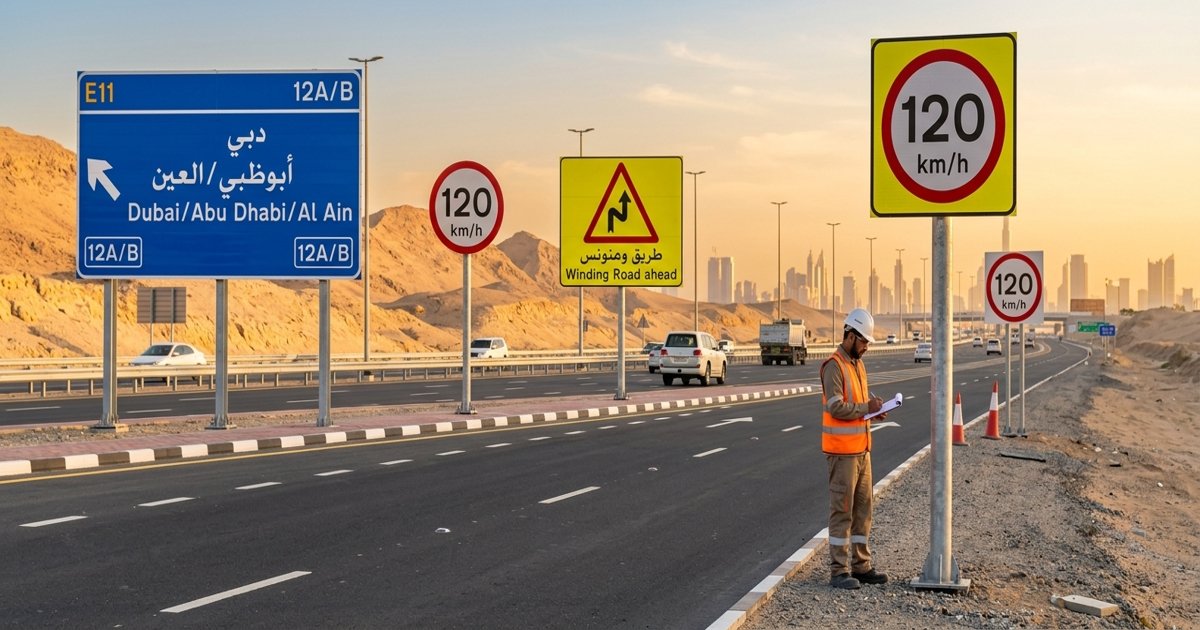
Traffic signs are the backbone of organized road infrastructure. Whether you are managing a highway project or an urban development, installing road traffic signs correctly is not optional. It is a critical safety requirement. Poor installation leads to driver confusion, non-compliance with regulations, and increased accident risk. In this blog, we cover the most important factors every project manager, contractor, and road authority must consider to ensure road signage serves its purpose effectively and meets UAE standards.
Key Takeaways
- Traffic signs must be placed at correct heights, angles, and positions to ensure maximum visibility, and material quality directly affects how long road traffic signs remain effective in the field.
- Compliance with UAE road authority regulations is mandatory for all road signage installation projects, and pre-installation site assessments reduce costly errors.
Why Correct Traffic Sign Installation Matters
Proper installation of traffic signs is not merely a construction formality. It is a direct contributor to public safety. A sign placed too low, at the wrong angle, or with poor reflective quality can fail to communicate the right information at the right moment. This creates dangerous situations for drivers, cyclists, and pedestrians alike.
According to the World Health Organization, road traffic injuries remain a leading global cause of death, with infrastructure quality playing a significant role. In the UAE, road authorities enforce strict standards to minimize these risks. Understanding those standards begins with the installation process itself.
At Revive Middle East, we manufacture and supply traffic management products that meet UAE compliance requirements. Getting installation right is part of the service we stand by.
Site Assessment Before Installing Road Traffic Signs
A thorough site assessment is the foundation of every successful road traffic sign installation project. Skipping this step leads to misplaced signs, inadequate visibility, and costly corrections after the fact.
During a site assessment, professionals evaluate the following:
- Road geometry, including curves, slopes, and intersections
- Existing vegetation or structures that may cause obstructions
- Speed limits and sight distance requirements
- Proximity to other signs to avoid information overload
- Ground conditions for pole or mounting foundation work
Each of these factors determines where a sign should be placed, how high it should be mounted, and what type of mounting hardware is appropriate. For example, on high-speed roads, traffic signs must be positioned further in advance of a decision point to give drivers adequate reaction time. On urban roads with lower speeds, placement requirements differ significantly.
A well-documented site assessment also creates a record that helps maintenance teams inspect and replace signs efficiently over time. Learn more about how proper planning supports road infrastructure on our road safety blog.
Material Selection and Sign Durability Standards
Choosing Durable Materials for Traffic Signs
The materials used in road signage directly determine how long a sign remains functional and legible in the field. In the UAE, where temperatures regularly exceed 40 degrees Celsius and sandstorms are common, material quality is especially critical.
Key material considerations include:
- Substrate material: Aluminum is the most widely used material for traffic signs due to its lightweight nature, corrosion resistance, and dimensional stability.
- Retroreflective sheeting: This is the material applied to the sign face to reflect headlight beams back to drivers at night. Higher grades of retroreflective sheeting extend nighttime visibility significantly.
- UV-resistant coatings: These protect sign colors and text from fading under intense solar radiation.
- Anti-corrosion treatments: These are essential for posts and brackets exposed to humidity or coastal environments.
Retroreflectivity is particularly important. The Federal Highway Administration outlines minimum retroreflectivity standards that serve as a global reference point for sign visibility at night. UAE-compliant projects follow similarly rigorous standards to ensure drivers can read road traffic signs in all lighting conditions.
Using substandard materials may reduce upfront costs but results in premature sign failure, replacement expenses, and potential liability. Investing in quality materials from the start is always the smarter infrastructure decision. Explore the full range of compliant products available at Revive Middle East products.
Placement Height and Positioning Guidelines for Road Signage
Positioning Traffic Signs for Maximum Driver Visibility
Even the highest quality traffic sign will fail if it is not positioned correctly. Height, lateral placement, and orientation are all governed by road authority standards and must be followed precisely.
Standard placement guidelines cover the following key dimensions:
- Mounting height: For most roadside installations, the bottom of the sign should be a minimum of 2.1 meters above the ground on urban roads. On rural or high-speed roads, this may increase to 2.4 meters or more.
- Lateral clearance: Signs must be placed at a safe lateral distance from the travel lane edge to protect road workers during maintenance and to avoid vehicle strike damage.
- Sign face angle: The sign face should be angled very slightly away from perpendicular to reduce glare caused by retroreflective materials under headlights.
- Overhead sign clearance: Gantry-mounted or overhead road traffic signs require a minimum vertical clearance above the roadway to accommodate large vehicles safely.
These are not suggestions. They are engineering requirements that protect both drivers and infrastructure workers. Deviating from them, even slightly, can result in a sign that is either too difficult to read or creates a hazard of its own. Projects should always reference the current UAE road marking and signage standards applicable to the specific road classification.
Regulatory Compliance and Authority Approvals
In the UAE, all road traffic sign installations must comply with the relevant federal and emirate-level road authority standards. This includes obtaining proper approvals before installation begins, using approved sign designs, and following submission processes that document every aspect of the planned work.
The key compliance considerations include:
- Conformance with UAE standard sign designs and colors as mandated by the relevant transport authority
- Use of approved retroreflective materials that meet specified performance grades
- Submission of traffic management plans for works on public roads
- Post-installation inspections and sign-off from road authorities
- Ongoing maintenance obligations to keep road signage legible and undamaged
Non-compliance exposes project owners and contractors to enforcement action, project delays, and potential legal liability if an incident occurs involving a non-compliant sign. Working with an experienced traffic management manufacturer and installer reduces this risk significantly.
For contractors and developers seeking professional guidance on compliance, our team at Revive Middle East provides end-to-end support from manufacturing to installation. You can reach our specialists through the contact us page for project consultations.
Maintenance Planning After Road Traffic Sign Installation
Keeping Traffic Signs Compliant Throughout Their Service Life
Installation is only the beginning. A traffic sign maintenance program is essential to ensure signs remain effective throughout their service life. In the UAE, environmental conditions accelerate wear and require more frequent inspection cycles than in milder climates.
A sound maintenance plan should include:
- Regular visual inspections to identify physical damage, fading, or obstructions caused by vegetation growth
- Retroreflectivity testing to confirm nighttime visibility still meets required performance thresholds
- Cleaning schedules to remove dust, sand, and debris that reduce sign legibility
- Prompt replacement of damaged or non-compliant signs without delay
Tracking sign condition through a structured reporting system allows road managers to prioritize replacements and budget appropriately. Proactive maintenance costs significantly less than reactive replacement following an incident or inspection failure.
Conclusion
Installing traffic signs involves far more than simply putting a post in the ground. From site assessment and material selection to height placement and regulatory compliance, every factor plays a direct role in how well road traffic signs protect drivers and support efficient traffic flow. In the UAE, where road infrastructure standards are high and environmental conditions are demanding, getting installation right requires expertise, quality materials, and a commitment to compliance. Revive Middle East supports infrastructure projects across the UAE with reliable manufacturing, supply, and installation services. For professional guidance on your next project, visit our traffic management standards and compliance guide or get in touch with our team today.
What is the correct mounting height for road traffic signs in urban areas?
In most urban road environments, the bottom of a traffic sign should be mounted at a minimum height of 2.1 meters above ground level. This ensures the sign is clearly visible to drivers without obstructing pedestrian movement or creating hazards along footpaths.
What materials are best suited for traffic signs in the UAE climate?
Aluminum substrates with UV-resistant retroreflective sheeting are the most suitable materials for road traffic signs in the UAE. These materials withstand extreme heat, sandstorms, and coastal humidity while maintaining legibility and reflective performance over a long service life.
Why is retroreflectivity important for road signage?
Retroreflectivity ensures that road signage reflects vehicle headlights back to drivers at night, making signs visible in low-light conditions. Without adequate retroreflectivity, drivers may fail to read critical signs in time to react safely, increasing accident risk significantly.
How does a site assessment improve traffic sign installation outcomes?
A site assessment identifies obstructions, road geometry, speed requirements, and ground conditions before work begins. This preparation ensures each traffic sign is placed at the correct position and height, reducing errors and avoiding costly post-installation corrections on live road environments.
What regulatory approvals are needed before installing road traffic signs in the UAE?
Projects must submit traffic management plans and use approved sign designs compliant with UAE transport authority standards. All materials must meet performance grades specified by the relevant emirate road authority before any road traffic sign installation work begins on public roads. Review the commonly asked infrastructure compliance questions for additional guidance.
How often should road signage be inspected after installation?
Regular visual inspections are recommended at least twice a year, with retroreflectivity testing conducted annually. In the UAE, dust and heat accelerate sign wear, making more frequent checks advisable. Consistent inspection schedules support the quality standards critical for traffic safety on all road types.
What is the difference between regulatory signs and warning signs?
Regulatory traffic signs communicate legal requirements such as speed limits or prohibited turns. Warning signs alert drivers to upcoming hazards like sharp curves or pedestrian crossings. Both categories follow specific shape, color, and size standards mandated by UAE road authorities for uniform national recognition.
Can road signage be customized for private developments and industrial sites?
Yes, road signage can be customized for private roads, industrial zones, and real estate developments. Custom signs must still follow recognized standards for visibility, materials, and legibility. Working with experienced manufacturers helps ensure that custom traffic management solutions meet both functional and safety requirements.
What causes traffic signs to deteriorate faster than expected?
Prolonged UV exposure, sandstorm abrasion, vehicle impact, and poor-quality retroreflective sheeting are the most common causes of premature sign deterioration. Using substandard materials at installation stage significantly shortens service life and increases long-term replacement costs for road authorities and infrastructure contractors.
How do I choose the right traffic sign supplier in the UAE?
Choose a supplier with proven experience in UAE compliance standards, quality manufacturing capabilities, and end-to-end installation support. Reviewing their product range, certifications, and project history helps confirm reliability. The Revive Middle East background and credentials provide a clear overview of their manufacturing and service capabilities.