Road marking durability in the UAE is tested harder than in almost any other market, and markings that would last five years in Europe can be visibly failing here inside two. The causes are well understood but rarely designed for, because specifications are often imported without adjustment. This article works through the four mechanisms that actually destroy a line in Gulf conditions, and sets out what genuinely extends service life rather than what simply sounds reassuring in a tender.
Key Takeaways
- Asphalt surface temperature, not air temperature, is the figure the material is actually being tested at.
- Sand acts as a continuous abrasive and also buries beads, which kills night performance before daytime appearance suffers.
- Most early failures are traceable to surface preparation and binder grade rather than to traffic volume.
Surface Temperature, Not Air Temperature
The single most common specification error in this region is designing around air temperature. Dark asphalt absorbs solar radiation all day and runs substantially hotter than the air above it.
On an exposed carriageway in high summer, the surface a marking is bonded to can hold well above 60 degrees Celsius for hours at a time. Every property of the material is being tested at that temperature. A binder graded for temperate conditions softens, which allows the line to deform under braking, to pick up rubber from tyres and to track in slow moving lanes. The line also expands and contracts against a substrate moving at a different rate, which loads the bond every single day.
Specifying binder grade against realistic surface temperature is the cheapest durability improvement available, and it costs nothing at tender stage.
Thermal cycling compounds the problem. The same surface that runs extremely hot by afternoon cools sharply overnight, particularly in the desert interior where the daily swing is largest. The marking and the road expand and contract at different rates through that cycle, and the interface between them takes the strain every single day. A brittle or poorly bonded line will fail at that interface long before it wears out from traffic.
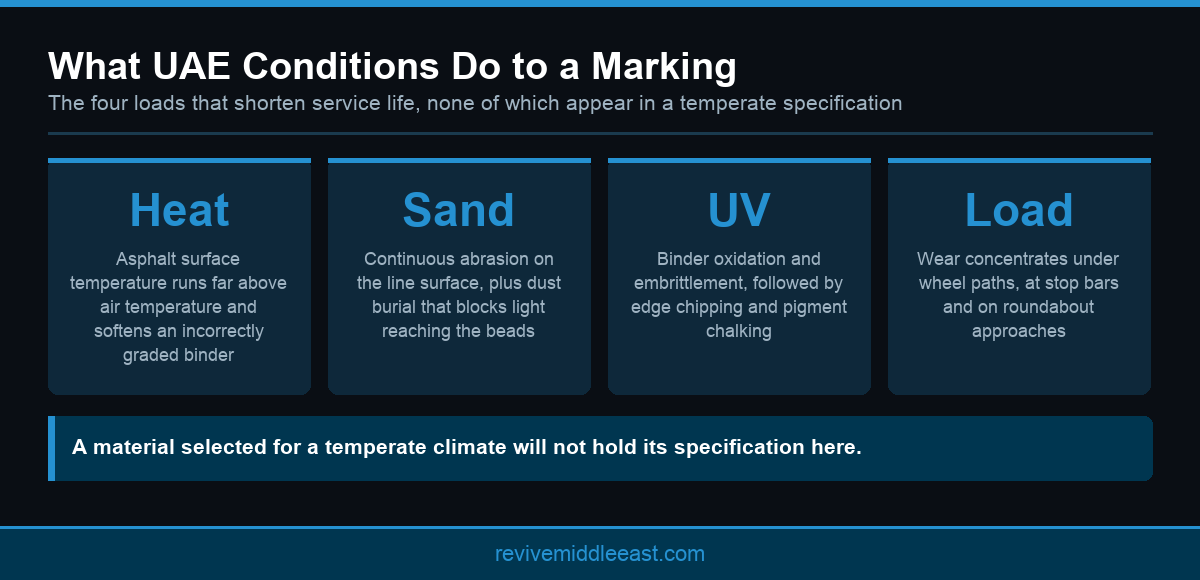
The four environmental loads acting on a road marking in Gulf conditions
Sand as a Continuous Abrasive
Sand attacks a marking in two separate ways, and only one of them is obvious.
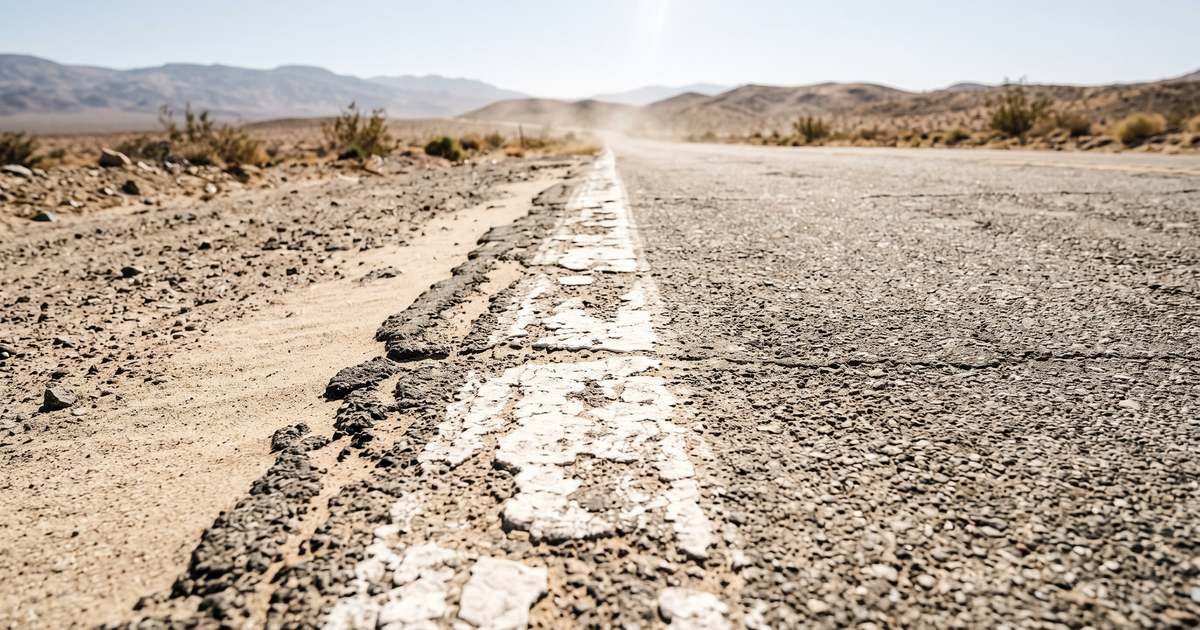
The visible mechanism is abrasion. Fine wind blown particles are dragged across the line surface by every passing vehicle, polishing exposed glass beads and steadily removing material. On desert routes this load is severe enough to cut years off service life compared with a sheltered urban road carrying similar traffic. The less obvious mechanism is burial. Dust settles into the surface texture of the line and blocks light from reaching the beads at all. Night performance can fall dramatically while the marking still looks perfectly white in daylight.
This is why routine mechanical sweeping recovers measurable performance and why markings often appear to improve after rain. Neither restores worn beads, but both remove what is covering them.
The effect is not uniform across the network either. Routes running through open desert take a far heavier abrasive load than urban roads shielded by buildings and landscaping, even where traffic volumes are similar. Treating the whole network as a single maintenance category therefore over serves the sheltered routes and under serves the exposed ones. Segmenting by exposure is one of the cheapest improvements available to an asset manager.
Sand also finds its way into the material during application if the surface was not cleaned late enough. Particles trapped in the film create weak points that begin to break down early, which is a preparation failure that presents itself as premature wear. It is one more reason the final clean belongs immediately before the applicator rather than at the start of the shift.
Sand exposure is the single largest variable in road marking durability across the Emirates road network.
Ultraviolet Exposure and Binder Ageing
Ultraviolet radiation works on the binder system continuously and irreversibly, and its effects appear gradually rather than suddenly.
Prolonged exposure causes the binder to oxidise and embrittle. A brittle line no longer flexes with the substrate underneath it, so thermal movement produces fine cracking, then chipping at the edges, then loss of whole sections. Pigment is affected too. Low quality or under dosed pigment systems yellow and chalk under sustained ultraviolet load, which lowers daytime contrast against the road surface. Chalking also releases the surface binder that was holding the top layer of beads in place.
Ultraviolet stability is a formulation property, decided by the manufacturer and invisible on site. Our article on what happens inside a thermoplastic paint plant explains where those choices are made.
Ultraviolet damage is also cumulative and irreversible, which distinguishes it from dust burial. Sweeping recovers a marking that is merely dirty. Nothing recovers a binder that has already oxidised. This is why a line can look serviceable and then deteriorate very rapidly once the surface layer begins to break down, because the material underneath has been ageing quietly throughout.
Traffic Loading and Where Wear Concentrates
Wear is never evenly distributed across a scheme, which is why average service life is a misleading way to plan maintenance.
Markings under wheel paths take vastly more punishment than edge lines a metre away. Transverse markings such as stop bars and pedestrian crossings sit directly under braking loads, where tyres are both loaded and sliding slightly. Roundabout approaches combine braking with turning, which imposes shear on the bond rather than simple abrasion. Bus stops and taxi ranks concentrate heavy axle loads onto the same few square metres many times a day.
Recognising this at design stage allows selective use of a higher performance material at the stress points, rather than paying for it across the whole layout. Our material comparison article covers where that upgrade is justified.
Vehicle mix matters alongside volume. A route carrying heavy goods traffic imposes far more load per pass than a car dominated road with the same daily count, and industrial areas across the Emirates carry a very high proportion of heavy axles. Design marking life against the vehicle mix rather than the headline traffic figure, or the estimate will be optimistic. Our article on traffic safety on infrastructure projects covers how these loads are assessed.
Planning for road marking durability therefore means designing against the stress points rather than against an average.
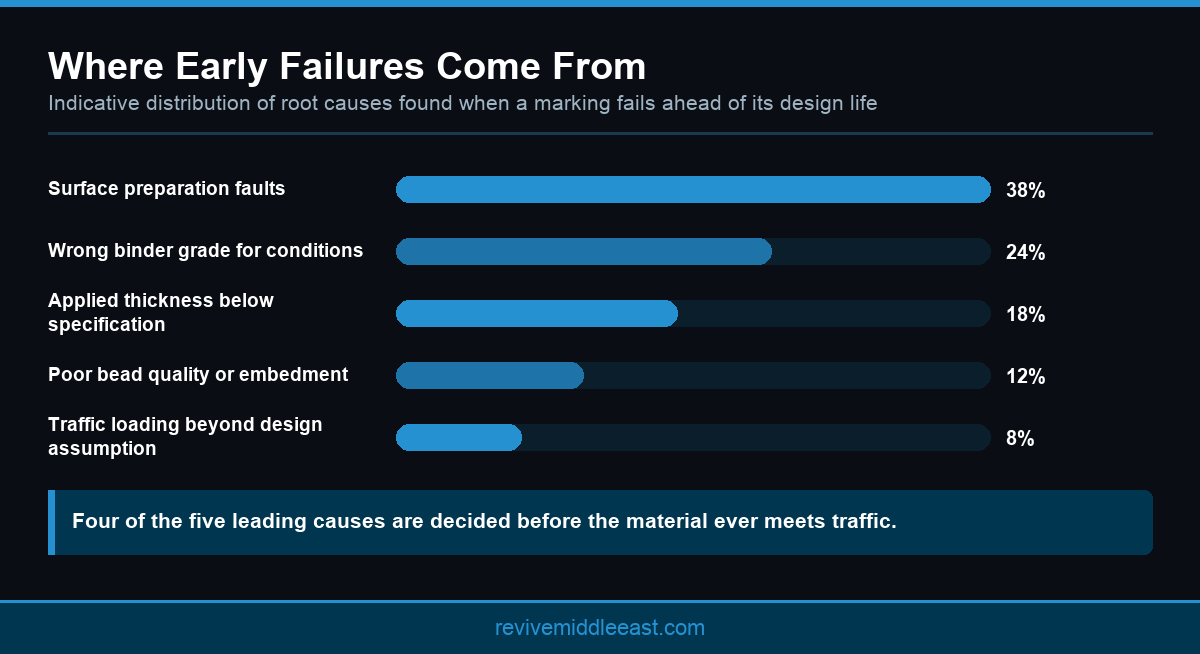
Where early marking failures actually originate, based on typical site investigation findings
What Actually Extends Service Life
Four measures deliver most of the available improvement, and none of them involve buying a more expensive brand of the same product.
Correct surface preparation comes first, because a marking that never bonded properly will fail regardless of material quality. Binder grade matched to real surface temperature comes second. Honest applied film thickness comes third, since a shortfall of half a millimetre is invisible at handover and obvious two years later. Adequate intermix bead content comes fourth, because it lets the line renew its own night performance as the surface abrades.
Beyond those, a planned inspection cycle with retroreflectivity measurement lets you remark on evidence rather than on complaints. Our guidance on surface preparation before marking covers the first and most important of the four.
A short note on measurement is worth adding. Retroreflectivity readings taken at the same locations each time turn a set of numbers into a trend, and a trend lets you forecast when a section will cross the threshold. Readings taken at random points each survey tell you very little. The discipline costs nothing beyond recording chainage properly the first time.
None of these four measures requires a premium product. They require a specification written for this climate and a contractor prepared to follow it, which is a very different proposition from simply paying more per square metre.
Improving road marking durability rarely requires a more expensive product, only a specification written for the conditions it will actually meet.
Conclusion
Road marking durability in the UAE is not a matter of luck or of paying more. Surface temperature, sand abrasion, ultraviolet ageing and concentrated traffic loading are all predictable, and all four can be designed for at specification stage at little or no extra cost. Prepare the surface properly, match binder grade to the real conditions, insist on the specified thickness, and measure performance rather than judging it by eye. Talk to Revive Middle East Paints about extending marking life on your network.