
Most published explanations of road traffic signs UAE types are written for drivers taking a test. Specifiers, contractors and asset owners need something different: not what each symbol means, but what each category obliges, what it costs to get wrong, and how the category changes the way a sign is designed, priced and maintained. This guide takes the three categories in turn and sets out the practical consequences of each for anyone producing a signing schedule.
Key Takeaways
- Category determines legal weight, and legal weight should determine maintenance priority and inspection interval.
- Shape and colour are the driver’s first read. A non standard shape defeats the whole system, whatever the legend says.
- Gulf convention differs from European and North American practice in specific ways, so imported drawings need review rather than adoption.
Regulatory Signs and Their Legal Weight
Regulatory signs impose an obligation that a driver must obey. Speed limits, no entry, mandatory direction, prohibition of turns, parking restrictions and priority instructions all sit in this family. Because disobedience is an offence, the sign has to be correct, visible and unambiguous, and an owner who allows a regulatory sign to become obscured or illegible has created a real exposure.
Shape and colour carry the message before the legend does. Circular signs in this family generally indicate an order, with red rings for prohibition and blue fields for mandatory instruction, and the octagonal stop sign is the one shape reserved for a single meaning worldwide. That reservation is what allows it to be recognised even when partially obscured, and it is why the shape must never be borrowed for anything else.
For a specifier, the practical consequence is prioritisation. In any inventory, regulatory road traffic signs UAE types should carry the shortest inspection interval and the fastest replacement target, because their failure mode has legal and safety consequences that an informative sign’s does not. Writing that policy down converts it from an intention into a practice.
Placement is also less forgiving here. A speed limit sign must be visible from the point at which the limit applies, and a prohibition must be visible before the movement it prohibits becomes available. These are not aesthetic judgements, and they should be checked on site rather than assumed from the drawing. The broader rules are covered in the guide to road traffic signs and signage systems.
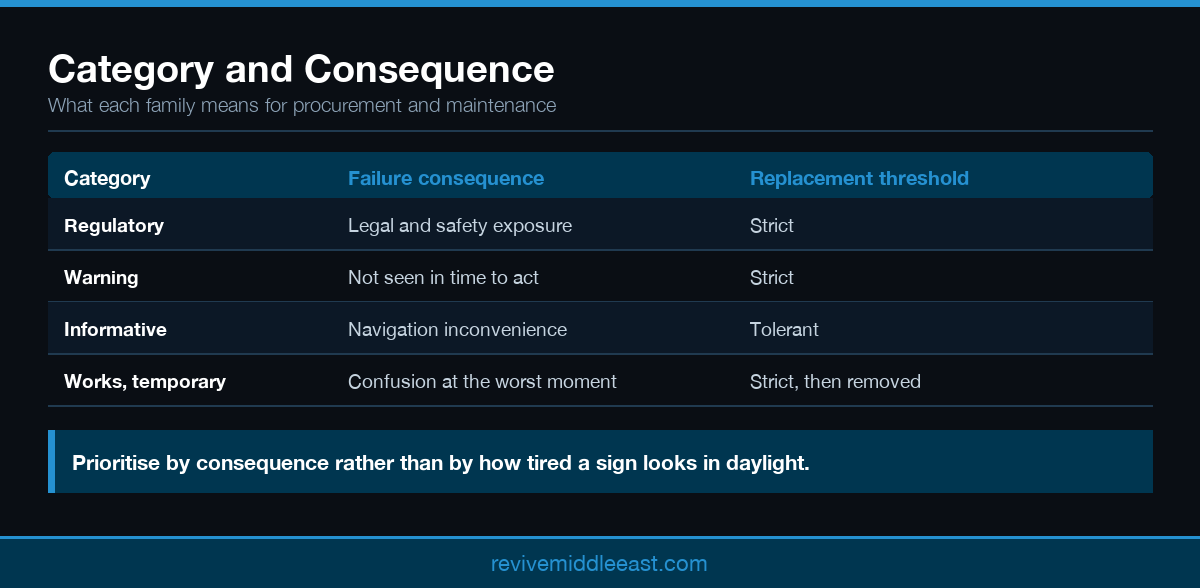
What each category obliges, and what it means for maintenance
Warning Signs and Reaction Distance
Warning signs advise of a hazard ahead and ask for judgement rather than compliance. Triangular with a red border in Gulf practice, they cover bends, junctions, gradients, road narrowing, animals, pedestrians and surface conditions. They are the family most sensitive to placement, because a warning that arrives too late is worthless and one that arrives far too early is ignored.
The placement distance follows from design speed and from the action being requested. A driver needs time to see the sign, read it, decide and then act, and on a fast road that chain consumes several hundred metres. Warning signs placed at a fixed distance regardless of speed are a common error on schemes where the signing schedule was produced without reference to the geometry.
Night performance matters disproportionately in this family. A driver reacting to a hazard is relying on the sign being seen at a distance in headlights, so sheeting grade should be chosen for the road class rather than for the budget. The selection logic is set out in the guide to retroreflective sheeting grades.
Animal warning signs deserve a specific mention in the UAE, because camel crossings on desert routes are a genuine and severe hazard. Where such a sign is used, it should be supported by physical measures rather than standing alone, and the article on camel fencing on UAE highways covers what those measures involve.
Informative and Direction Signs
Informative signs help a driver navigate and impose nothing. Direction signs, route confirmation, facility and service signs, and tourist signing all belong here, and they are usually the largest and most expensive signs on any route because they carry the most text in two languages.
The defining feature of this family is that it only works as a sequence. Advance notice, confirmation at the decision point and reassurance after it must all name the same destinations in the same words. A destination that appears once and never again leaves the driver searching, and no amount of additional signing at the junction repairs a sequence that was broken upstream.
Because they carry the most text, direction signs are where the bilingual requirement bites hardest, and where panel size, wind load and support cost all escalate together. The interaction is covered in the guide to bilingual Arabic and English road signage, and the general regional pattern can be seen in the summary of road signs in the United Arab Emirates.
Maintenance priority for this family is genuinely lower, and saying so openly is useful. An informative sign that has lost some night time brightness is still doing most of its job. That is not true of a warning or regulatory sign, and a budget that treats all three equally is spending in the wrong place.
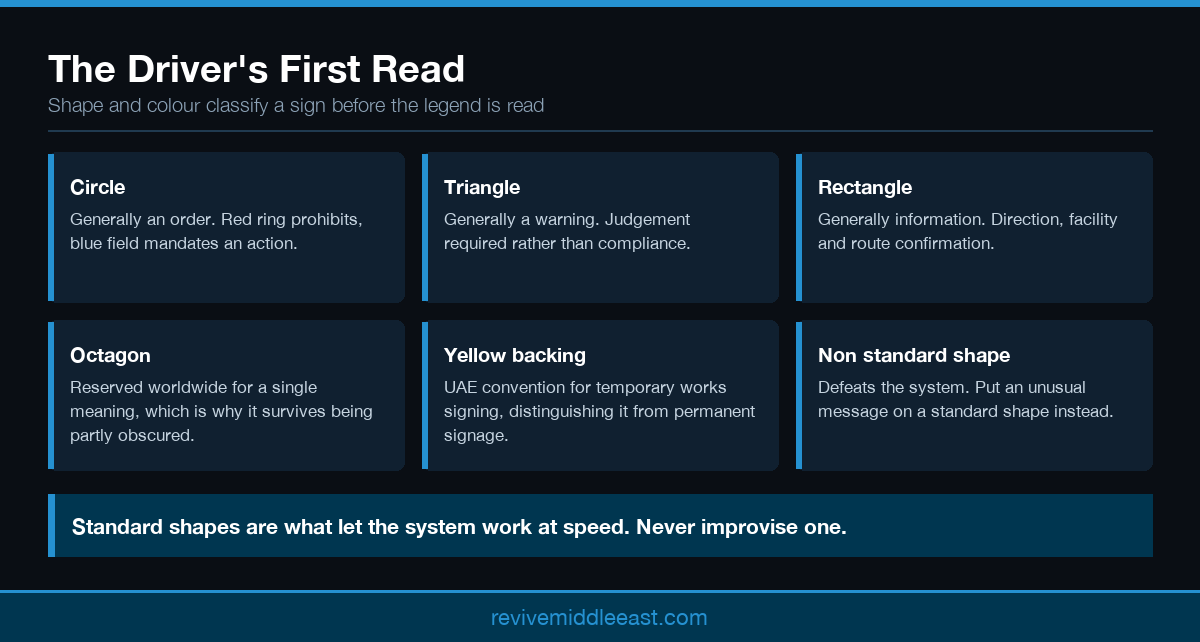
Shape and colour as the driver’s first read
Temporary and Works Signs
Works signs form a fourth practical group. They are regulatory while the works exist, they change as the works progress, and they sit exactly where drivers are least certain about what is happening. In UAE practice they are usually yellow backed to distinguish them from permanent signing, which is a convention worth preserving strictly.
The failure modes here are specific. Signs left in place after the works have finished, signs contradicting each other because an earlier phase was never removed, and signs blown flat because the ballast suited a calmer day are the three most common. All three are avoidable with an inspection routine rather than an engineering change.
Because works signs are part of an approved traffic arrangement rather than of the permanent asset, they are approved, installed and inspected under a different regime, described in the guide to temporary traffic management. Confusing the two leads to permanent signs being installed under a temporary approval and to temporary signs never being recorded at all.
Site boundary and occupational safety signage sits alongside works signing and follows the ISO 3864 colour and shape conventions rather than road conventions. The full requirement set is in the guide to construction site safety signage.
Using Categories to Build a Signing Schedule
A signing schedule that is organised by category rather than by chainage is easier to price, easier to check and easier to maintain. Each category has its own sheeting grade rule, its own placement rule and its own inspection interval, so grouping by category makes the assumptions visible.
The schedule should state, for every sign, the category, the face size, the sheeting grade, the substrate, the support arrangement and the chainage. Where any of those is left blank, a bidder will fill it with the cheapest defensible option, and the difference will not be visible until the first night drive after handover.
Reviewing imported drawings against local convention is a necessary step rather than a formality. European and North American practice differ from Gulf practice in the treatment of direction signing, in colour assignments and in the bilingual requirement, and a drawing adopted without review produces road traffic signs UAE types that look professional and read wrongly.
Finally, the schedule should include the removal of superseded signs as a priced item. Removal is routinely omitted, which is why so many UAE routes carry signs describing conditions that ended years ago. Our road signage services page covers manufacture, installation and the audit work that identifies those.
Conclusion
Understanding road traffic signs UAE types is less about symbols and more about consequences. Regulatory signs carry legal weight and deserve the shortest inspection interval. Warning signs live or die on placement and night performance. Informative signs only work as a sequence. Build the schedule around those distinctions and the asset behaves predictably. Revive Middle East Paints manufactures and installs signage across the Emirates. Contact our team to discuss a scheme.